Nebraska Transfer on Death Deed (Tenants in Common)
County Specific Legal Forms Validated as recently as October 2, 2026 by our Forms Development Team
About the Nebraska Transfer on Death Deed (Tenants in Common)
How to Use This Form
- Select your county from the list
- Download the county-specific form
- Fill in the required information
- Have the document notarized if required
- Record with your county recorder's office
What Others Like You Are Saying
"Saved me so much time and $!!"
"Overall positive experience; especially liked immediate access to downloaded documents and instructi…"
"Easily find and print forms necessary for peace of mind."
"Fast, easy, saves money!!!"
"Website is very easy to navigate."
4.8/5 from 4,823 reviews. Read all
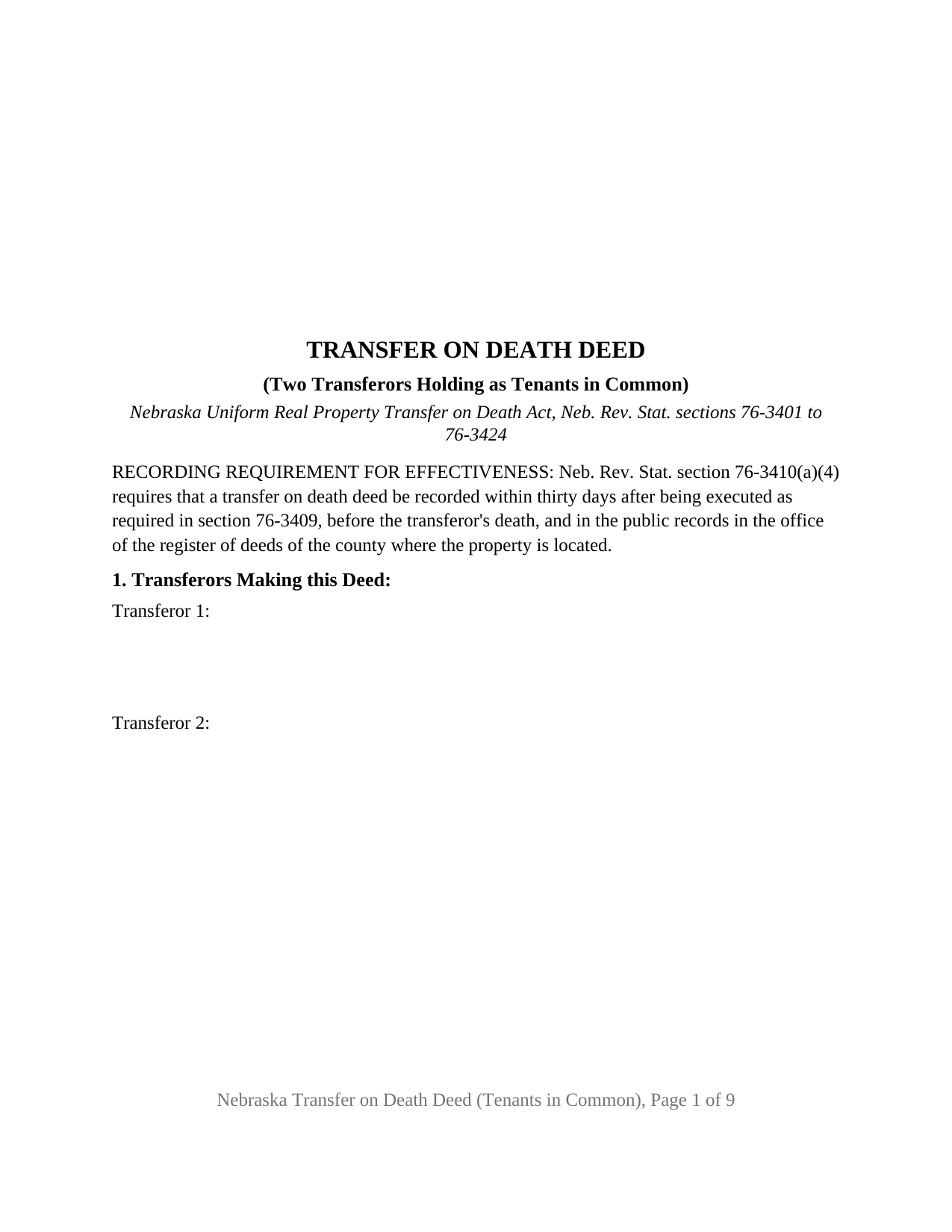
Two owners of one Nebraska parcel, each holding an undivided share that answers only to that owner, are the title this deed is drawn for. It carries two transferors on a single instrument, a separate beneficiary designation for each undivided interest, and a separate signing set for each owner, so the first death moves one share and leaves the other exactly where it was.
An undivided share that does not wait for a second death
Nebraska's transfer on death act sorts co-owners by one question: does the title carry a right of survivorship? Neb. Rev. Stat. section 76-3402(4) answers it for tenants in common, defining a joint owner as an individual who owns concurrently with a right of survivorship and excluding a tenant in common who holds without one. Two consequences follow. The rule that only the deed of the last surviving joint owner operates has no application here, so each co-tenant's designation takes effect at that co-tenant's own death. The joinder rule for revoking a joint owners' deed drops away as well: under section 76-3413(b), a revocation signed by one transferor leaves the other transferor's interest untouched. A beneficiary deed written on undivided shares is really two designations traveling together.
How this version is configured
Section 6 states the undivided interest each transferor owns and transfers, in the fractions the vesting deed created, whether that is half apiece or an uneven split. Sections 7 through 10 give each transferor a designation of its own, primary and alternate, so one co-tenant may name two children while the other names a single beneficiary or a trustee. Sections 14 and 15 each carry a complete execution unit: the transferor's sworn declaration in the words the statute prints, a signature block with a printed name line, two disinterested witness blocks, and an officer certificate. Siblings holding inherited farm ground in undivided halves, and two unmarried buyers whose granting clause carried no survivorship language, present the pattern this deed recites. The form recites exactly two record owners holding undivided interests; a co-ownership that does carry survivorship answers to a different rule inside the same act, and the deed states that distinction on its face.
Signatures the officer watches
Nebraska asks more of a TOD deed than of an ordinary conveyance. Section 76-3409 has the transferor sign, has two disinterested witnesses attest in writing, and has all of those signatures made before an officer authorized to administer oaths, whose certificate follows in substantially the form the statute sets out. Because the co-tenants here make independent transfers, each one gets that full set on the form, which is what lets them sign days apart, in different counties, before different notaries. A witness cannot be a designated beneficiary or the heir, child, or spouse of one, which leaves the role to people outside the beneficiaries' families.
Thirty days, and then the record governs
Recording is an element of this deed rather than notice of it. Section 76-3410 calls for the instrument to reach the register of deeds in the property's county inside thirty days of signing and before the transferor dies. On a two-owner deed with staggered signings, that window opens at the earlier signing, which is why the completed example records promptly once both owners have signed. The deed itself is exempt from documentary stamp tax, and the Form 521 real estate transfer statement belongs to the later filing, the one that follows a death and makes a single owner's transfer effective.
What a designated beneficiary receives
At an owner's death the named beneficiary takes that owner's undivided interest, contingent on surviving by one hundred twenty hours unless the deed sets a different period, subject to the mortgages, easements, liens, and contracts burdening the property then. The act passes the interest without covenant or warranty of title. It also sends the transferor's unfinished business along with it: Nebraska inheritance tax reaches the property as though the owner had held it at death, and section 76-3417 can call a beneficiary to account where estate assets fall short of claims, statutory allowances, and administration expenses. The four warnings printed in the deed, including the property insurance warning added by LB422 in 2025, put those points in the statute's own words.
The package delivers the blank fillable deed, a completed example on a Buffalo County farm ground fact pattern, and a guide covering the fifteen numbered sections, the section 76-3409 formalities, and Nebraska recording format and fees. These materials are informational and are not legal advice.
Important: County-Specific Forms
Our transfer on death deed (tenants in common) forms are specifically formatted for each of the 93 counties in Nebraska.
After selecting your county, you'll receive forms that meet all local recording requirements, ensuring your documents will be accepted without delays or rejection fees.