Pershing County Deed Upon Death Form
Last validated November 14, 2026 by our Forms Development TeamFormatted for recording in Pershing County, for property anywhere in the county or independent city: rural and unincorporated areas as well as Imlay, Lovelock.
- 3 documents included
- Immediate PDF download
- Formatting guarantee
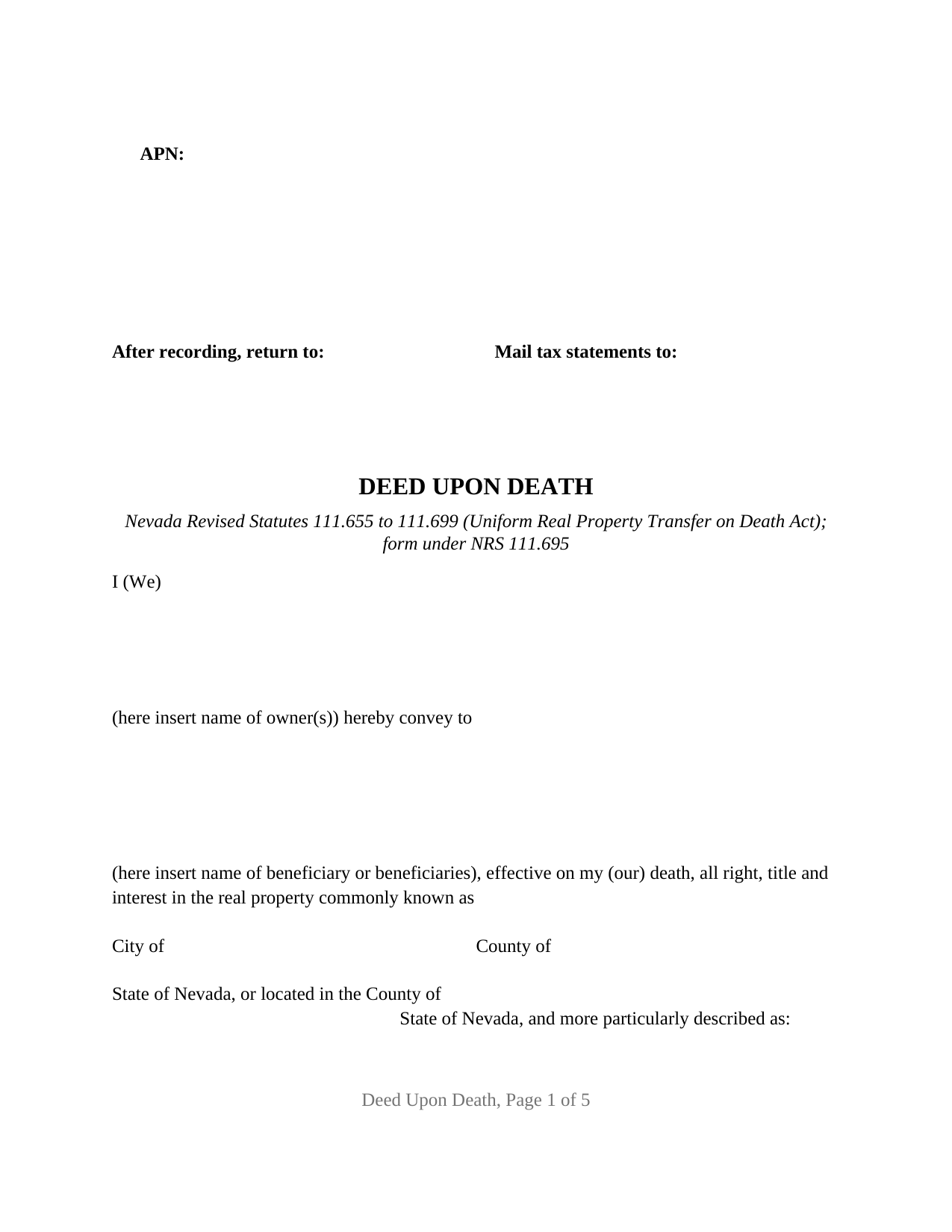
Pershing County Deed Upon Death Form
Fill in the blank Deed Upon Death form formatted to comply with all Nevada recording and content requirements.
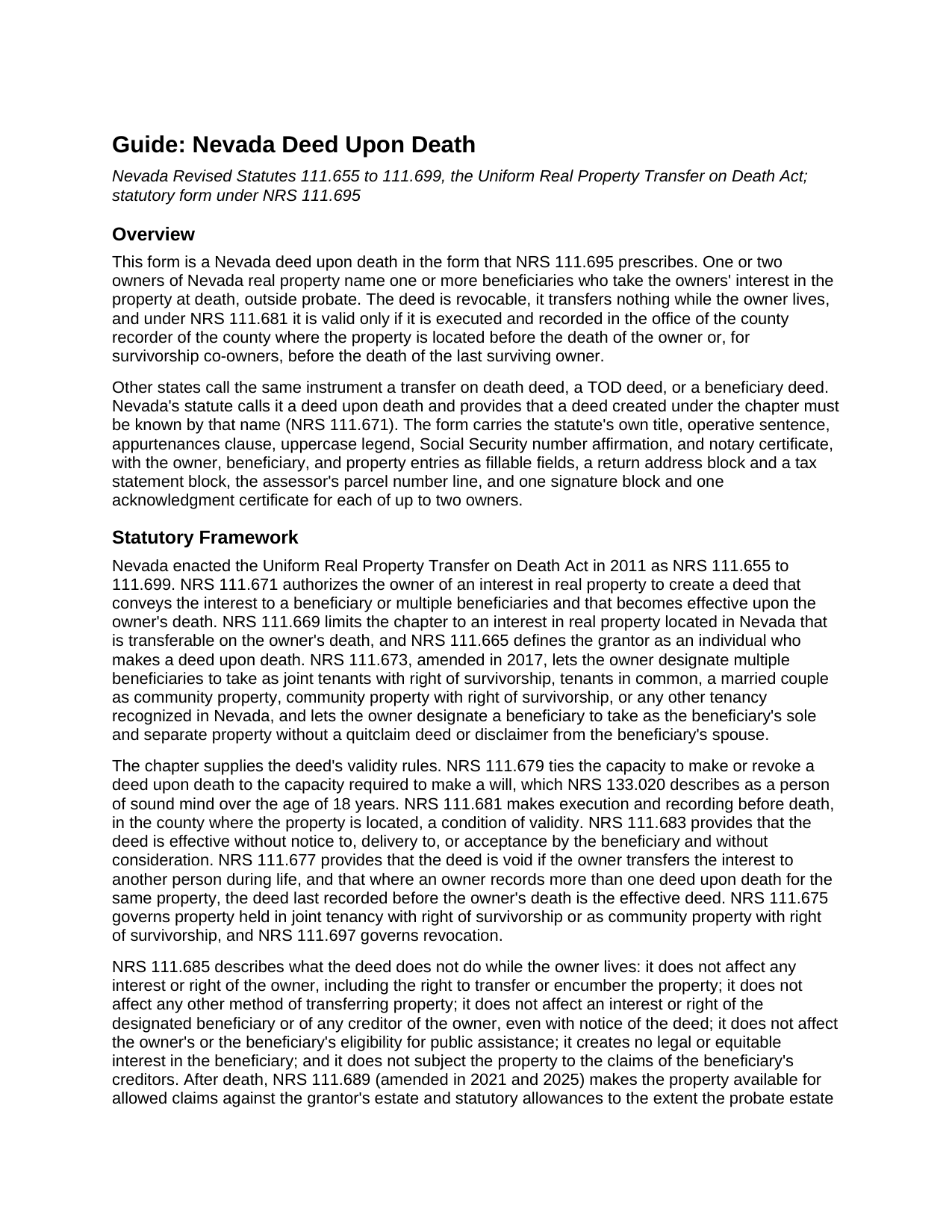
Pershing County Deed Upon Death Guide
Line by line guide explaining every blank on the Deed Upon Death form.
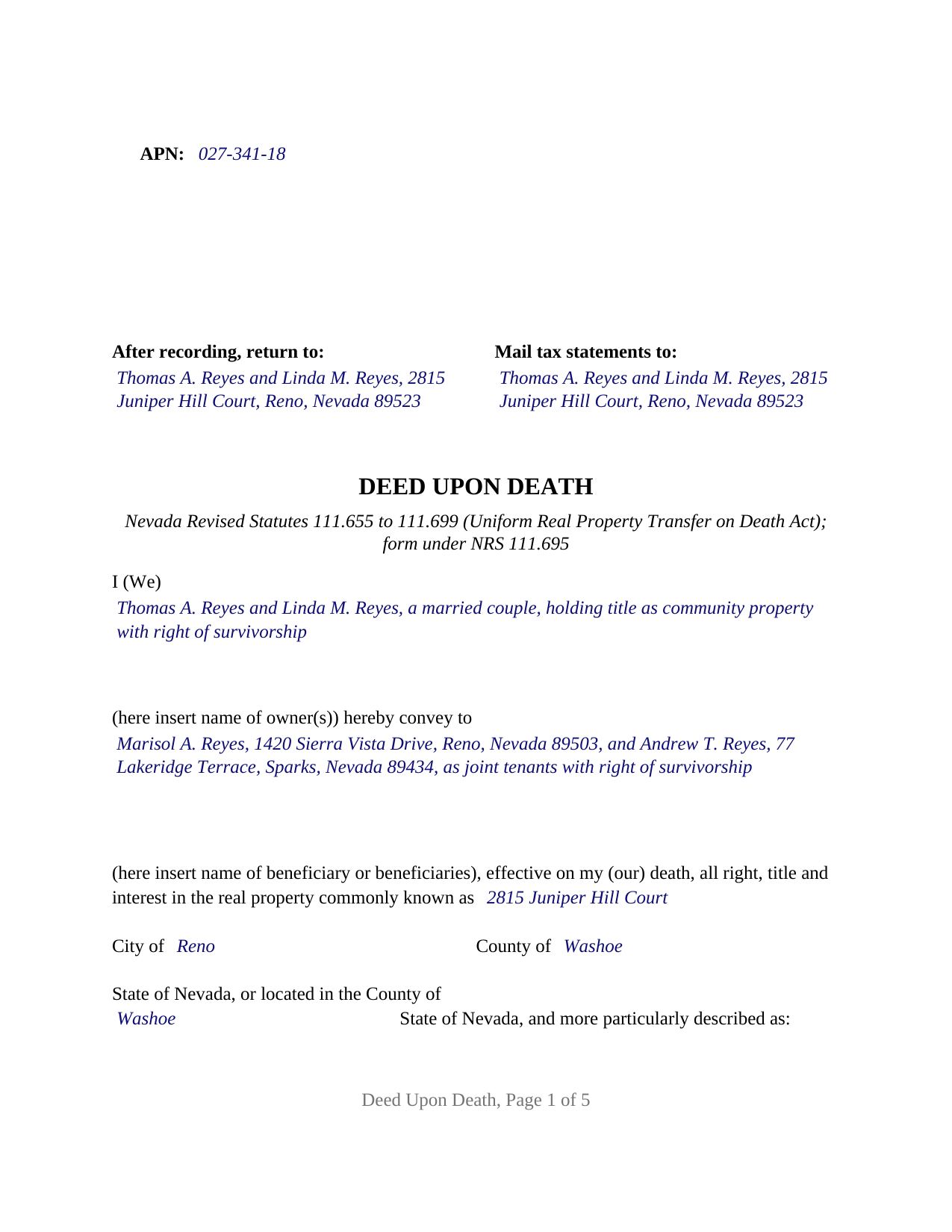
Pershing County Completed Example of the Deed Upon Death Document
Example of a properly completed Nevada Deed Upon Death document for reference.
All 3 documents above included • One-time purchase • No recurring fees
Immediate Download • Secure Checkout
Additional Nevada and Pershing County documents included at no extra charge:
Where to Record Your Documents
Pershing County Recorder/Auditor
Lovelock, Nevada 89419-0736
Hours: 8:00 to 5:00 M-F; Recording: 8:30 to 4:30
Phone: (775) 273-2408
Recording Tips for Pershing County:
- Bring your driver's license or state-issued photo ID
- Ensure all signatures are in blue or black ink
- Make copies of your documents before recording - keep originals safe
- Recorded documents become public record - avoid including SSNs
- Recording fees may differ from what's posted online - verify current rates
Cities and Jurisdictions in Pershing County
Properties in any of these areas use Pershing County forms:
- Imlay
- Lovelock
Hours, fees, requirements, and more for Pershing County
How do I get my forms?
Forms are available for immediate download after payment. The Pershing County forms will be in your account ready to download to your computer. An account is created for you during checkout if you don't have one. Forms are NOT emailed.
Are these forms guaranteed to be recordable in Pershing County?
Yes. Our form blanks are guaranteed to meet or exceed the applicable formatting requirements used for recording in Pershing County, including margin requirements, font requirements, and other layout standards. This guarantee applies to formatting, not to the legal sufficiency of information entered by the user or the suitability of a form for a particular transaction.
Can I reuse these forms?
Yes. You can reuse the forms for your personal use. For example, if you have multiple properties in Pershing County you only need to order once.
What do I need to use these forms?
The forms are PDFs that you fill out on your computer. The free Adobe Acrobat Reader is recommended, and most PDF apps also work. You do NOT enter your property information online - you download the blank forms and complete them privately on your own computer.
Are there any recurring fees?
No. This is a one-time purchase. Nothing to cancel, no memberships, no recurring fees.
How much does it cost to record in Pershing County?
Recording fees in Pershing County vary. Contact the recorder's office at (775) 273-2408 for current fees.
Questions answered? Let's get started!
Nevada gives property owners a way to name who receives their real estate at death without probate, and it gives them the exact words to do it. This form prepares a Nevada deed upon death, the instrument that NRS 111.655 to 111.699 (the Uniform Real Property Transfer on Death Act) authorizes and that NRS 111.695 prints as a statutory form. Nevada's name for the instrument is distinctive: what other states call a transfer on death deed, TOD deed, or beneficiary deed is, under NRS 111.671, a deed that must be known as a deed upon death.
A deed written by the Legislature
Most states leave the drafting of a transfer on death deed to the owner. Nevada did not. NRS 111.695 provides that a deed upon death must be in substantially the following form and then prints the form: the title, the sentence by which the owner or owners convey to the named beneficiary or beneficiaries, effective on the owner's death, all right, title and interest in the described property, an appurtenances clause, an uppercase legend, a Social Security number affirmation, a date and signature line, and a notary certificate. This form reproduces that statutory text word for word and places the owner, beneficiary, and property entries where the statute leaves its blanks, so the recorded deed reads as the statute wrote it.
The uppercase legend carries the statute's own warnings. The deed is revocable. It does not transfer any ownership until the death of the grantor or grantors. And it revokes all prior deeds upon death of the same property, whether or not those earlier deeds conveyed the grantor's entire interest. The affirmation that the document contains no Social Security number, which Nevada recorders look for under NRS 239B.030, is part of the printed form.
Nothing moves until death, and nothing moves at all without recording
During the owner's life the deed is close to inert. NRS 111.685 provides that it does not affect the owner's right to sell, mortgage, or encumber the property, creates no legal or equitable interest in the beneficiary, does not expose the property to the beneficiary's creditors, and does not affect anyone's eligibility for public assistance. NRS 111.683 makes the deed effective without notice to, delivery to, or acceptance by the beneficiary and without consideration. The beneficiary does not sign and may not even know the deed exists.
Recording is where Nevada is strict. Under NRS 111.681 a deed upon death is valid only if it is executed and recorded in the office of the county recorder of the county where the property is located before the death of the owner, or of the last surviving owner where co-owners hold with a right of survivorship. A deed signed and notarized but left in a drawer conveys nothing. The form restates that condition on its face, and the guide walks through the county recorder's intake items under NRS 111.312: the assessor's parcel number at the top left of the first page, the grantee's mailing address, and the tax statement address, each of which the form carries. The deed is accompanied by the State of Nevada Declaration of Value, and NRS 375.090(10) exempts a deed upon death from the real property transfer tax.
Beneficiaries in the statute's own terms
NRS 111.673 lets the owner name one beneficiary or several, and where several are named, lets the owner state how they take in the terms Nevada title law recognizes: as joint tenants with right of survivorship, as tenants in common, as a married couple as community property, as community property with right of survivorship, or in any other tenancy recognized in the state. The owner may also designate a beneficiary to take as that beneficiary's sole and separate property, without a quitclaim deed or disclaimer from the beneficiary's spouse. NRS 111.667 defines a person broadly, so a beneficiary may be an individual, a trust, or an entity. The beneficiary field on this form carries the names, the mailing addresses NRS 111.312 requires, and any tenancy designation, and the guide shows the naming convention for each class.
One owner or two, in one deed
The statutory form is written in the first person plural as well as the singular, I (We), and this form carries that flexibility as its architecture. The owner field receives one or two natural persons signing in their own right, with the status recital the vesting deed supports: one unmarried owner, one married owner conveying that owner's own interest, two spouses or registered domestic partners, or two co-owners who are not married to each other. The form carries two owner signature blocks and two acknowledgment certificates, one for each owner, so two owners may sign on different dates or before different notaries; when one owner conveys, the second block and its certificate stay blank. The form is not set up for an owner who signs through an attorney-in-fact, for a trustee or an entity as owner, or for three or more owners on one instrument.
Two owners who hold as joint tenants with right of survivorship or as community property with right of survivorship are the configuration NRS 111.675 addresses, and the two-owner capacity of this form is what lets both convey in one deed. Where the deed includes a conveyance from each of the survivorship owners, it becomes effective on the death of the last surviving owner; where only one such owner signs, the deed takes effect at that owner's death only if that owner is the last to survive. The completed example shows two Washoe County spouses who hold as community property with right of survivorship conveying to their two children as joint tenants with right of survivorship.
The certificate the form prints
The NRS 111.695 form prints its own notary certificate, and this form reproduces it: the venue State of Nevada, County of, a sworn sentence, an acknowledgment sentence in which the owner, personally known to the notary or proved by satisfactory evidence, acknowledges executing the instrument, and the notary's signature and seal. NRS 111.240 requires a conveyance of Nevada real property to be acknowledged before it is recorded, and NRS 240.1655(3)(b) makes a certificate in a form otherwise prescribed by Nevada law sufficient. The guide describes what the notary completes, the Nevada stamp requirement, and the treatment of an owner who signs while in another state or before a Nevada electronic notary by audio-video communication.
Changing course later
The deed is revocable at any time, but only by a recorded act. NRS 111.697 provides that the revocation is valid only if executed and recorded in the county where the property is located before the death of the owner who executes it, that a deed upon death may not be revoked by a revocatory act on the deed itself, and that a revocation of a survivorship owners' deed not signed by all of them takes effect only when the last surviving owner executes and records it. The revocation of deed upon death is a separate statutory instrument under NRS 111.697, prepared and recorded separately and not included in this package. Recording a new deed upon death for the same property displaces the earlier one under NRS 111.677, and a lifetime transfer of the property to someone else voids the deed. After the last grantor's death, the beneficiary records the Death of Grantor Affidavit under NRS 111.699, with the death certificate and a declaration of value attached, and publishes the notice to creditors under NRS 111.689; the affidavit is likewise a separate instrument prepared and recorded separately and not included in this package. The beneficiary inherits subject to liens existing at the grantor's death under NRS 111.691.
The package includes the fillable Nevada deed upon death form in the NRS 111.695 statutory text, a completed example filled in for a realistic Washoe County fact pattern, and the guide that explains each part of the form, the statutes behind it, and the recording process. This description and the guide describe the form and the governing Nevada statutes in general terms; they are not legal advice.
Important: Your property must be located in Pershing County to use these forms. Documents should be recorded at the county or independent city recording office listed above.
This Deed Upon Death meets all recording requirements specific to Pershing County.
Our Promise
The documents you receive here are guaranteed to meet or exceed the applicable Pershing County recording format requirements. If there is a rejection caused by our formatting, we will correct the issue or refund your payment. This guarantee applies to document formatting only and does not extend to information entered by the user, the selection of the form, or the legal effect of the completed document.
Save Time and Money
Get your Pershing County Deed Upon Death form done right the first time with Deeds.com Uniform Conveyancing Blanks. At Deeds.com, we understand that your time and money are valuable resources, and we don't want you to face a penalty fee or rejection imposed by a county recorder for submitting nonstandard documents. We constantly review and update our forms to meet rapidly changing state and county recording requirements for roughly 3,500 counties and local jurisdictions.
4.8 out of 5 - ( 4,853 Reviews )
John L B. 5 out of 5 stars
I ordered the Deed package for my state of NJ and the county I needed to prepare the documents. I was able to complete everything that is required to close on an investment property. Fast easy with step by step instructions no matter your situation. Definitely will recommend to family & friends. Save $ instead of paying others to do the same thing you can do yourself.
Thank you for your feedback. We really appreciate it. Have a great day!
Fernando V. 5 out of 5 stars
Excellent!
Thank you!
Sandra T. 5 out of 5 stars
I hope this will address all I need to make sure my father is not being taken for granted by my siblings and a nephew and his wife. thank you
Thank you!
John F. 5 out of 5 stars
The document I purchased was perfect for what I needed done. Very easy to obtain the document. Website very easy to navigate. Would use again and would recommend to anyone who needs the documents.
Thank you for your feedback. We really appreciate it. Have a great day!
Nancy E. 3 out of 5 stars
Took me awhile to figure out and get the information printed so I can use it later. Thank you.
Your insights are invaluable to us and help us strive for better service. Thank you for taking the time to share your thoughts.
Kathleen H. 5 out of 5 stars
EASY!!
Thank you!
Joseph T. 5 out of 5 stars
I downloaded the wrong form, how do I change this, or can I?
Sorry to hear that. As a one time courtesy we have canceled your order and payment for the documents you ordered in error. Have a great day.
Scott R. 5 out of 5 stars
Thanks that was great.
Thank you for your feedback. We really appreciate it. Have a great day!
Marion Paul W. 5 out of 5 stars
Quick service .Easy download.I ordered Quit Claim and should have ordered warranty deed. I will make it work
Thank you!
David R. 3 out of 5 stars
$40 is an excessively expensive price for this very simple form, especially since I couldn't view it before purchasing. I did successfully register the TODD at my county clerks office, although I wasn't certain it would be accepted given the notary format was on a separate page. Knowing what I know now, I would have formatted a form on my computer and filled it in with a pen. The background materials were superfluous and in my case, didn't add value.
David, we’re glad you successfully recorded your deed using our form. The value of a DIY package is not measured by how complicated the finished document looks or how easily it could be recreated on a computer. It provides a prepared form and supporting information rather than requiring you to research and draft a document from scratch. Having that starting point is what the purchase provides—even when, in hindsight, doing it yourself appears straightforward.
Donald W. 5 out of 5 stars
Could not have been any easier to download the quit claim forms. The provided instructions and samples look to be helpful. Only have to set aside the time to fill out. Thanks
Thank you!
JOHN S. 5 out of 5 stars
They had everything for a living trust but the form to transfer your house into the living trust
We appreciate your business and value your feedback. Thank you. Have a wonderful day!
Timothy G. 5 out of 5 stars
Easy peezy.
Thank you!
Mary L. 5 out of 5 stars
Super easy, fast recording time. 100% recommend.
We appreciate your business and value your feedback. Thank you. Have a wonderful day!
Shabaz W. 5 out of 5 stars
Very convenient
Thank you!