New York Transfer on Death Deed (Sole Owner, Multiple Beneficiaries (Equal Shares))
County Specific Legal Forms Validated as recently as November 19, 2026 by our Forms Development Team
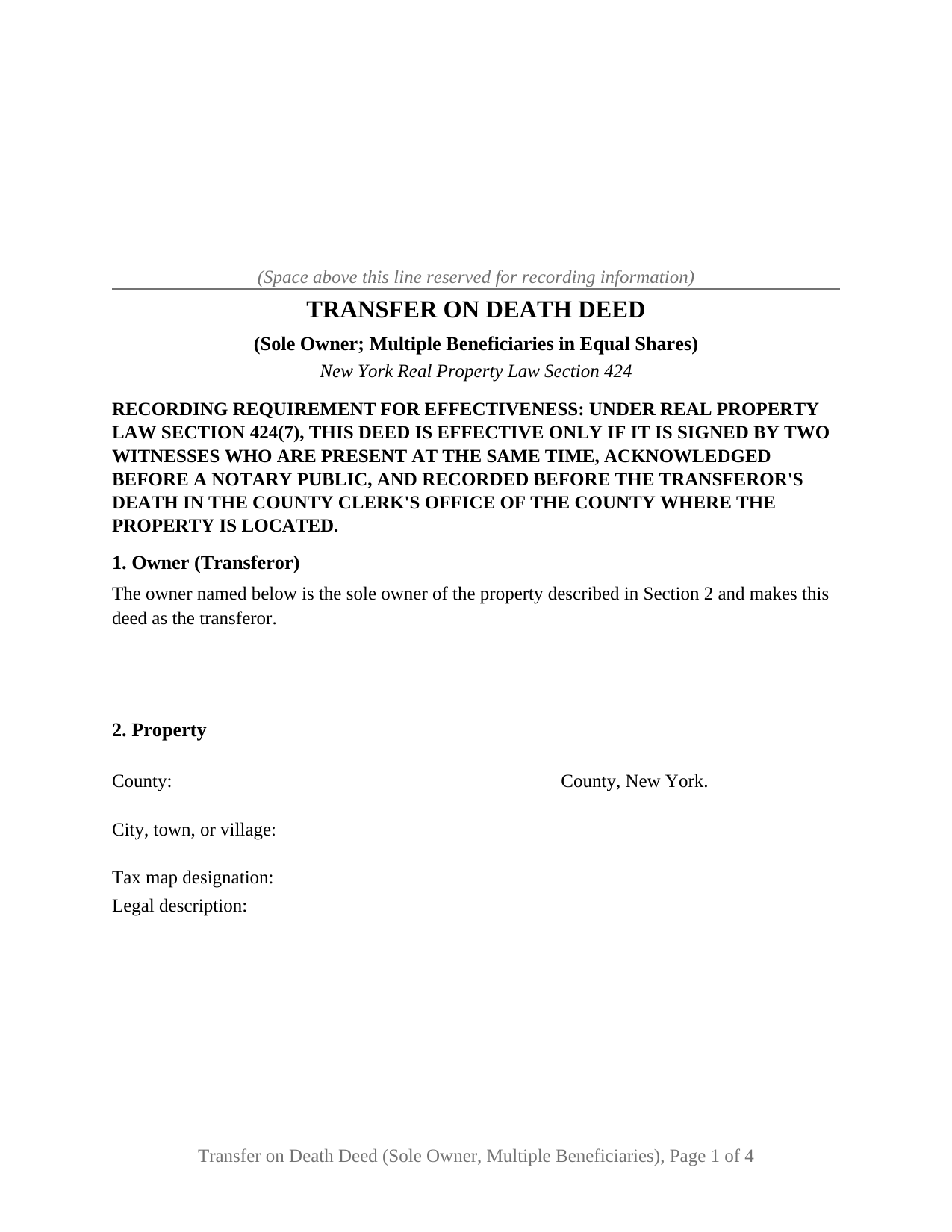
About the New York Transfer on Death Deed (Sole Owner, Multiple Beneficiaries (Equal Shares))
How to Use This Form
- Select your county from the list
- Download the county-specific form
- Fill in the required information
- Have the document notarized if required
- Record with your county recorder's office
What Others Like You Are Saying
"I purchased he Alabama Correction Warranty Deed Form to correct a mistake in the legal description. …"
"Easy to navigate! Will use your services again!"
"Excellent service & very easy to use."
"Very helpful and quick responses"
"I was pleased with the process. Easy and secure. Great customer service. I will use again for sure"
4.8/5 from 4,864 reviews. Read all
This New York transfer on death deed is set up for one owner who holds the property alone and who names two or more beneficiaries to take it in equal shares at the owner's death. The deed is made under Real Property Law Section 424, the statute New York enacted in 2024 that lets a property owner name who receives real estate at death without probate and without giving anything up during life.
Equal shares, fixed in the deed
When a New York transfer on death deed names more than one beneficiary, Section 424(11)(a)(3) supplies the default: the beneficiaries take concurrent interests in equal and undivided shares with no right of survivorship. This form prints that rule as deed text rather than leaving it to the statute's default, so the recorded instrument says on its face how three children, two siblings, or any other group of beneficiaries divide the property. It also prints the companion rule of Section 424(11)(a)(4): if one of several designated beneficiaries fails to survive the owner, that beneficiary's share passes to the other designated beneficiaries in proportion to the interest of each. A beneficiary who does not survive the owner takes nothing, because Section 424(11)(a)(2) makes every designated beneficiary's interest contingent on surviving the transferor.
Because the shares and the lapse rule are fixed, the beneficiary section asks for nothing but names and mailing addresses. There is no blank for percentages, no survivorship language to choose, and no alternate beneficiary line. A deed that needs unequal shares, a substitute gift to a deceased beneficiary's children, or an alternate who takes if no primary beneficiary survives follows a different pattern than this form recites.
One owner, signing alone
The owner recital identifies the named owner as the sole owner of the described property and as the transferor. The form fixes no marital status: a married owner who holds title alone signs alone, because New York has no dower for modern marriages (Real Property Law Section 190), abolished curtesy (Section 189), and has no statute requiring a spouse to join a deed of property titled in the other spouse's name. Section 424(1)(g) defines the transferor as the individual who makes the deed, so a spouse who is not on the title has no signature line. The form is not set up for co-owners; a joint tenant, a tenant by the entirety, or a tenant in common presents a different configuration, and Section 424(11)(c) and (d) treat a joint owner's deed under their own survivorship rules.
Two witnesses and a notary, then the county clerk
New York's statute requires both witnesses and an acknowledgment. Under Section 424(7)(c) the deed is signed by two witnesses who were present at the same time and who witnessed the owner's signing, and under Section 424(7)(d) it is acknowledged before a notary public. The form carries one owner signature block, two witness signature blocks with printed names, and one acknowledgment certificate in the Real Property Law Section 309-a form, with the identity lines Executive Law Section 137 has a notary complete beneath the signature.
The step that gives the deed its effect is recording. Section 424(7)(e) requires the deed to be recorded before the transferor's death in the county clerk's office of the county where the property is located, in the same manner as any other deed, and a deed left unrecorded at death transfers nothing. The form carries a recording-requirement notice at the top of its first page for that reason. The Department of Taxation and Finance has stated that a transfer on death deed does not need to be accompanied by the RP-5217 transfer report or the TP-584 transfer tax return that accompany a sale, and the Suffolk County Clerk publishes the same position; the guide describes the county cover pages and fee items that vary from clerk to clerk, and the form itself carries the party residences, the municipality, and the tax map designation that Real Property Law Section 333 places in a deed.
What the deed leaves untouched
During the owner's life the deed changes nothing. Section 424(10) provides that it does not affect the owner's right to transfer or encumber the property, does not affect the owner's creditors or eligibility for public assistance, and creates no interest in favor of the beneficiaries. The deed is revocable at any time under Section 424(4), even if a later instrument says otherwise, but Section 424(9) allows revocation only by a later recorded transfer on death deed, a recorded instrument of revocation, or a recorded lifetime deed that expressly revokes it, each acknowledged after the deed being revoked; a will does not revoke it, and neither does destroying the recorded original. At death the beneficiaries take subject to every mortgage, lien, and other interest then affecting the property (Section 424(11)(b)), without covenant or warranty of title (Section 424(11)(e)), and the estate may reach the property for allowed claims and statutory allowances in a proceeding commenced within eighteen months after the death (Section 424(14)).
The configuration this form recites
The form recites exactly one transferor, the sole owner of the property, and a group of two or more designated beneficiaries taking equal and undivided shares with no right of survivorship. It carries one signature block for the owner, two witness blocks, and one acknowledgment certificate. A parent leaving a house to several children in equal parts, an owner dividing a parcel among siblings, and a widow or widower who holds the family home alone and names the next generation present the pattern this deed recites. The form is not set up as a deed by two or more owners, a deed to a single beneficiary, a deed with unequal shares or an alternate beneficiary, or a deed signed by a trustee, an entity, or an attorney-in-fact.
The package includes the fillable transfer on death deed, a completed example filled in for an Erie County fact pattern with three beneficiaries, and the guide that walks through every section of the form, the witness and notary formalities, and the recording process. This description and the guide describe the form and the governing New York statutes in general terms; they are not legal advice.
Important: County-Specific Forms
Our transfer on death deed (sole owner, multiple beneficiaries (equal shares)) forms are specifically formatted for each of the 62 counties in New York.
After selecting your county, you'll receive forms that meet all local recording requirements, ensuring your documents will be accepted without delays or rejection fees.