North Dakota Quitclaim Deed (Trustee Grantee)
County Specific Legal Forms Validated as recently as October 21, 2026 by our Forms Development Team
About the North Dakota Quitclaim Deed (Trustee Grantee)
How to Use This Form
- Select your county from the list
- Download the county-specific form
- Fill in the required information
- Have the document notarized if required
- Record with your county recorder's office
What Others Like You Are Saying
"Very easy and quick. Report gave me the info I needed to know. Will use again if I need to."
"Excellent service!!"
"Fast Speedy great communication worry-free"
"Deed.com had some hard to find mineral interest deeds for Oklahoma.I'm an attorney in Texas with no …"
"It was quick and easy to print and download the forms I needed."
4.8/5 from 4,830 reviews. Read all
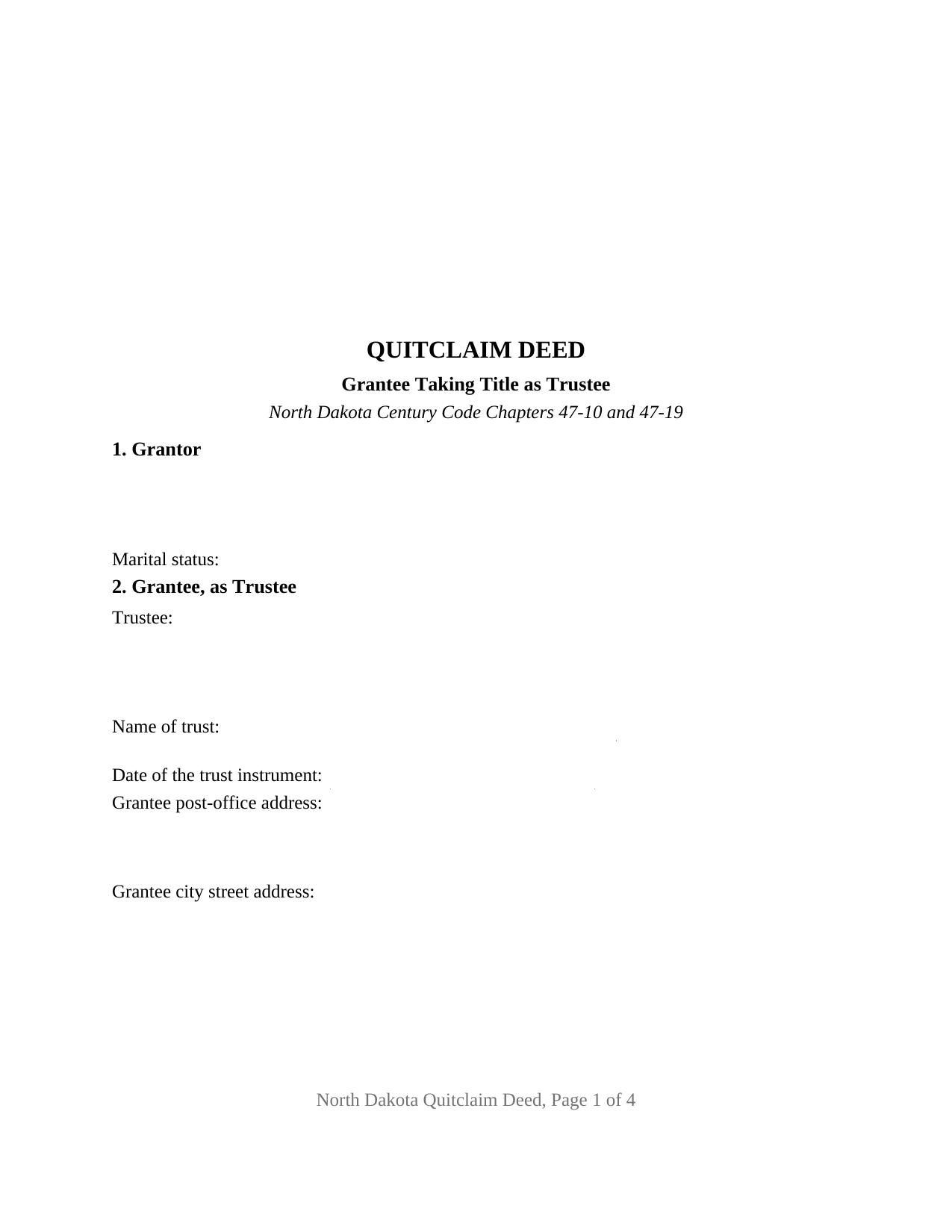
The receiving party on this North Dakota quitclaim deed is named twice over: once by name, and once by the capacity in which the name takes title. The form is configured for a trustee grantee. Its grantee section collects the trustee, the name of the trust, and the date of the trust instrument, and the deed states that title vests in that trustee as trustee of the named trust, and not in the trustee individually.
A grantee named in a capacity
North Dakota law has a rescue provision for deeds that get this wrong. Section 47-19-42.1 of the North Dakota Century Code provides that an instrument is not void merely because a trust or an estate is named as grantee, so long as the identity of the trust or estate is reasonably ascertainable. This form does not lean on that provision: it names a trustee, in the trustee capacity, for a trust identified by name and date. Two more provisions sit behind the grantee line. Section 47-10-26 presumes that a trustee holding title to real property has the power to sell, convey, and encumber it unless restrictions are placed of record in the county where the land sits, and Section 47-02-27.4 states that a business trust other than a real estate investment trust may not own North Dakota real property at all. Where a recorder, examiner, or lender asks for proof of the trust and of who currently serves, a certification of trust under Section 59-18-13 answers that question; it is prepared, and where the parties choose recorded, separately from this deed.
What the release reaches
The operative words are remises, releases, and forever quitclaims, and the word grant is deliberately absent from them. That absence does two things under North Dakota law: Section 47-10-19 reads two limited covenants into the word grant, and current Section 47-10-15 makes a quitclaim carrying that word pass title the grantor picks up later. The deed says so expressly, and it says as well that no covenant or warranty of title is made. A trust that receives property this way takes the interest the grantor held at delivery, along with the easements, severed mineral interests, restrictions, and liens already of record.
Where trustee grantees appear in the record
Three patterns bring this configuration forward. An owner funding a revocable living trust moves the parcel from an individual name into the trustee's hands, often naming the same person on both sides of the deed, as the completed example does. A relative conveying an inherited fractional interest into an existing family trust presents the same architecture with different people on the two lines. So does a correction, where an earlier deed named the trust alone and a fresh instrument puts the trustee capacity on the record. The form recites exactly one grantor and exactly one grantee taking as trustee, so it carries one signature line and one acknowledgment certificate; a conveyance made by a trustee, and one needing a second grantor signature, each follow a different architecture. A marital status entry sits in the grantor section because Section 47-18-05 conditions the conveyance of a married person's homestead on execution and acknowledgment by both spouses. A quit claim deed into a trust, in the spelling that fills the search box, moves an interest without promising anything about it.
The lines the recorder reads
Two statutory entries print on the deed itself. Section 10 carries the certification that Section 11-18-02.2 puts on the face of every North Dakota deed, with a blank for the exempt subdivision of subsection 6, signed and dated by the grantee or the presenting agent and touched by no notary. Section 5 carries the legal description statement of Section 47-19-03.1 for a description written in metes and bounds, as the completed example's Stark County tract is. The grantee entries answer Sections 47-10-07 and 47-19-05, which condition acceptance on each grantee's post-office address and city street address. From there the deed travels through the county auditor, whose certificate under Section 11-18-02 precedes recording, to the recorder, where the statutory fee runs twenty dollars through six pages and North Dakota collects no transfer tax of any kind.
The download delivers the blank trustee grantee quitclaim deed as a fillable PDF, a completed example worked through a Stark County fact pattern, and a guide covering every numbered section, the ownership forms open to grantees, the signing formalities, and the auditor-to-recorder path. These materials describe North Dakota law in general terms and are not legal advice.
Important: County-Specific Forms
Our quitclaim deed (trustee grantee) forms are specifically formatted for each of the 53 counties in North Dakota.
After selecting your county, you'll receive forms that meet all local recording requirements, ensuring your documents will be accepted without delays or rejection fees.