North Dakota Quitclaim Deed (Divorce)
County Specific Legal Forms Validated as recently as September 29, 2026 by our Forms Development Team
About the North Dakota Quitclaim Deed (Divorce)
How to Use This Form
- Select your county from the list
- Download the county-specific form
- Fill in the required information
- Have the document notarized if required
- Record with your county recorder's office
What Others Like You Are Saying
"Glad to find the Easement Forms for Halifax County, NC online. Thanks"
"Gave me exactly what i needed"
"An excellent service. Makes filing deeds so much easier than having to go to the courthouse or use F…"
"Perfect! Recorded my completed deed today with no problems."
"Good"
4.8/5 from 4,836 reviews. Read all
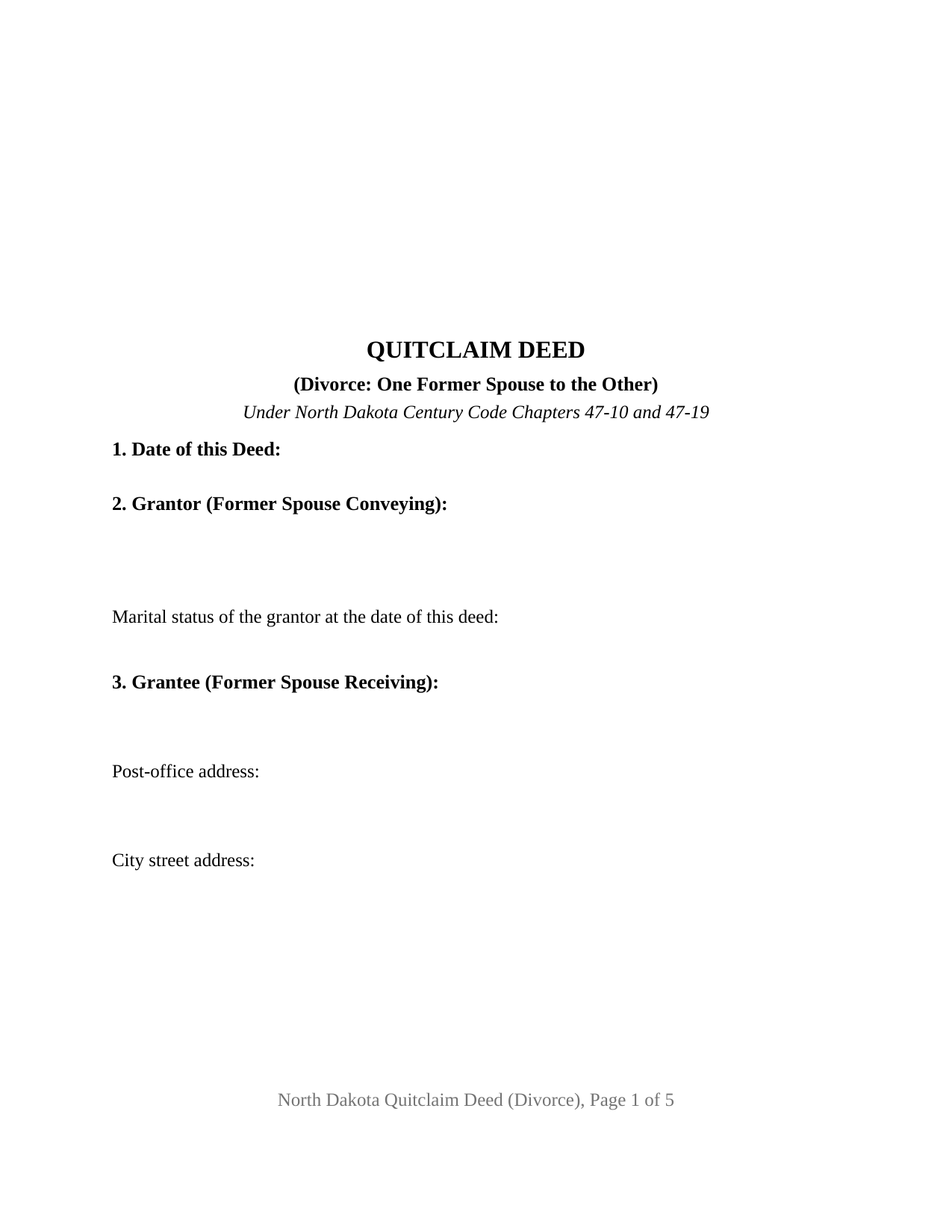
North Dakota lets a divorce court enter a judgment that records like a deed. This form is the other road: a North Dakota quitclaim deed signed by one former spouse, releasing that person's interest to the other former spouse after the marriage has been dissolved. One grantor signs, and the deed names the judgment and decree that ended the marriage.
The judgment a recorder can take in place of a deed
Section 14-05-24.2 of the North Dakota Century Code provides for a summary real estate disposition judgment in a divorce, and subsection 5 states that it operates as a conveyance and transfer of each interest in the real estate it describes. The state court system's self-help materials describe it as recorded in place of a quitclaim deed; it is obtained and recorded through the court file and is not part of this package, while this deed is recorded by the parties. The deed also keeps the parties' social security numbers out of the property record: Section 14-05-02.1 requires a divorce decree to carry them; Section 11-18-23 keeps a document bearing a number the law does not require off the record.
The signature that stopped being required
During a marriage, Section 47-18-05 puts a homestead conveyance beyond the reach of one spouse acting alone, whatever the property is worth: the instrument takes the signature and the acknowledgment of each. Section 14-05-01 dissolves the marriage by judgment, and the pairing that statute keys to goes with it. One signature line and one acknowledgment certificate follow. Section 2 still asks the grantor's marital status, because a grantor who has remarried may hold a homestead in the new marriage. No reported North Dakota decision reaches the rule as applied between divorced parties, so the deed puts the marital facts on its face.
What the release reaches, and what it never touches
Three verbs do the conveying: the grantor remises, releases, and forever quitclaims. The word grant is deliberately missing. Section 47-10-19 would imply narrow covenants about the grantor's prior dealings, and Section 47-10-15 would carry title the grantor picks up after delivery. What arrives is the interest the grantor owns on the day of delivery, with recorded easements, mineral severances, mortgages, and liens still attached. The closing line in capital letters marks the limit that matters most in a divorce: this deed releases nobody from a promissory note. A former spouse whose name leaves the title has not left the mortgage.
One grantor, one grantee, sole ownership
The form recites exactly one grantor and exactly one grantee, each a former spouse of the other, so it carries one signature block, one acknowledgment certificate, and a grantee entry vesting the interest in that person in sole ownership. Section 4 collects the judicial district, county, case number, and judgment date. Three patterns bring this architecture forward. Spouses who held as joint tenants with right of survivorship find that Section 30.1-10-04 severed the survivorship at the divorce and left equal shares in common, and one deed gathers both shares in the spouse the court awarded the property. A house standing in one spouse's name alone takes a deed from the other, closing a claimed interest a title examination would carry forward. A parcel awarded years earlier and never deeded surfaces during a refinancing. A release signed by two grantors, and a transfer to someone outside the former marriage, follow a different architecture. Searches written as a quit claim deed after divorce arrive here.
The two lines a North Dakota recorder reads
Section 11 prints the certification that Section 11-18-02.2 places on the face of a deed, in both statutory alternatives: the full consideration paid, or the exempting subdivision of subsection 6. The example designates h, which the statute writes as all transfer of ownership of property for which is given a quitclaim deed, and the grantee signs that block with no notarial officer involved. Section 6 prints the legal description statement of Section 47-19-03.1, completed through the statute's closing phrase. An auditor's certificate under Section 11-18-02 comes ahead of the recorder, Section 11-18-05 prices a five-page deed at twenty dollars, and North Dakota collects nothing resembling a transfer tax.
The download holds three files: the blank deed as a fillable PDF, a completed example worked through a Burleigh County divorce, and a guide treating every numbered section, the homestead and severance statutes, and what the auditor and the recorder each look for. These materials describe North Dakota law in general terms and are not legal advice.
Important: County-Specific Forms
Our quitclaim deed (divorce) forms are specifically formatted for each of the 53 counties in North Dakota.
After selecting your county, you'll receive forms that meet all local recording requirements, ensuring your documents will be accepted without delays or rejection fees.