North Dakota Quitclaim Deed (Trustee Grantor)
County Specific Legal Forms Validated as recently as October 7, 2026 by our Forms Development Team
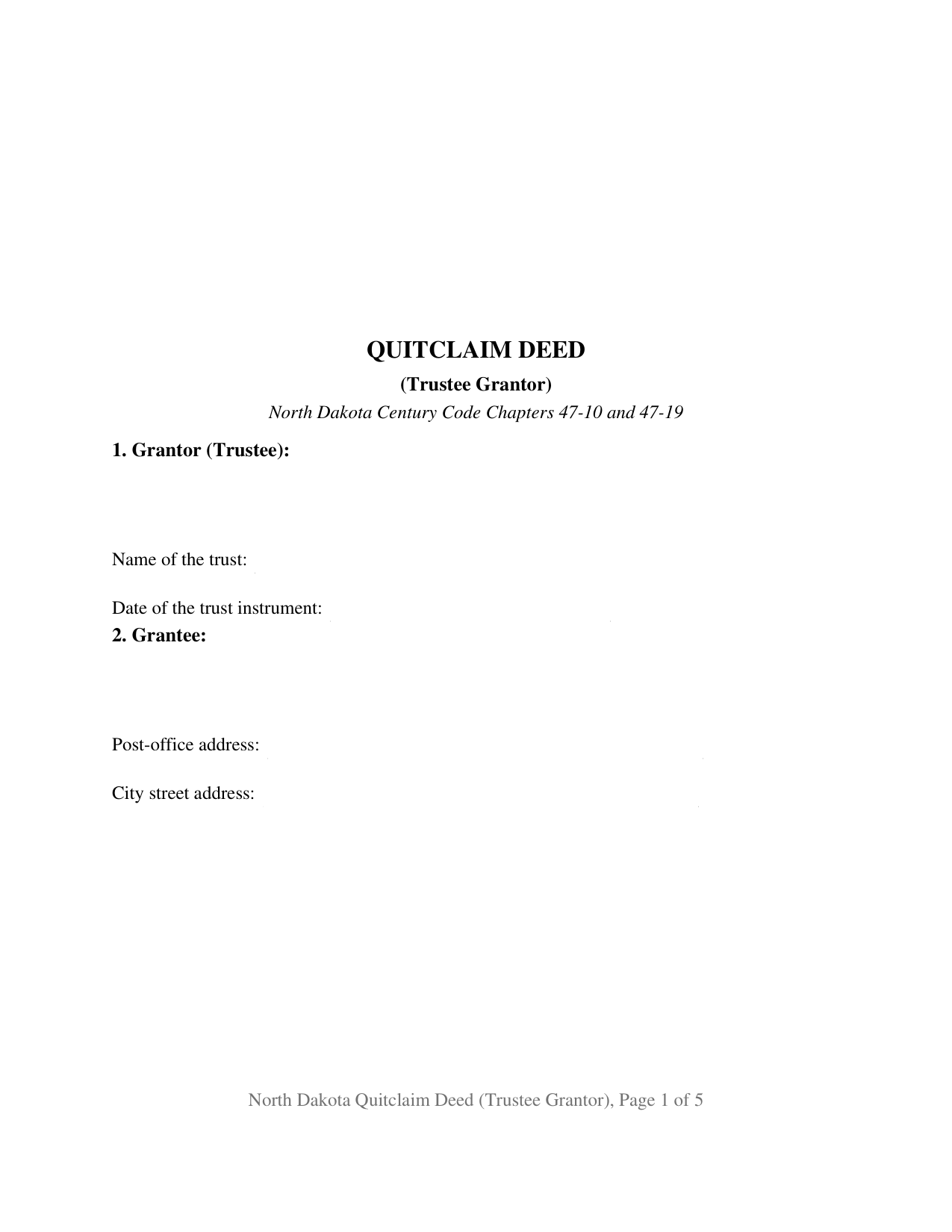
About the North Dakota Quitclaim Deed (Trustee Grantor)
How to Use This Form
- Select your county from the list
- Download the county-specific form
- Fill in the required information
- Have the document notarized if required
- Record with your county recorder's office
What Others Like You Are Saying
"Excellent service. Easy to use. Thank you."
"Review: Forms are on point, to the point, and cover the vast majority of situations. Would not sugge…"
"I thought your site was focused on my specific county, but it wasn't. Therefore, I did not complete …"
"Good service; thank you."
"The great part about Deeds.com is that the staff works with filers to get the job done."
4.8/5 from 4,829 reviews. Read all
The person signing this North Dakota quitclaim deed owns nothing here personally. The form is set up for a trustee as the only grantor, so the grantor entry states a fiduciary capacity, names the trust, and dates its governing instrument. What moves is whatever interest the trust holds, released with no covenant or warranty of title behind it.
An office on the grantor line
Record title to trust real estate in North Dakota ordinarily stands in the trustee, so the party who signs is signing for an office rather than for a personal holding. This deed keeps that distinction on its face. The grantor entry carries the capacity, Section 9 states that the interest released is trust property rather than property held individually, and the printed name line under the signature repeats the title, as the example does for a successor trustee. Nothing here reaches what that same individual owns in an individual name.
Where the power to sign comes from
Three provisions stand behind that signature. Section 47-10-26 of the North Dakota Century Code presumes that a trustee holding title to real property has the power to sell, convey, and encumber it, and it puts the exception in the county records: restrictions on the power operate when they are placed of record where the land lies. Section 59-16-15 of the North Dakota Uniform Trust Code gives a trustee, absent a limit in the trust's terms, the powers an unmarried owner who is not incapacitated has over individually owned property, and Section 59-16-16 adds specific powers, among them selling property at public or private sale. Where an examiner or a lender asks who currently serves and what the trust permits, the certification of trust described in Section 59-18-13 answers in its own document, which is not part of this package.
A release with nothing promised
The words of conveyance are remises, releases, and forever quitclaims, and the word grant is kept out of them deliberately. Under Section 47-10-19 that word carries two limited covenants about the grantor's own acts, and under current Section 47-10-15 a quitclaim carrying it reaches title the grantor picks up afterward. This form excludes both results in terms and adds that no covenant or warranty of title is made. What the grantee receives is the trust's interest as it stands at delivery, with the easements, severed minerals, restrictive covenants, mortgages, and tax liens of record riding through untouched, a result the section restates in one bold closing line.
One trustee, one signature line
The form recites exactly one serving trustee and one grantee, so it carries a single signature block and a single acknowledgment certificate; a trust whose cotrustees all sign, an estate conveyance made by a personal representative, and a release by an individual owner in an individual name each follow a different architecture. Three patterns bring this one forward. A successor trustee distributes real property to a beneficiary after the settlor's death, as the example does in Morton County. A trustee releases the trust's interest to a co-owner or buyer without putting the trust behind any title covenant. A trustee unwinds a funding transfer, returning a parcel to the settlor who placed it in trust. Searches for a quit claim deed out of a trust, or for a trustee's quitclaim deed, land on this configuration.
The entries a North Dakota recorder looks for
Two statutory entries print on the deed. Section 10 carries the certification of Section 11-18-02.2 designating subdivision h of subsection 6, the exemption for a transfer of ownership of property for which a quitclaim deed is given; the grantee or the presenting agent signs and dates it, and no notarial officer takes part. Section 5 carries the legal description statement of Section 47-19-03.1 for a metes and bounds description, completed in the example with the surveyor who wrote it. Section 2 collects the grantee address entries that Sections 47-10-07 and 47-19-05 make conditions of acceptance. The county auditor's certificate under Section 11-18-02 comes before the recorder may take the deed at all, recording then runs twenty dollars through six pages, and North Dakota collects no transfer or deed tax.
Three files arrive with the purchase: the fillable blank deed, the Morton County example filled in end to end, and a guide that walks the numbered sections, the trustee's signing formalities, the ownership choices a grantee may take, and both counters this deed passes through. Everything in the package is a general description of North Dakota law, not legal advice.
Important: County-Specific Forms
Our quitclaim deed (trustee grantor) forms are specifically formatted for each of the 53 counties in North Dakota.
After selecting your county, you'll receive forms that meet all local recording requirements, ensuring your documents will be accepted without delays or rejection fees.