North Dakota Quitclaim Deed
County Specific Legal Forms Validated as recently as September 23, 2026 by our Forms Development Team
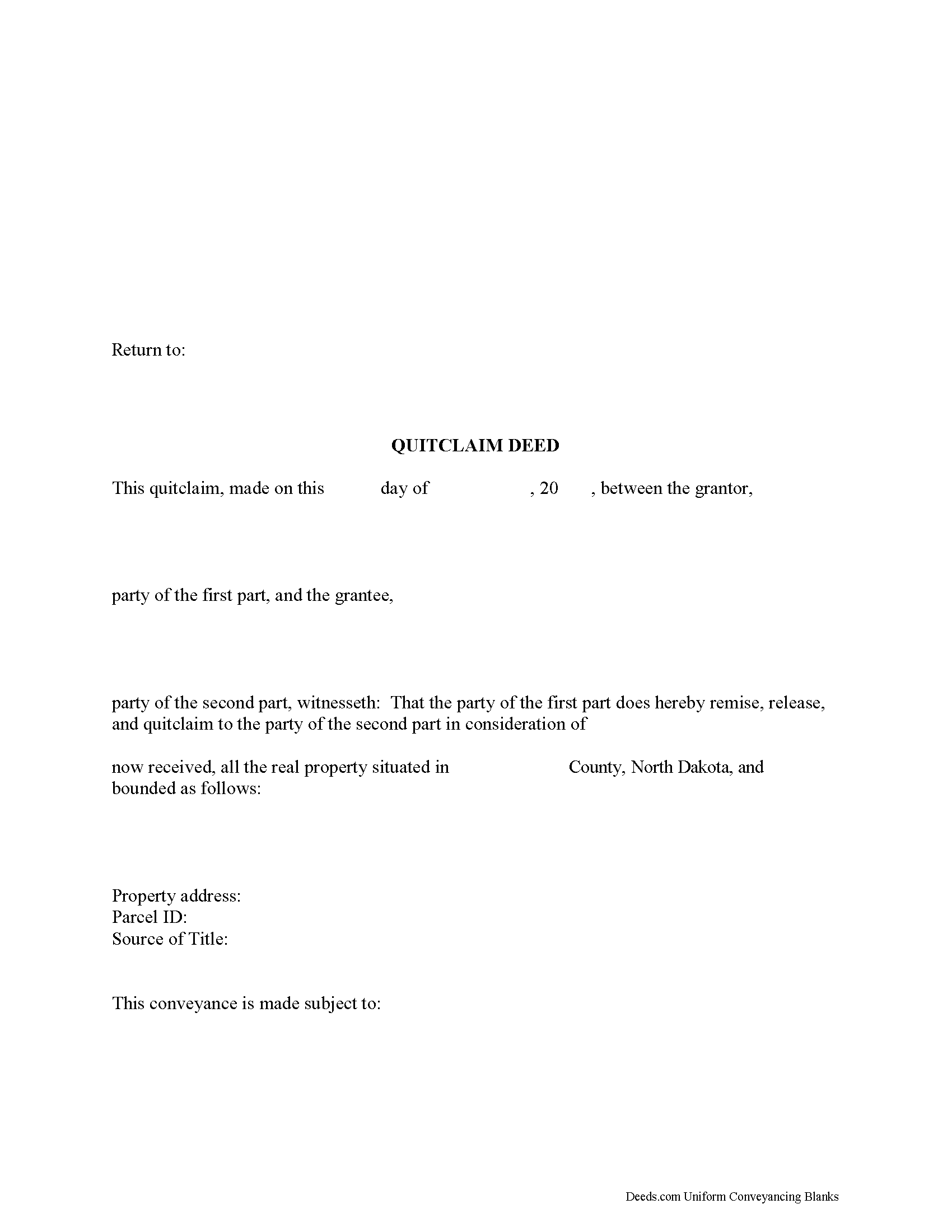
About the North Dakota Quitclaim Deed
How to Use This Form
- Select your county from the list
- Download the county-specific form
- Fill in the required information
- Have the document notarized if required
- Record with your county recorder's office
What Others Like You Are Saying
"The form was very easy to use and the sample tool you had was very helpful. the only problem i had w…"
"very simple to use"
"Great service. It had all the forms I needed."
"Quick, efficient and the instructions were clear. Thank you"
"I was searching information about my boyfriend family home and received the results in a timely mann…"
4.8/5 from 4,830 reviews. Read all
Nothing is preprinted on this North Dakota quitclaim deed about who the parties are to one another. The grantor block and the grantee block are open lines, and the status words, the relationship words, and the co-ownership words belong to whoever completes the form. That openness is the design: this is the base configuration of the North Dakota quitclaim deed, holding one or two individual grantors on the releasing side and one or two individual grantees on the receiving side.
Open party blocks, and what fills them
A quitclaim deed makes no promise about the title it moves, so the entries that matter most on it describe who signs and how the receiving side takes. A grantor writes out a name and whatever status that grantor states; grantees write out their names and, where two take together, the designation fixing their co-ownership. North Dakota Century Code Section 47-02-08 supplies the answer when a deed to two or more grantees designates nothing at all, treating the interest as one held in common, while Section 47-02-06 recognizes a joint tenancy only where the transfer expressly declares it. The guide sets out each ownership form the state recognizes, the words that create it, and the one form, tenancy by the entirety, that North Dakota has never recognized at all.
The word this deed keeps out
North Dakota legislated something most states left to the common law: what happens when a quitclaim deed uses the word grant. Under current Section 47-10-15, a quitclaim deed carrying that word in its words of conveyance passes title the grantor picks up afterward, whatever words describe the interest conveyed, and Section 47-10-19 reads two narrow covenants about the grantor's own prior dealings into the same word. Section 8 conveys through remises, releases, and forever quitclaims, states that grant is not among its words of conveyance, and excludes both consequences by its terms. The grantee ends up with the interest standing in the grantor at delivery, with easements, plat restrictions, severed minerals, mortgages, liens, and unpaid taxes riding through untouched. The same statute adds a reassurance in the other direction: conveying this way creates no defect in the conveying party's own title.
Four count patterns on one instrument
The form recites natural persons signing in their own right, in any of four counts: one grantor to one grantee, one grantor to two grantees, two grantors to one grantee, and two grantors to two grantees. Two signature blocks appear, headed for a grantor and a second grantor, each followed by its own short-form acknowledgment certificate, and a single-grantor conveyance simply leaves the second block and second certificate blank. Section 47-18-05 is the reason the second block matters beyond arithmetic: a married person's homestead, whatever its value, is conveyed only through an instrument executed and acknowledged by both spouses, and that rule reads on the marriage rather than on the record title. Three or more owners on either side outrun the two blocks, and a deed signed for a company, a partnership, a trust, an estate, or by an agent under a power of attorney takes a configuration built around the acknowledgment certificate North Dakota prescribes for that signer.
The entries a recorder checks on the face
Two North Dakota requirements print on the deed itself rather than on a separate return. Section 9 carries the certification of Section 11-18-02.2, where the grantee or the presenting agent states either the full consideration paid or the subsection 6 exemption relied on, then signs and dates it with no notarial officer involved; subdivision h names a transfer for which a quitclaim deed is given. Section 7 carries the legal description statement of Section 47-19-03.1 for a description written in metes and bounds. Grantee address entries answer Sections 47-10-07 and 47-19-05, the auditor certifies transfer and taxes under Section 11-18-02 first, recording opens at twenty dollars through six pages under Section 11-18-05, and the state imposes nothing resembling a transfer tax. Buyers searching for a quit claim deed, spelled as two words, land on this same instrument.
Three files come with the purchase: the blank deed as a fillable PDF, a completed example worked end to end through a Morton County conveyance, and a guide that walks the ten numbered sections, the execution formalities, and the co-ownership choices a grantee entry can carry. Everything here is general information about North Dakota law rather than legal advice.
Important: County-Specific Forms
Our quitclaim deed forms are specifically formatted for each of the 53 counties in North Dakota.
After selecting your county, you'll receive forms that meet all local recording requirements, ensuring your documents will be accepted without delays or rejection fees.