North Dakota Quitclaim Deed (Interspousal)
County Specific Legal Forms Validated as recently as October 21, 2026 by our Forms Development Team
About the North Dakota Quitclaim Deed (Interspousal)
How to Use This Form
- Select your county from the list
- Download the county-specific form
- Fill in the required information
- Have the document notarized if required
- Record with your county recorder's office
What Others Like You Are Saying
"Very easy and convenient to use. Low cost and saves a trip to the courthouse and/or having to do mai…"
"hi, It is very easy to do it. tanks."
"Thank you for an easy to use system. I was able to find all the information I needed."
"EXCELLENT JOB DEEDS.COM I AM SO PROUD I WAS ABLE TO RECEIVE A COPY OF THE REAL ESTATE DEED FROM MY O…"
"Delivered as promised. Highly recommend!"
4.8/5 from 4,829 reviews. Read all
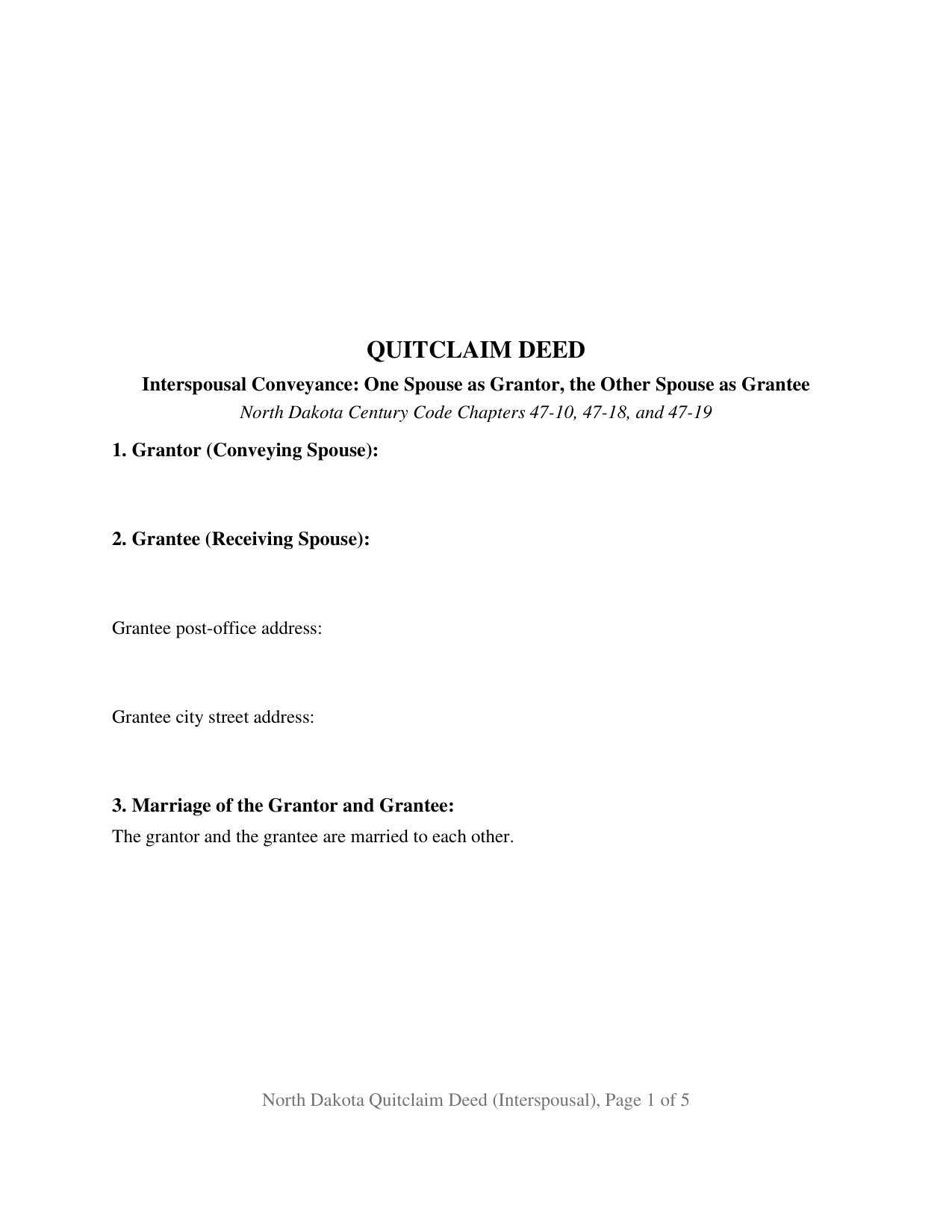
On this North Dakota quitclaim deed the person receiving the property signs it as well, because that person is the grantor's husband or wife. The form is configured for an interspousal conveyance: one spouse is named as grantor, the other spouse as grantee, and the release runs from one side of a marriage to the other without any covenant or warranty of title.
A deed the receiving spouse also signs
North Dakota Century Code Section 47-18-05 lets a married person's homestead be conveyed only through an instrument that both husband and wife have signed and acknowledged, whatever the property is worth. That rule reads on the marriage rather than on the record title, and it does not pause because the new owner happens to be the other spouse. This form answers it by architecture instead of by argument: Section 3 recites that the parties are married to each other, Section 10 records that both of them execute and acknowledge the instrument, and Section 12 carries a signature block for each spouse followed by its own acknowledgment certificate. Section 10 also states the limit of the grantee's signature, which moves nothing away from the grantee and leaves Section 9 as the only conveyance the deed makes. Whether the homestead rule is satisfied or simply inapplicable when a spouse conveys to a spouse is a question no reported North Dakota decision has answered, so the deed carries the two-signature formality on its face.
What the release reaches
The operative words are remises, releases, and forever quitclaims. The deed never uses the word grant in its words of conveyance, which matters twice under North Dakota law: Section 47-10-19 reads two limited covenants into that word, and Section 47-10-15 makes a quitclaim carrying it pass title the grantor picks up later. Excluding it keeps both effects out, and the form says so expressly. The grantee spouse takes the interest the grantor spouse holds at delivery, along with the easements, mineral severances, liens, and restrictions already of record. Nothing in the deed releases either spouse from a mortgage note; that release comes from a lender, not from a recorder's stamp.
Where interspousal transfers show up in the record
Three patterns bring this configuration forward. A dissolution settlement allocates the parcel to one spouse, and a deed from the other spouse conforms the record to the allocation, alongside the joint tenancy severance Section 30.1-10-04 works at divorce. A name added at a closing, or on a later correction, goes back to the other spouse in a single recorded instrument. Spouses who hold a parcel together consolidate it in one name while an estate plan is being put in place. The form recites exactly one grantor spouse and exactly one grantee spouse who are married to each other, so title vests in that spouse in sole ownership; a conveyance to both spouses in joint tenancy under Section 47-10-23 names two grantees, and a transfer to anyone outside the marriage follows a different architecture. A quit claim deed between spouses, in the spelling that turns up in searches, is the ordinary instrument for these moves because it shifts an interest without promising anything about it.
The lines the recorder checks
Two statutory entries print on the deed itself. Section 11 carries the certification Section 11-18-02.2 puts on the face of every North Dakota deed, with the full consideration paid or the exempting subdivision of subsection 6 designated; subdivision h covers property transferred by quitclaim deed and subdivision c covers a transfer within the same family, so a deed between spouses is reached by either letter, and the grantee or presenting agent signs and dates that entry with no notary involved. Section 5 carries the drafter statement of Section 47-19-03.1 for a metes and bounds description. Each grantee address entry answers Sections 47-10-07 and 47-19-05, the county auditor certifies transfer and taxes under Section 11-18-02 before the recorder may take the deed, the statutory fee is twenty dollars through six pages, and North Dakota collects no transfer tax or deed tax at all.
The download holds the blank interspousal quitclaim deed as a fillable PDF, a completed example filled in for a Williams County husband and wife, and a guide covering every numbered section, both acknowledgments, the homestead signature rule, and the trip from the auditor's counter to the recorder's. These materials describe North Dakota law in general terms and are not legal advice.
Important: County-Specific Forms
Our quitclaim deed (interspousal) forms are specifically formatted for each of the 53 counties in North Dakota.
After selecting your county, you'll receive forms that meet all local recording requirements, ensuring your documents will be accepted without delays or rejection fees.