North Dakota Transfer on Death Deed (Sole Owner, Multiple Beneficiaries (Equal Shares))
County Specific Legal Forms Validated as recently as November 20, 2026 by our Forms Development Team
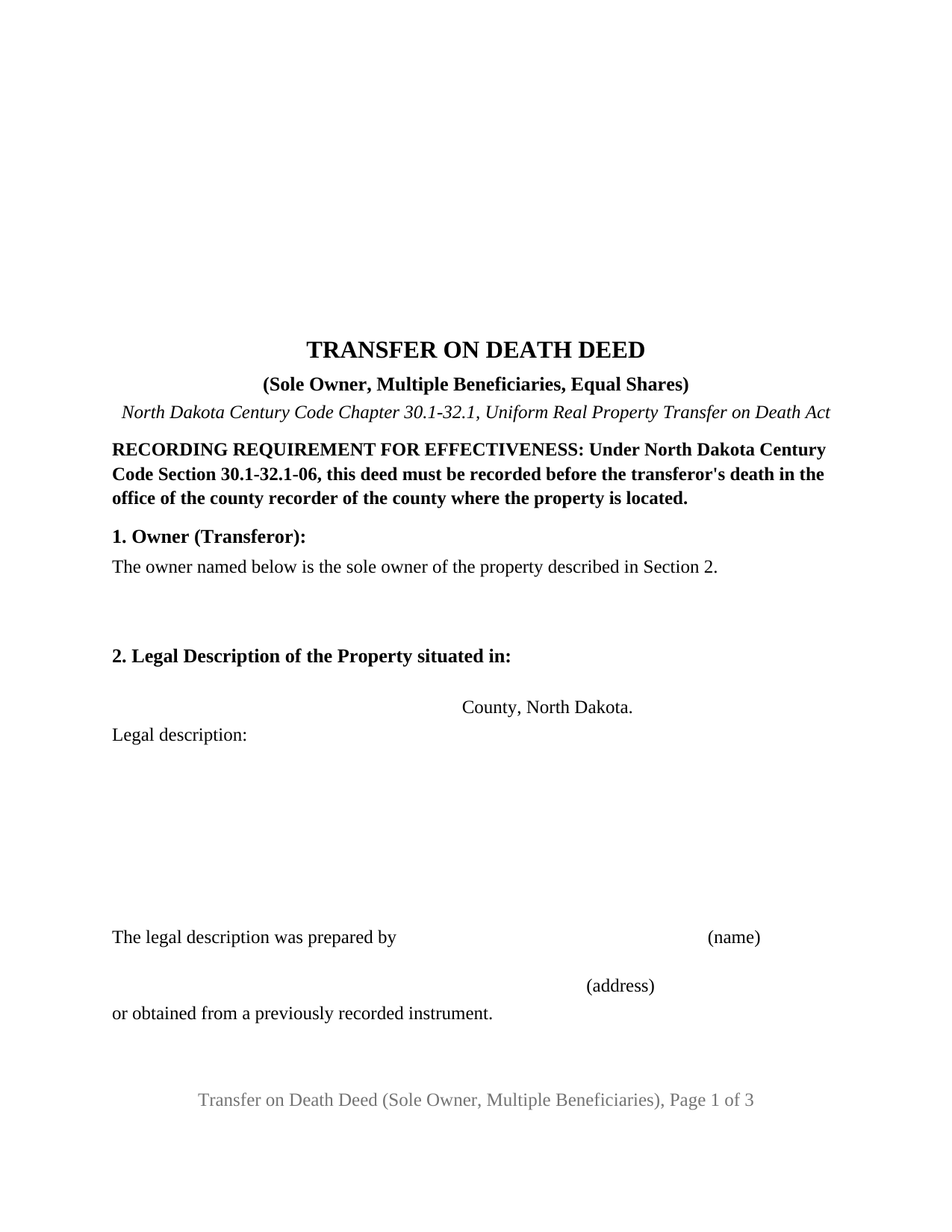
About the North Dakota Transfer on Death Deed (Sole Owner, Multiple Beneficiaries (Equal Shares))
How to Use This Form
- Select your county from the list
- Download the county-specific form
- Fill in the required information
- Have the document notarized if required
- Record with your county recorder's office
What Others Like You Are Saying
"I am a tax attorney and had worked as a Valuation Engineer with Internal Revenue Service. I can acce…"
"The process to obtain online forms was simple and straight forward and uncomplicated."
"Very easy to use and modify if necessary. Spot on with each county requirement for recording and Not…"
"I created an account for one particular document. It was very easy to find what I needed for my stat…"
"So far this looks like exactly what I need and at a reasonable price. Glad it was so easy to find on…"
4.8/5 from 4,862 reviews. Read all
Several children, one house, equal shares. The owner of a parcel of North Dakota real estate who holds it alone can name two or more people to receive it together at death, each taking the same undivided share, and this North Dakota transfer on death deed is drawn for exactly that designation. Its sole-owner recital and its equal-share designation are printed as fixed deed text, and it carries a single signature block and a single acknowledgment certificate, so the blanks on the page receive nothing but names, addresses, and the description of the land.
Equal undivided shares, and no survivorship among the takers
Section 5 of the deed opens with a printed sentence: the owner designates the two or more persons named below as the designated beneficiaries of this deed, to take in equal and undivided shares with no right of survivorship. Those are the words of Section 30.1-32.1-10(1)(c) of the North Dakota Century Code, the rule the Uniform Real Property Transfer on Death Act applies to concurrent beneficiaries unless a deed provides otherwise, and this deed prints them rather than leaving the share arrangement to a blank. Three beneficiaries each take an undivided one third at the owner's death and hold as tenants in common from that moment; a beneficiary's share passes through that beneficiary's own estate afterward, because the deed creates no survivorship among them. The six-line block beneath the sentence takes each beneficiary on a line of its own, a natural person by full name and mailing address, a trust by its name and trustee, or an entity by its legal name, since the Uniform Probate Code definitions that govern the chapter treat all of them as persons.
When one of the named beneficiaries dies first
The chapter answers the question a multiple-beneficiary deed raises most often. Under Section 30.1-32.1-10(1)(b) each designated beneficiary's interest is contingent on surviving the owner, and the interest of one who does not survive lapses; Section 30.1-09.1-02 deems an individual who is not shown by clear and convincing evidence to have survived by one hundred twenty hours to have predeceased. Under Section 30.1-32.1-10(1)(d) a lapsed share is transferred to the other beneficiaries in proportion to their interests, so with three equal takers and one lapse the two survivors each take one half. The chapter makes both rules subject to state law on antilapse where it applies to nonprobate transfers, and the antilapse rule for beneficiary designations, Section 30.1-09.1-06, creates a substitute gift in the surviving descendants of a deceased beneficiary who was a grandparent, a descendant of a grandparent, or a stepchild of the owner, which is how a predeceased child's share can pass to that child's own children by representation instead of to the other named beneficiaries. The deed prints no lapse term of its own so that these rules apply exactly as the legislature wrote them, and the guide walks through each of them with its citation.
The operative paragraph and the statement the chapter requires
Section 6 has no blanks. The owner, as transferor, transfers to the designated beneficiaries named in Section 5, effective at the transferor's death, all of the transferor's interest in the described property, in equal and undivided shares with no right of survivorship, and the paragraph then states, as Section 30.1-32.1-06(2) requires of every North Dakota TOD deed, that the transfer to the designated beneficiaries is to occur at the transferor's death. A second paragraph then prints three rules the chapter applies whatever a deed says: revocability under Section 30.1-32.1-03, the absence of any legal or equitable interest in a beneficiary during the owner's life under Section 30.1-32.1-09, and the transfer without covenant or warranty of title under Section 30.1-32.1-10(4). The title carries the phrase transfer on death deed, which the same section also requires. Because the deed passes only what the owner holds at death, a later sale leaves nothing for it to transfer, and a later mortgage rides along to the beneficiaries.
One owner, one certificate, one stamp
Section 1 prints the sole-owner recital, the owner named below is the sole owner of the property described in Section 2, and the two-line blank beneath it takes one name and one mailing address. The owner signs under the OWNER heading and acknowledges before a notarial officer; the certificate prints the North Dakota short form sentence of Section 44-06.1-19, this record was acknowledged before me on, and the form reserves a captioned space beneath the commission line for the official stamp that Section 44-06.1-14 places on a paper certificate, sized for the largest round or rectangular stamp Section 44-06.1-16 permits a North Dakota notary to carry. An acknowledgment taken in another state before that state's officer has the same effect under Section 44-06.1-10. The deed fixes no marital status, and it carries no signature line for a spouse who is not an owner of record; the homestead statute, Section 47-18-05, calls for both spouses to execute and acknowledge a conveyance or encumbrance of a married person's homestead, and whether a deed that conveys nothing during life is such an instrument is a question Chapter 30.1-32.1 leaves open, which the guide describes from the statutes on both sides.
What the recorder sees
Nothing passes under the deed unless the county recorder of the county where the property lies has recorded it before the owner dies, and the form prints that effectiveness condition in bold directly under its title. Section 30.1-32.1-06 excuses a transfer on death deed from the auditor's certificate of transfer and the statement of full consideration that an ordinary North Dakota deed carries, and North Dakota collects no transfer tax; the fee is the statewide schedule of Section 11-18-05, twenty dollars for a deed of one to six pages, and this deed records on three. The beneficiary block carries each taker's mailing address, which Sections 47-10-07 and 47-19-05 make part of a recordable deed, and the legal description preparer statement of Section 47-19-03.1 prints beneath the legal description for a deed whose description is written by metes and bounds, its two blanks staying empty for a description copied from the prior deed.
What this configuration is, and is not, set up as
The deed is fixed at one owner of record holding the whole interest in an individual capacity and at two or more designated beneficiaries taking equal and undivided shares. A parent who owns the family home alone and names all of the children, an owner naming several nieces and nephews, and an owner naming two friends and a charitable organization to share alike all present the pattern the deed recites. A deed by co-owners who hold a parcel together, as joint tenants or as tenants in common, is a different instrument: it carries two signature blocks and the joinder rule of Section 30.1-32.1-08, under which a deed of joint owners is revoked only by all of the living joint owners. Where title stands in a trustee, in an estate's personal representative, or in a corporation or limited liability company, or where an owner signs through an attorney-in-fact, the signer acts in a representative capacity, and neither the owner recital nor the individual-capacity certificate on this deed expresses such an office. The chapter permits a designation of a single beneficiary, of beneficiaries in unequal shares, and of an alternate who takes if the first takers do not survive, and each is a different beneficiary pattern for which this form prints no blank and no sentence. Revoking a recorded transfer on death deed takes its own instrument under Section 30.1-32.1-08, acknowledged after the deed it revokes and recorded before death; that revocation instrument is prepared and recorded separately and is not included in this package.
Inside the download are the fillable transfer on death deed in PDF form, a completed example worked through for a Grand Forks County owner naming his three children in equal shares, and a guide covering each numbered section, the survival and lapse rules, the acknowledgment certificate, and the trip to the recorder. These materials describe the form and North Dakota law in general terms and are not legal advice.
Important: County-Specific Forms
Our transfer on death deed (sole owner, multiple beneficiaries (equal shares)) forms are specifically formatted for each of the 53 counties in North Dakota.
After selecting your county, you'll receive forms that meet all local recording requirements, ensuring your documents will be accepted without delays or rejection fees.