North Dakota Transfer on Death Deed (Sole Owner, Primary and Alternate Beneficiary)
County Specific Legal Forms Validated as recently as November 20, 2026 by our Forms Development Team
About the North Dakota Transfer on Death Deed (Sole Owner, Primary and Alternate Beneficiary)
How to Use This Form
- Select your county from the list
- Download the county-specific form
- Fill in the required information
- Have the document notarized if required
- Record with your county recorder's office
What Others Like You Are Saying
"Filled my need for the documents needed. thank you, I am sure I will return soon."
"i really liked that the information i received from Deed .com concerning deed and title transfer for…"
"Deeds.com was easy to use and their easement deed was exactly what I was looking for. I knew I didn'…"
"Wonderful service, very user friendly!"
"Awesome and so easy Thanks"
4.8/5 from 4,862 reviews. Read all
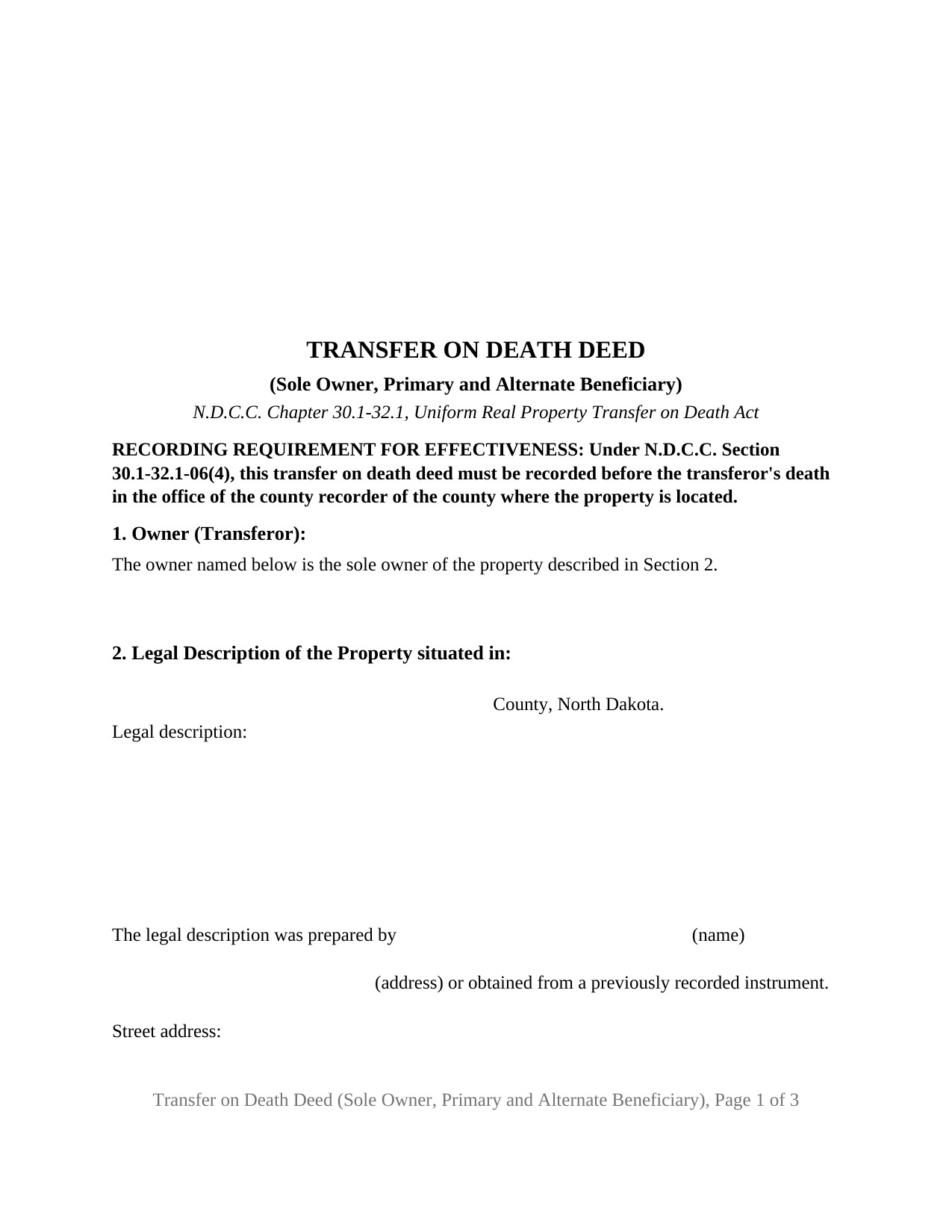
A first choice and a fallback, both printed on the deed. Built for an owner who alone holds title to North Dakota real estate, this transfer on death deed names one primary designated beneficiary to receive the parcel at death and one alternate designated beneficiary who takes only if the first choice does not survive the owner. The sole-owner recital, the primary designation, and the alternate's condition are all fixed deed text under Chapter 30.1-32.1 of the North Dakota Century Code, so the blanks receive two names, two addresses, and the description of the land, and nothing about the order in which the two takers stand is left to be drafted.
A named fallback, fixed in deed text
Section 4 of the deed designates the person named below as primary designated beneficiary, and Section 5 designates the person named below as alternate designated beneficiary, to take under this deed only if the primary designated beneficiary does not survive the transferor. Each blank takes one person as Title 30.1 defines the word: a natural person by full name and mailing address, a trust by its name and trustee, or an entity by its legal name. The condition on the alternate is printed, not written in, which is what makes the arrangement an alternative beneficiary designation within Section 30.1-09.1-06 of the Century Code, a designation expressly created by the governing instrument that takes effect instead of another designation on the happening of an event such as failure to survive. A standby taker is what the two sections together provide, and this beneficiary deed form prints the arrangement as the chapter and the Uniform Probate Code definitions describe it.
What happens when the first choice dies first
Three rules of Title 30.1 meet at that moment, and the deed is drawn so that they apply exactly as written. Section 30.1-32.1-10(1)(b) makes a designated beneficiary's interest contingent on surviving the owner, and Section 30.1-09.1-02 supplies the measure: a person not shown by clear and convincing evidence to have survived by one hundred twenty hours is deemed to have predeceased. Section 30.1-09.1-06 then creates a substitute gift in the surviving descendants of a predeceased beneficiary who was a grandparent, a descendant of a grandparent, or a stepchild of the owner, and the same section says which of the two wins. Under subsection 2(d), the substitute gift in a predeceased primary beneficiary's descendants is superseded by the alternate designation only if the expressly designated alternate is entitled to take. So where a daughter named as primary dies before her parent leaving children of her own, and the grandson named as alternate survives, the grandson takes under the deed and the daughter's children do not; where the alternate also fails to survive and each left descendants who take a substitute gift, subsection 3 chooses between them, and the primary's substitute gift prevails unless the alternate was a descendant of the primary. The guide walks through each branch with its citation, and where no one named or substituted is entitled to take, the interest lapses and the deed transfers nothing.
The operative paragraph and the statement the chapter requires
Section 6 has no blanks. The owner, as transferor, transfers to the primary designated beneficiary, effective at the transferor's death, all of the transferor's interest in the described property; if the primary does not survive, the transferor instead transfers that interest to the alternate; and the paragraph closes with the sentence Section 30.1-32.1-06 requires of every North Dakota transfer on death deed, that the transfer to the designated beneficiary is to occur at the transferor's death. The same paragraph records the three rules the chapter applies whatever a deed says: revocability under Section 30.1-32.1-03, no legal or equitable interest in a beneficiary during the owner's life under Section 30.1-32.1-09, and a transfer without covenant or warranty of title under Section 30.1-32.1-10(4). The owner keeps every right of ownership while living, and a later sale or mortgage is simply what the beneficiary finds at death.
Signing once, and the recorder's counter
The owner signs under the OWNER heading and acknowledges before a notarial officer, and the certificate prints North Dakota's individual-capacity short form of Section 44-06.1-19 with a reserved area for the official stamp Section 44-06.1-14 places on a paper certificate. The deed is effective only if it is recorded before the owner's death in the office of the county recorder of the county where the land lies, a condition the form prints in bold under its title; it goes to the recorder without the auditor's certificate of transfer and without the statement of full consideration, which Section 30.1-32.1-06(5) excuses for a transfer on death deed, and the statewide fee of Section 11-18-05 is twenty dollars for a deed of one to six pages. This deed records on three. The deed fixes no marital status, carries no signature line for a spouse who is not an owner of record, and leaves to the guide the homestead statute, Section 47-18-05, and the divorce rule of Section 30.1-10-04 that a spouse named as primary brings into view.
The pattern this deed recites, and the ones it does not
The deed is fixed at one owner of record holding the whole interest in an individual capacity, one primary designated beneficiary, and one alternate designated beneficiary. A parent naming a child as primary and a grandchild as alternate, an owner naming a partner as primary and a sibling as alternate, and an owner naming a friend as primary with a charitable organization standing behind present the pattern the deed recites. A deed by two co-owners of record carries a second signature block and the joinder rule of Section 30.1-32.1-08, and a deed by a trustee, a personal representative, an entity, or an attorney-in-fact is signed in a representative capacity that this deed's recital and certificate do not express; neither is this instrument. Nor does the deed print blanks for two or more primary beneficiaries, for shares, for a class of takers, or for a second alternate; each is a different beneficiary pattern. Revocation takes its own instrument under Section 30.1-32.1-08, acknowledged after the deed it revokes and recorded before death, prepared and recorded separately and not included in this package.
The package contains three items: the fillable deed as a PDF, a completed example for a Ward County owner naming her daughter as primary and her grandson as alternate, and a guide to each numbered section, the survival and substitute gift rules, the certificate, and recording. This description and the guide describe the form and North Dakota law in general terms and are not legal advice.
Important: County-Specific Forms
Our transfer on death deed (sole owner, primary and alternate beneficiary) forms are specifically formatted for each of the 53 counties in North Dakota.
After selecting your county, you'll receive forms that meet all local recording requirements, ensuring your documents will be accepted without delays or rejection fees.