North Dakota Transfer on Death Deed
County Specific Legal Forms Validated as recently as November 20, 2026 by our Forms Development Team
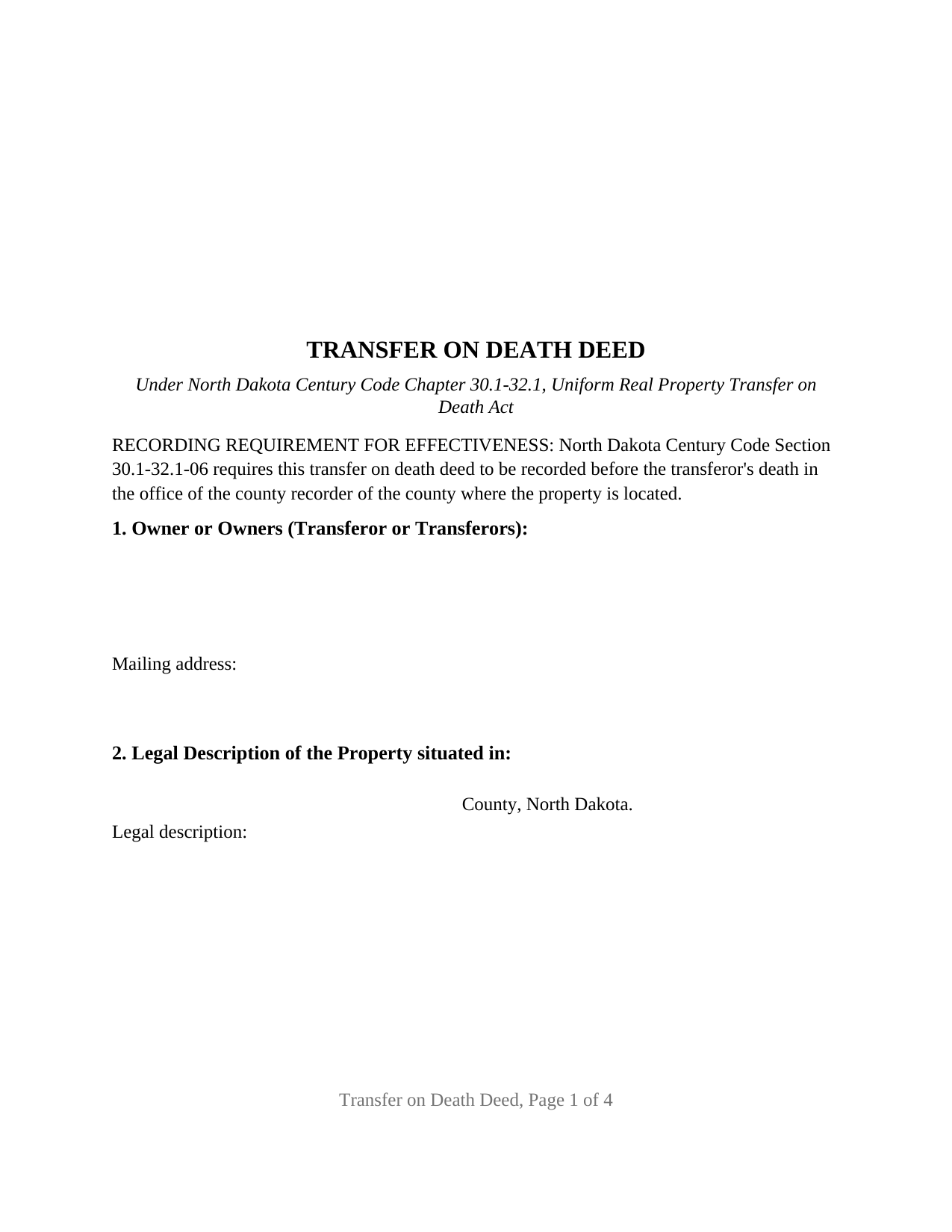
About the North Dakota Transfer on Death Deed
How to Use This Form
- Select your county from the list
- Download the county-specific form
- Fill in the required information
- Have the document notarized if required
- Record with your county recorder's office
What Others Like You Are Saying
"Outstanding website, very refreshing to use. Thank you"
"great job but, I wanted to upload a document. I got it wrong, but the info was good."
"Thx. Easy to research and download. Now proof is in the pudding. :-)"
"I was very pleased with your service. You got me the information I required within one day. Thank yo…"
"I found the documents I needed and so many more that I will utilize for business, personal and famil…"
4.8/5 from 4,862 reviews. Read all
A North Dakota transfer on death deed names who receives a parcel of North Dakota real estate when its owner dies, and it does nothing else until that moment. This form prepares that deed under Chapter 30.1-32.1 of the North Dakota Century Code, the Uniform Real Property Transfer on Death Act as North Dakota enacted it, for one or two owners of record who sign in their own names.
A deed that waits for a death
While the owner lives, the recorded deed changes nothing. Section 30.1-32.1-09 states that the deed does not affect any interest or right of the transferor or any other owner, including the right to transfer or encumber the property, does not affect the rights of the owner's creditors, does not affect anyone's eligibility for public assistance, and creates no legal or equitable interest in the person named. The owner keeps the property, may sell it or mortgage it, and may revoke the deed; Section 30.1-32.1-03 makes the deed revocable even if the deed itself says otherwise. The capacity to make it is the capacity to make a will, and no notice to the beneficiary, delivery, acceptance, or consideration is required. At the owner's death, the designated beneficiary receives whatever interest the owner then holds, subject to every mortgage, lien, and other interest affecting the property at that time, and without any covenant or warranty of title.
Recorded before death, or not at all
Section 30.1-32.1-06 sets the five requirements. The deed carries the essential elements and formalities of a recordable North Dakota deed; it states that the transfer to the designated beneficiary is to occur at the transferor's death; its title uses the phrase transfer on death deed or the abbreviation TOD; it is recorded before the transferor's death in the office of the county recorder of the county where the property is located; and it goes to the recorder without the county auditor's certificate of transfer and without the statement of full consideration that an ordinary North Dakota deed carries. A signed and notarized deed that is still unrecorded at the owner's death transfers nothing. The form prints the required statement in its operative section and the required phrase in its title, and the recording fee is the statewide schedule of Section 11-18-05, twenty dollars for a deed of one to six pages; North Dakota imposes no transfer tax or deed tax.
One owner or two, on one form
The form is the base configuration of this deed. Section 1 is a free-form owner block that receives one owner's name or two co-owners' names with whatever status the owners write in, and nothing about marital status or the way title is held is preprinted. Two signature blocks follow, captioned OWNER and SECOND OWNER (if applicable), each with its own acknowledgment certificate, so two owners may acknowledge on different dates or before different officers; a deed by one owner leaves the second block and its certificate blank. For two owners who hold as joint tenants with right of survivorship, Section 30.1-32.1-10(3) supplies the timing: at the first death the property belongs to the surviving joint owner, and the deed takes effect when the last surviving joint owner dies. Two owners who hold as tenants in common each transfer only their own undivided interest at their own death. The form is not set up as a deed by a corporation, a trustee, or an agent under a power of attorney, and it carries no third owner block; the chapter itself defines the transferor as an individual.
Who may be named, and what they take
The designated beneficiary block receives a natural person by name and mailing address, a trust by its name and trustee, or an entity by its legal name; under the Uniform Probate Code definitions that govern the chapter, a person includes an organization, and an organization includes a trust. Where two or more beneficiaries are named and the entry says nothing more, they take in equal and undivided shares with no right of survivorship, and the share of a beneficiary who does not survive passes to the surviving concurrent beneficiaries in proportion to their interests. An optional alternate block names who takes if no designated beneficiary survives the owner; the form fixes that condition in a printed sentence, so no legal drafting is left to the person completing it. The guide describes how the survival, antilapse, and divorce rules of Title 30.1 bear on these designations.
Signing, the North Dakota certificate, and the recorder
Each owner signs before a notarial officer, and the certificate on the form prints the North Dakota short form sentence of Section 44-06.1-19, this record was acknowledged before me on, followed by the date and the name of the owner acknowledging. An acknowledgment taken in another state before that state's notary has the same effect under Section 44-06.1-10, so an owner living elsewhere signs where that owner lives. Two North Dakota deed content rules reach this instrument and the form carries both: the post-office address of each person who takes under the deed, which Sections 47-10-07 and 47-19-05 make part of a recordable deed, and the legal description drafter statement of Section 47-19-03.1, which the form prints beneath the legal description for a deed whose description is written by metes and bounds. The first instrument page reserves the three inches the recorder uses for its recording information, every page keeps a one-inch margin, and the body type is twelve point, above the ten point Calibri floor Section 11-18-05 sets for a document not issued by a government agency. A revocation under Section 30.1-32.1-08 is a separate instrument, acknowledged after the deed it revokes and recorded before death, prepared and recorded separately and not included in this package.
The package includes the fillable transfer on death deed form, a completed example filled in for a realistic Cass County fact pattern, and the guide that walks through every numbered section, the signing rules, and the recording process. This description and the guide describe the form and the governing North Dakota statutes in general terms; they are not legal advice.
Important: County-Specific Forms
Our transfer on death deed forms are specifically formatted for each of the 53 counties in North Dakota.
After selecting your county, you'll receive forms that meet all local recording requirements, ensuring your documents will be accepted without delays or rejection fees.