Ohio Affidavit of Survivorship (Beneficiary of Last Surviving Owner)
County Specific Legal Forms Validated as recently as October 23, 2026 by our Forms Development Team
About the Ohio Affidavit of Survivorship (Beneficiary of Last Surviving Owner)
How to Use This Form
- Select your county from the list
- Download the county-specific form
- Fill in the required information
- Have the document notarized if required
- Record with your county recorder's office
What Others Like You Are Saying
"Deeds.com provides outstanding service! Quick e-recording, at a reasonable price, and if there are a…"
"It was a very easy to use application. I can only give it four stars because I have yet to receive c…"
"Fast turn-around, very efficient!!"
"Great resource and everything went smoothly except email was performed through autofill prompted by …"
"Had used website while working as Land Rep for major oil company (retired 2.5 years ago). Recently h…"
4.8/5 from 4,830 reviews. Read all
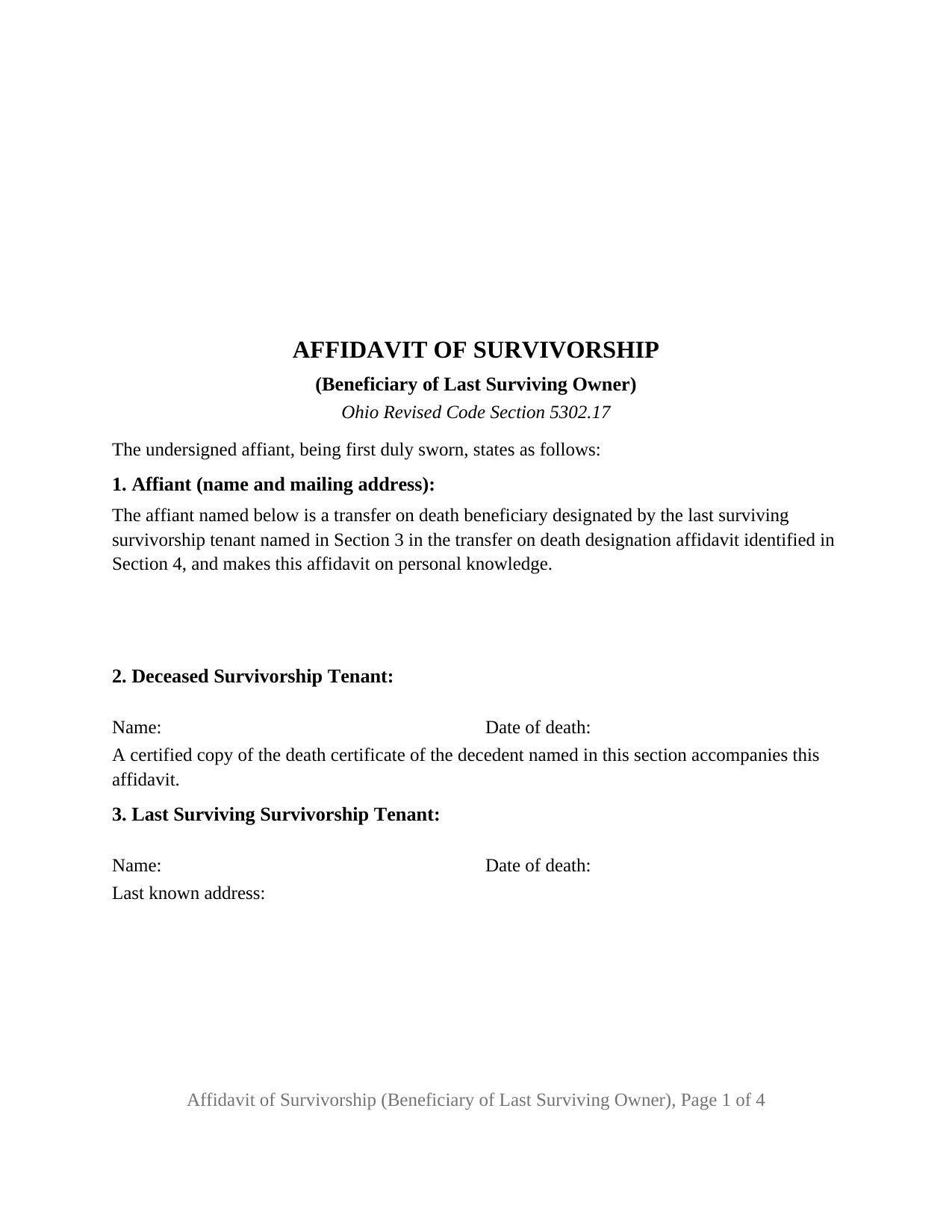
When the last of two Ohio survivorship tenants dies and the first death was never placed of record, the chain of title has a gap: the deed still shows two owners, and the transfer on death beneficiary who takes under Ohio Revised Code Section 5302.22 has no recorded instrument showing that the last surviving owner held the whole title at death. This Ohio Affidavit of Survivorship (Beneficiary of Last Surviving Owner) closes that gap. It is the Section 5302.17 survivorship affidavit made by the beneficiary rather than by a living surviving tenant, reciting the first death so the record shows the last survivor as sole owner before that survivor's own death is recorded.
Two deaths, one affidavit for the first
Under Section 5302.20(B), each death in a survivorship tenancy vests the decedent's title in the survivors, and the last one living is fully vested as the sole title holder. In the pattern this form recites, nobody recorded that vesting. Section 5302.17 lets a deceased tenant's transfer be recorded by an affidavit with a certified death certificate, reciting the other tenant's name and address, the date of death, and the property, and it names no required affiant. This form fixes the affiant as a transfer on death beneficiary of the last surviving owner and recites both deaths in order, the decedent's in Section 2 and the last surviving tenant's in Section 3, with that tenant's last known address.
Where the beneficiary's standing comes from
Section 5302.22(C)(2) sets the sequence for survivorship property under a transfer on death designation affidavit: while more than one tenant lives, a death vests title in the survivors, and at the death of the last surviving survivorship tenant, title vests in the designated beneficiaries. Section 5302.23(B)(7)(b) adds the condition the recital assumes: a designation signed only by the first tenant to die, without the last survivor joining, was nullified at that death, and a last survivor with no designation in effect leaves the interest to probate. Section 4 identifies the designation affidavit by executing owners, date, and recording reference, so the affiant's position reads straight from the record.
What is left to the affidavit of confirmation
The affidavit transfers nothing and says so on its face: it records only the decedent's interest passing to the last surviving tenant. The last survivor's death, and the vesting of that tenant's interest in the beneficiary, are the subject of the affidavit of confirmation under Section 5302.222, a separate instrument prepared separately and not included in this package, with its own certified death certificate and the Medicaid estate recovery form of Section 5302.221. When both deaths are unrecorded, the two affidavits travel together through the county auditor and county recorder in the order the deaths occurred, and the Section 319.54(G)(3)(n) exemption for a transfer to a surviving survivorship tenant reaches this one.
The configuration this form recites
The form recites exactly two survivorship tenants under one survivorship deed, both deceased, and one affiant: a natural person signing in that person's own right as a transfer on death beneficiary designated by the last surviving owner. Section 1 carries that recital as fixed text; the names, dates of death, addresses, designation affidavit, property, and survivorship deed are the entries. Section 7 carries the sworn statements with no blanks, and Section 8 carries one signature block followed by one jurat under Section 147.542, with venue lines for the state and county where the oath is administered. Spouses whose joint designation affidavit named a child, and a parent and adult child whose joint designation named a grandchild, present the pattern this affidavit recites once both tenants have died. The form is not set up as an affidavit by a living surviving tenant, for a tenancy of three or more tenants, for a trustee or entity beneficiary, for a devisee or heir where the last survivor died with no designation and the Section 2113.61 certificate of transfer governs, or for registered land under Chapter 5309. It is laid out to the Section 317.114 standard format, three inch blank top margin included, so it records at the base fee.
The package includes the fillable affidavit form, a completed example built on a Hamilton County fact pattern in which the first death went unrecorded for seven years, and the guide that walks through each numbered section, the jurat, and the auditor and recorder steps. This description and the guide describe the form and the governing Ohio statutes in general terms; they are not legal advice.
Important: County-Specific Forms
Our affidavit of survivorship (beneficiary of last surviving owner) forms are specifically formatted for each of the 88 counties in Ohio.
After selecting your county, you'll receive forms that meet all local recording requirements, ensuring your documents will be accepted without delays or rejection fees.