Ohio Affidavit of Survivorship (Married Beneficiaries)
County Specific Legal Forms Validated as recently as October 23, 2026 by our Forms Development Team
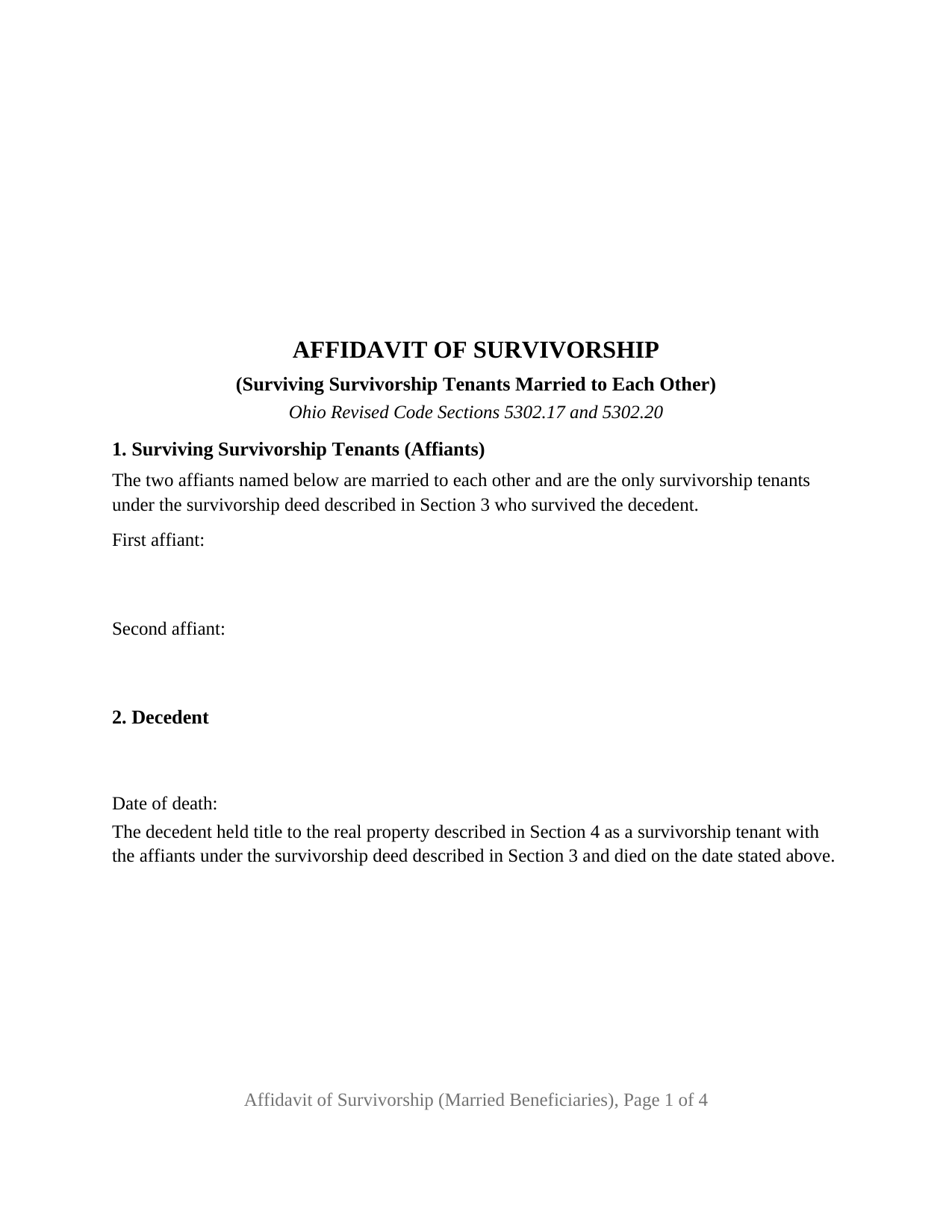
About the Ohio Affidavit of Survivorship (Married Beneficiaries)
How to Use This Form
- Select your county from the list
- Download the county-specific form
- Fill in the required information
- Have the document notarized if required
- Record with your county recorder's office
What Others Like You Are Saying
"Sorry that this a little late. I'm VERY HAPPY with everything. The deeds paperwork was just what I w…"
"So helpful and quick! The response time and kindness was amazing! The steps were easy to follow as w…"
"Great site with the forms I needed"
"I found the information easy to understand, and the forms to be correct for my needs."
"The site was easy to use, I just wasn't sure which of all these documents I needed."
4.8/5 from 4,831 reviews. Read all
When a three person Ohio survivorship deed loses one tenant and the two who remain are married to each other, the record needs one affidavit with two affiants. This Ohio Affidavit of Survivorship (Married Beneficiaries) is that instrument: two surviving survivorship tenants who are married to each other swear to the death of the third tenant, and the county auditor and county recorder carry the title forward in their two names under Ohio Revised Code Section 5302.17.
Two survivors, one marriage, one recital
The form fixes its configuration as affidavit text rather than leaving it to a blank. Section 1 recites that the two affiants are married to each other and are the only survivorship tenants under the described deed who survived the decedent; the names and mailing addresses of the two spouses are the only entries there. The elements Section 5302.17 asks the affidavit to recite follow under their own headings: the decedent and date of death, the survivorship deed by date and recording reference, and the county, legal description, parcel number, and street address. A certified copy of the death certificate accompanies the affidavit, and the sworn statement in Section 5 says so.
The pattern the form recites appears where a parent took title with an adult child and the child's spouse under a survivorship deed and the parent has died, and where spouses and a relative or friend held under a three name deed and that third tenant has died. The form is not set up as an affidavit by a single survivor, by two survivors who are not married to each other, or by three or more survivors; each of those presents a different recital and a different count of signatures and certificates.
What changes when the third tenant dies
Nothing in the affidavit moves title. Section 5302.20(B) vested the decedent's share proportionately in the surviving tenants at the instant of death; the affidavit records that event. What does change is which rule of Section 5302.20 now governs the couple. While the third tenant lived, the second paragraph of division (C)(5) kept the tenancy unaffected by a divorce, dissolution, or annulment between the spouses unless the court altered their interests. Once the entire title is held by two survivorship tenants who are married to each other, the first paragraph of division (C)(5) applies instead: a later termination of the marriage converts the title to a tenancy in common unless the judgment expressly states that the survivorship continues. The recorded affidavit is the first instrument of record that shows the title in exactly that form.
Two affiants, two jurats
Both spouses sign, and the form carries a separate verification on oath or affirmation for each of them. An affidavit is sworn, so each certificate is a jurat, the certificate Section 147.542(C)(3)(b) describes with the words sworn to and subscribed before me, and not an acknowledgment; Section 147.542(D) keeps the two certificates to their separate acts. The two certificate layout is the form's design rather than a statutory command: it lets the spouses swear on different dates, before different officers, or in different states, with each certificate's venue lines recording where that oath was administered, and the form preprints no state on either venue line for that reason.
Exempt at the auditor, recorded at the recorder
The affidavit is presented to the county auditor and then filed with the county recorder of the county where the land lies. At the auditor, the transfer to surviving survivorship tenants is exempt from the state conveyance fee under Section 319.54(G)(3)(n), which keeps it outside any county permissive transfer tax under Section 322.01 as well; the auditor takes the Department of Taxation's exemption statement, form DTE 100EX, and the fifty cent transfer fee of Section 319.54(G)(2), and enters the address from Section 1 on the tax list under Section 319.20. At the recorder, the affidavit is recorded in the official records at the fee of Sections 317.32 and 317.36, thirty four dollars for the first two pages and eight dollars for each page after that before any county surcharge. The form is built to the standard format of Section 317.114 and runs four recorded pages.
The package contains the fillable affidavit, a completed example built on a Hamilton County fact pattern, and the guide that covers each numbered section, both certificates, and the auditor and recorder steps. The description and the guide describe the form and the governing Ohio law in general terms and are not legal advice.
Important: County-Specific Forms
Our affidavit of survivorship (married beneficiaries) forms are specifically formatted for each of the 88 counties in Ohio.
After selecting your county, you'll receive forms that meet all local recording requirements, ensuring your documents will be accepted without delays or rejection fees.