Ohio Affidavit of Survivorship (Contingent Beneficiary)
County Specific Legal Forms Validated as recently as October 23, 2026 by our Forms Development Team
About the Ohio Affidavit of Survivorship (Contingent Beneficiary)
How to Use This Form
- Select your county from the list
- Download the county-specific form
- Fill in the required information
- Have the document notarized if required
- Record with your county recorder's office
What Others Like You Are Saying
"I found a lot of useful information regarding the Lady Bird Deed and feel it will serve my needs as …"
"Great service fast and easy."
"This is an excellent resource. I was surprised because the price is so low I thought the products mi…"
"Worked great. Not being real tech savey was no problem."
"Service was fantastic. So helpful and they promptly get back with you. No reason to drive if you are…"
4.8/5 from 4,830 reviews. Read all
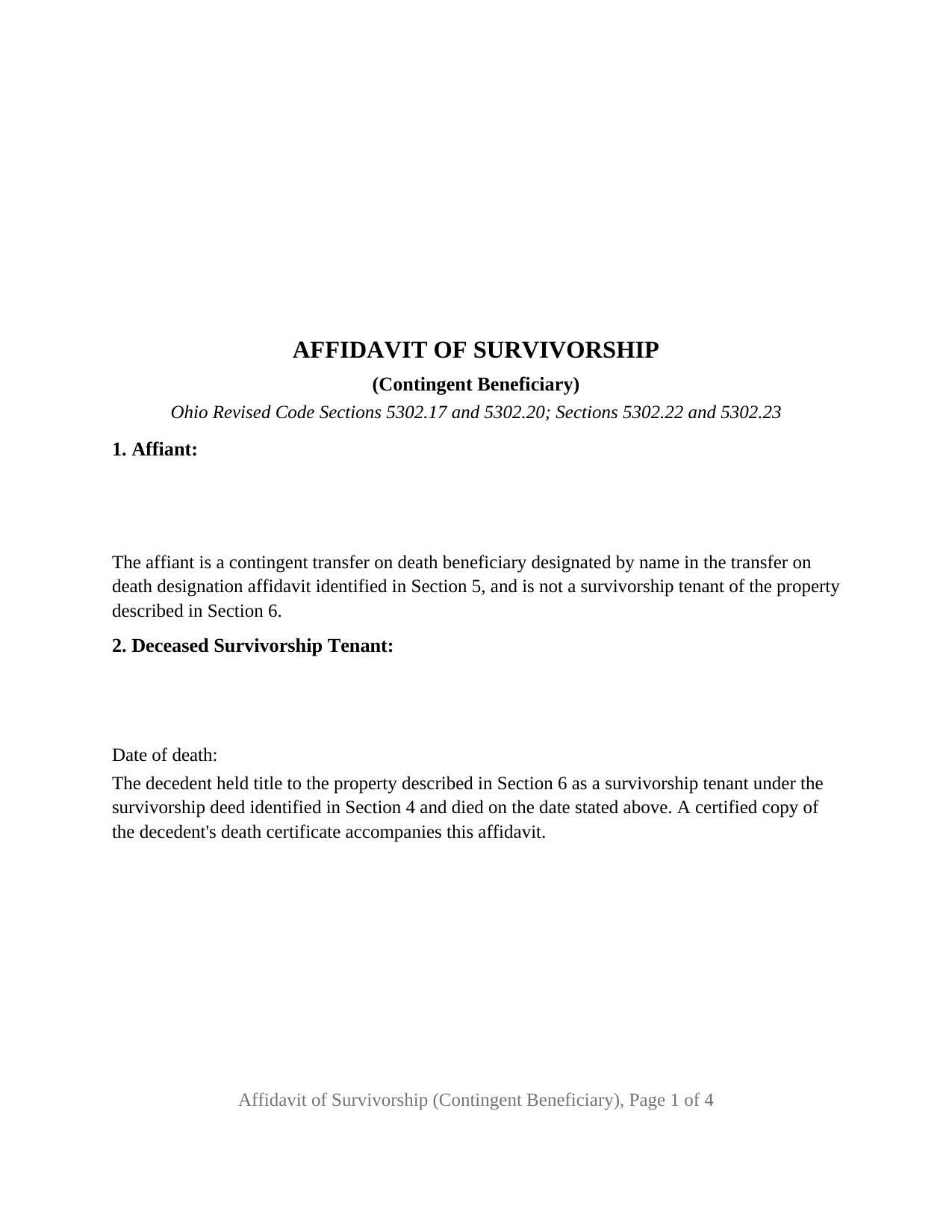
Most Ohio survivorship affidavits are sworn by the co-owner who outlived the other. This one is sworn by someone else: a contingent transfer on death beneficiary who, after both survivorship tenants have died and the first-named beneficiary did not survive, records the first death so the county records can carry title forward. The Ohio Affidavit of Survivorship (Contingent Beneficiary) is built for exactly that affiant under Ohio Revised Code Section 5302.17, with the affiant's capacity printed as fixed text.
An affiant who is not the survivor
Section 5302.17 lets the death of a survivorship tenant be recorded by an affidavit accompanied by a certified copy of the death certificate, and it says nothing about who swears to it. That silence is what makes this configuration possible. The affidavit identifies the affiant by name and address and then states, as preprinted text, that the affiant is a contingent transfer on death beneficiary designated by name in a recorded transfer on death designation affidavit and is not a survivorship tenant of the property. The surviving tenant whose title the affidavit records is named with a last known address in a separate section, even though in this pattern that tenant has since died as well.
Why a contingent beneficiary needs the first death on record
Section 5302.22(C)(2) sets the order of events when survivorship tenants record a transfer on death designation affidavit: at the first death, title vests in the surviving tenant; at the last tenant's death, it vests in the designated beneficiaries. Section 5302.23(B)(2) allows the designation to name contingent beneficiaries, and division (B)(1) sends a predeceased beneficiary's share to them. When the first death was never recorded, the auditor's tax list and the recorder's index still show both original tenants. This affidavit supplies the missing step, recording that the decedent's title vested in the surviving tenant under Section 5302.20(B); the beneficiary's affidavit of confirmation under Section 5302.222, prepared and recorded separately and not included in this package, then records the last death and the vesting in the beneficiary.
Two recorded instruments the affidavit identifies
Section 4 identifies the survivorship deed by recording date, instrument number or volume and page, and county, which doubles as the prior instrument reference Section 319.20 contemplates for anything the auditor transfers. Section 5 identifies the transfer on death designation affidavit the same way, and a fixed sentence beneath it states that the identified affidavit designates the affiant by name as a contingent transfer on death beneficiary under Section 5302.23(B)(2).
Sworn, not acknowledged
Because the instrument is an affidavit, its certificate is a jurat. Section 147.542(C)(3)(b) accepts a jurat that reads sworn to and subscribed before me or its substantial equivalent, and division (D) keeps a jurat and an acknowledgment from standing in for one another. The form carries one affiant block, one signature block, and one jurat, whose venue lines record where the oath was actually administered rather than where the property sits.
Auditor first, recorder second, no conveyance fee
The affidavit goes to the county auditor before the county recorder, with the certified death certificate accompanying it at both offices. A transfer to a surviving survivorship tenant under Section 5302.17 is exempt from the state conveyance fee under Section 319.54(G)(3)(n), so the auditor's exemption statement, form DTE 100EX, accompanies it rather than a statement of value. The form is laid out to the standard format of Section 317.114, including the three-inch blank top margin reserved on the first page.
What this configuration is and is not
The form recites one affiant acting as a contingent transfer on death beneficiary and one deceased survivorship tenant whose death left at least one tenant surviving. A grandchild named as the backup beneficiary behind a parent who died before the last grandparent, and a niece named behind an uncle who predeceased the aunt he was to take from, present the pattern this affidavit recites. The form is not set up for an affiant who is the surviving tenant, for a first-named transfer on death beneficiary, for an estate representative acting under letters, for registered land under Chapter 5309, or for a certificate of transfer under Section 2113.61.
The package includes the fillable affidavit form, a completed example filled in for a realistic Summit County fact pattern, and the guide that walks through every numbered section and both recordings. This description and the guide describe the form and the governing Ohio statutes in general terms; they are not legal advice.
Important: County-Specific Forms
Our affidavit of survivorship (contingent beneficiary) forms are specifically formatted for each of the 88 counties in Ohio.
After selecting your county, you'll receive forms that meet all local recording requirements, ensuring your documents will be accepted without delays or rejection fees.