Ohio Affidavit of Survivorship
County Specific Legal Forms Validated as recently as October 23, 2026 by our Forms Development Team
About the Ohio Affidavit of Survivorship
How to Use This Form
- Select your county from the list
- Download the county-specific form
- Fill in the required information
- Have the document notarized if required
- Record with your county recorder's office
What Others Like You Are Saying
"Love the fact that you can buy a form instead of a subscription. I would highly recommend this site."
"it would be nice to have explanation of all the forms required. For a first time estate DPOA, I feel…"
"Love this service! So easy and quick"
"Deeds.com is helpful to help me finish my forms and submit my forms to the County successfully. Very…"
"All very good"
4.8/5 from 4,836 reviews. Read all
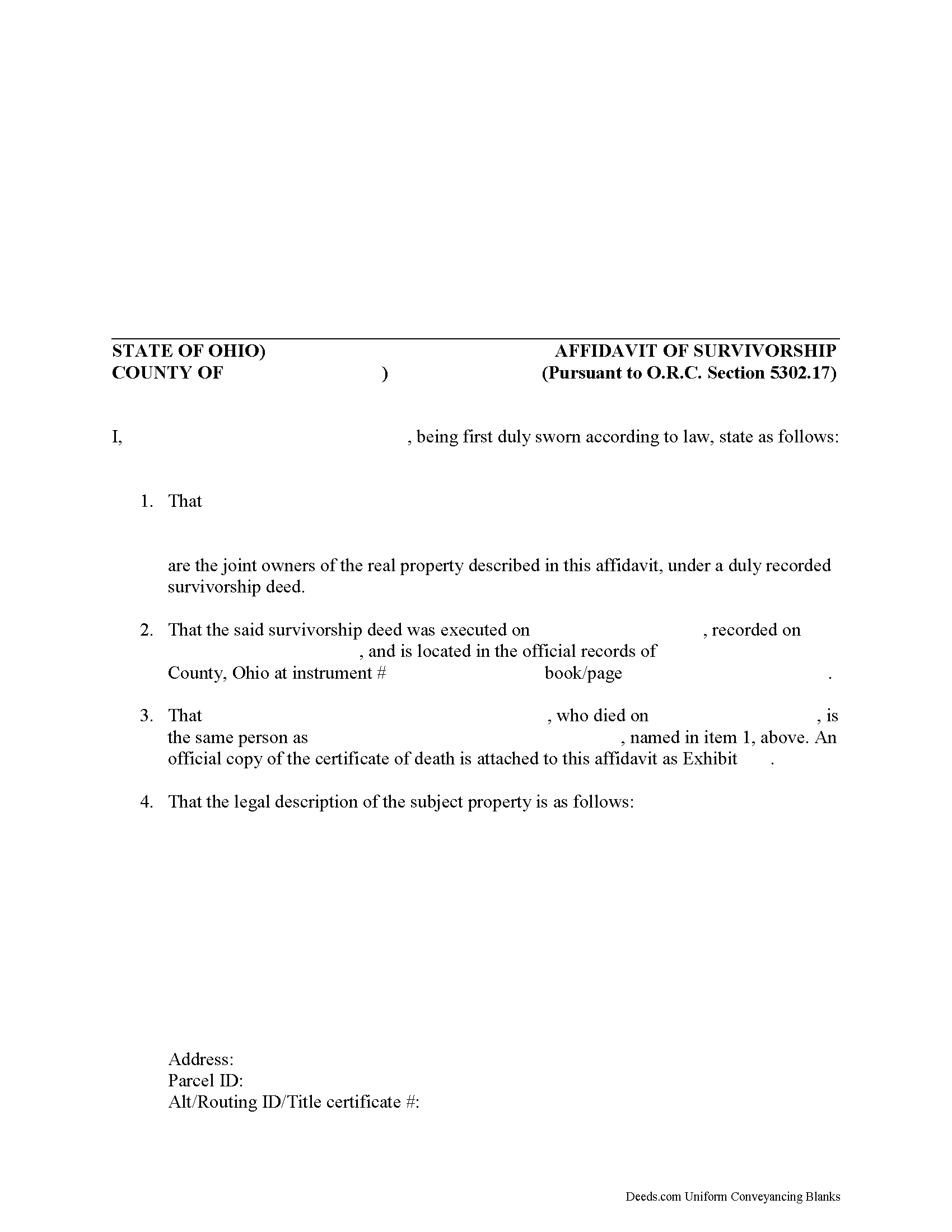
When an Ohio survivorship tenant dies, the surviving tenant already owns the property. Ohio Revised Code Section 5302.20 vests the decedent's title in the survivor at the moment of death, so there is nothing left to convey; what remains is to put that fact into the county records. The Ohio Affidavit of Survivorship is the instrument Section 5302.17 provides for that step: a sworn statement, accompanied by a certified copy of the death certificate, that the county auditor transfers and the county recorder records.
Title that moved at the moment of death
A survivorship deed in Ohio conveys to two or more people for their joint lives, remainder to the survivor of them. Section 5302.20(B) states what happens next: on the death of any tenant, the decedent's title vests proportionately in the surviving tenants, and when one tenant remains, that survivor is fully vested as the sole title holder. No new deed is signed. The affidavit transfers nothing itself; it records a transfer the statute made, which is why its contents are recitals rather than words of conveyance.
What Section 5302.17 asks the affidavit to recite
The affidavit recites the names of the other survivorship tenant or tenants, their address, the date of the decedent's death, and a description of the real property, and it is accompanied by a certified copy of the death certificate. This form carries each of those elements in its own numbered section and adds the two items Section 319.20 contemplates for any instrument the auditor transfers: the address of the person taking title, which the auditor enters on the tax list, and the prior instrument reference, the survivorship deed itself by date, recording reference, and county. The parcel number and street address sit beside the legal description so the auditor can match the affidavit to the tax record.
Two offices, one certified death certificate
Ohio splits real property records between the county auditor, who keeps the tax list, and the county recorder, who keeps the official records. Section 5302.17 routes the affidavit through both: it is presented to the auditor and filed with the recorder of the county where the property is located, with the certified death certificate accompanying it. Once recorded, the surviving tenant's name and address stand in the public record and on the tax duplicate, and the chain of title shows how the decedent's interest ended.
A fee exemption the auditor's form already names
A transfer to a surviving survivorship tenant under Section 5302.17 is exempt from the state real property conveyance fee under Section 319.54(G)(3)(n), and Section 322.01 keeps an exempt instrument outside any county permissive transfer tax as well. The auditor still asks for the Department of Taxation's exemption statement, form DTE 100EX, whose line 5(n) covers a transfer to a surviving tenant, and collects the fifty-cent transfer fee of Section 319.54(G)(2). The guide walks through that statement, the recorder's fee under Sections 317.32 and 317.36, and the standard format rules of Section 317.114 the form is built to, including the three-inch blank top margin on the first page and the one-and-one-half-inch top margin on later pages.
One affiant, one jurat
The form is the general configuration of this instrument: one affiant block, one signature block, and one jurat certificate, with nothing preprinted about who the affiant is to the decedent, how many tenants survive, or anyone's marital status; those facts are entries. The surviving tenant block is free form and holds one or more surviving tenants with their addresses, so a surviving spouse recording the first death, two siblings who held with a third under a survivorship deed, and an unmarried co-owner present the same pattern this affidavit recites. The jurat, not an acknowledgment, is the certificate an affidavit takes under Section 147.542(D), and its venue lines record where the oath is actually administered. The form is not set up as a certificate of transfer for property that passed through an estate under Section 2113.61, as the affidavit Section 5302.222 provides for a transfer on death beneficiary, or as a transfer of registered land under Chapter 5309; each of those is prepared separately and is not included in this package.
The package includes the fillable affidavit of survivorship form, a completed example filled in for a realistic Franklin County fact pattern, and the guide that walks through every numbered section and the recording steps. This description and the guide describe the form and the governing Ohio statutes in general terms; they are not legal advice.
Important: County-Specific Forms
Our affidavit of survivorship forms are specifically formatted for each of the 88 counties in Ohio.
After selecting your county, you'll receive forms that meet all local recording requirements, ensuring your documents will be accepted without delays or rejection fees.