Ohio Easement Deed (Two Individuals)
County Specific Legal Forms Validated as recently as October 28, 2026 by our Forms Development Team
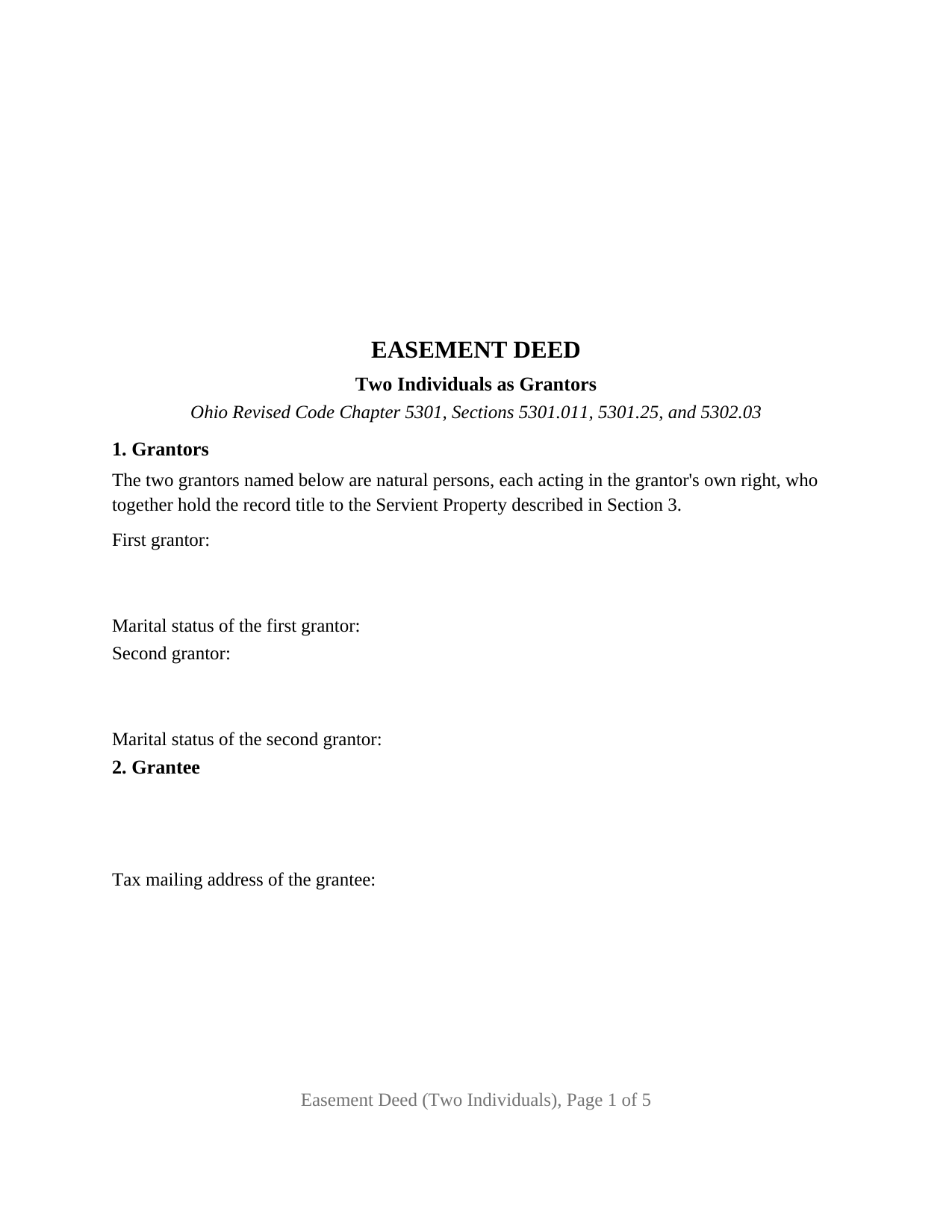
About the Ohio Easement Deed (Two Individuals)
How to Use This Form
- Select your county from the list
- Download the county-specific form
- Fill in the required information
- Have the document notarized if required
- Record with your county recorder's office
What Others Like You Are Saying
"I am new to needing this type of service, and the Deeds.Com team has been fantastic. Responsive, pro…"
"High rating, great site and forms were exactly what I needed. Thanks for being there for me."
"So thankful that I could just find the form and complete the estate I am working on for my parents. …"
"Quick and easy, but the 2MB file limit ended up causing some big headaches. Had I known the limit co…"
"This website was very handy and had everything I needed. Thanks!"
4.8/5 from 4,837 reviews. Read all
When two people hold the record title to an Ohio parcel, an easement across it is granted by both of them, and the deed has to say who they are, what each releases, and where each acknowledges. This Ohio Easement Deed (Two Individuals) is drawn for exactly that pair: two natural persons, each signing in that person's own right, who together hold the record title to the burdened parcel and grant a perpetual easement over a described part of it. The configuration is printed on the deed as fixed text.
Two record owners, printed on the deed
Section 1 of the form recites that the two grantors named below are natural persons, each acting in the grantor's own right, who together hold the record title to the Servient Property. Each grantor's name is a blank, and each grantor's marital status is a factual blank, because Ohio dower under Revised Code Section 2103.02 reaches a married grantor's conveyance of real property and county auditors look for the status on the face of a deed. Two siblings who inherited a lot together, two unmarried buyers holding as tenants in common, or spouses who both appear of record present the pattern this deed recites. The form is not set up as a deed by a sole owner, by an owner whose spouse holds no title and signs only for dower, by an entity, a trustee, or an attorney-in-fact, or by three or more owners.
What each grantor releases
The operative section grants, in the single word Section 5302.03 makes sufficient, a perpetual easement over, under, and across the Easement Area for the stated purpose, with the right of entry reasonably necessary to use it, then has each grantor release all rights of dower in the Easement Area. Where the two grantors are married to each other, that sentence covers both spouses' dower in each other's interest; where a grantor is married to someone who holds no title, the non-signing spouse's dower is untouched, which is the reason the status blank exists. The deed conveys the easement without covenants of title, the posture Section 5302.03 assigns to the word grant.
Appurtenant or in gross, by one entry
The deed describes the Servient Property, the Easement Area within it, and the Benefited Property the easement serves. The easement is appurtenant to the Benefited Property and runs with it to every later owner; where Section 5 identifies no Benefited Property, the deed states that the easement is in gross and belongs to the grantee. Ohio courts read an express easement by the language of its grant and treat a grant with no time limit as perpetual unless released or abandoned, so the purpose entry fixes what the grantee may do on the strip. The form also carries the Section 5301.25(B) survey statement and the Section 5301.011 prior instrument reference.
Each signer acknowledges on the page where that signer signed
The form carries two signature blocks, headed FIRST GRANTOR and SECOND GRANTOR, each with a printed name line under the signature, and each is followed on the same page by that grantor's own acknowledgment certificate in the Section 147.55(A) short form. The two grantors may therefore acknowledge on different days, before different notaries, or in different states. The pairing follows the Franklin County Auditor's current transfer standards, which place a notarial certificate on the same page as the signature it certifies, and it keeps the recorded deed to five pages at the Section 317.114 format.
Through the auditor, then the recorder
The deed goes to the county recorder of the county where the Servient Property lies; Section 5301.25 makes recording the notice that binds a later purchaser of the burdened land, since an easement left off the record is fraudulent as to a bona fide purchaser who buys without knowledge of it. Many Ohio auditors see the deed first: Franklin County stamps an easement Transfer Not Necessary without a conveyance form but will not stamp one that lacks a valid legal description, and Section 319.54(G)(3)(p) charges no conveyance fee on an easement whose value does not exceed one thousand dollars.
The package includes the fillable easement deed form for two individual grantors, a completed example filled in for a Franklin County sewer lateral easement between neighboring lots, and the guide that walks through every numbered section, the dower release, and the auditor and recorder steps. This description and the guide describe the form and the governing Ohio law in general terms; they are not legal advice.
Important: County-Specific Forms
Our easement deed (two individuals) forms are specifically formatted for each of the 88 counties in Ohio.
After selecting your county, you'll receive forms that meet all local recording requirements, ensuring your documents will be accepted without delays or rejection fees.