Ohio Easement Deed (Husband and Wife)
County Specific Legal Forms Validated as recently as October 29, 2026 by our Forms Development Team
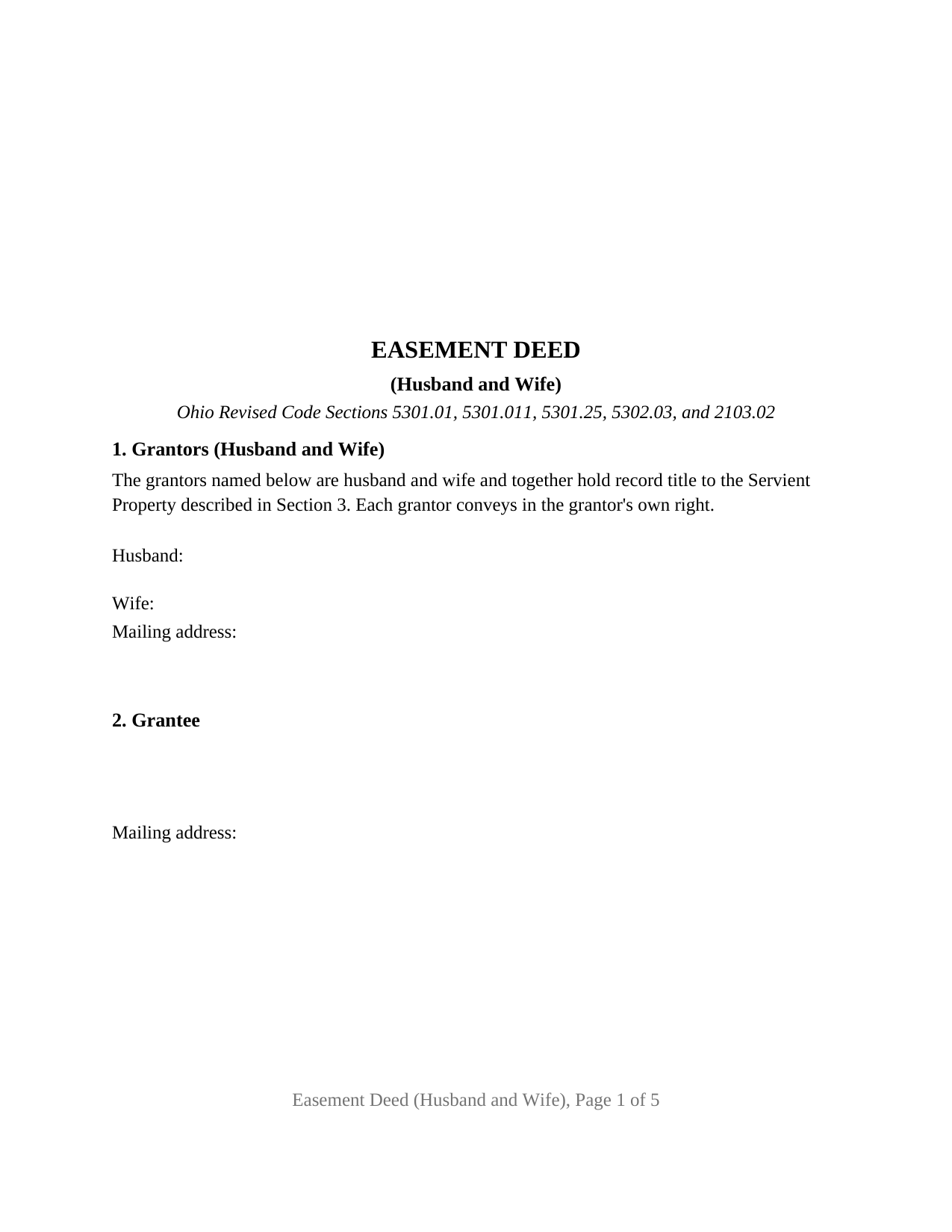
About the Ohio Easement Deed (Husband and Wife)
How to Use This Form
- Select your county from the list
- Download the county-specific form
- Fill in the required information
- Have the document notarized if required
- Record with your county recorder's office
What Others Like You Are Saying
"Fairly easy to use. Need to be able to find platts easy."
"I found The blank documents easy to use and the instructions informative and simple to follow. Thank…"
"EASY, FAST, AND CONVENIENT."
"Absolutely the best ever!!!"
"It was quick and easy."
4.8/5 from 4,837 reviews. Read all
This Ohio Easement Deed (Husband and Wife) puts both spouses on the grantor line. The two grantors are married to each other, together hold record title to the parcel the easement will cross, and each signs as a grantor conveying in the grantor's own right. Because each grantor is also the other grantor's spouse, the operative paragraph has each of them release all rights of dower in the Easement Area, so the deed needs no separate dower release block.
Why a married couple's easement needs both signatures
Section 2103.02 of the Ohio Revised Code gives each spouse dower: a life estate in one third of the real property the other spouse held as an estate of inheritance at any point in the marriage. When spouses hold the burdened parcel together, each owns an interest and each holds inchoate dower in the other's interest, so a grant signed by one of them leaves the other's ownership and dower untouched. This deed answers both points: Section 1 prints, as fixed deed text, that the grantors named below are husband and wife and together hold record title to the Servient Property, and Section 8 closes with the sentence by which each grantor, being the spouse of the other grantor, releases all rights of dower in the Easement Area. The signature section carries a block headed GRANTOR (HUSBAND) and a block headed GRANTOR (WIFE), each followed on the same page by that grantor's own acknowledgment certificate in the short form of Section 147.55(A), so the two may acknowledge on different dates or before different officers.
What the spouses grant together
The deed describes the couple's whole parcel as the Servient Property, with the recording reference of the deed by which they took title, the reference Section 5301.011 places in a recorded grant creating an easement, and the Easement Area as the part of it the easement occupies. The grant is a perpetual easement over, under, and across the Easement Area for the purpose Section 6 states, with the right of entry reasonably necessary to exercise it. Where Section 5 names a Benefited Property, the easement is appurtenant to that land and runs with it to every later owner of each parcel; where Section 5 reads None, the grantee holds the easement in gross. The grantors keep every use of the strip that does not interfere with the easement, and because Section 5302.03 provides that no covenant is implied from the word grant, the deed says on its face that it carries no covenant of title.
The configuration this deed recites
The form recites exactly two grantors, spouses who are both record owners. A married couple granting a well and water line easement across the back of their lot to the farm next door, and spouses who hold their home as survivorship tenants opening an access and utility strip to a landlocked rear lot, present the husband-and-wife pattern this deed recites. A parcel titled in one spouse alone, with the other spouse signing only to release dower, is a one-grantor pattern with a separate release and is not what this deed is set up as. Nor is the deed set up as a conveyance by unmarried co-owners, by a corporation or limited liability company, by a trustee, by an agent under a power of attorney, or by three or more record owners. The deed states no maintenance, cost-sharing, or termination terms.
Recording in the county where the land lies
The acknowledged deed is recorded with the county recorder where the Servient Property is situated; under Section 5301.25 an unrecorded deed is fraudulent as to a later bona fide purchaser without knowledge of it. County auditors handle easements differently: Franklin County's conveyance standards effective March 2, 2026, list easements among the non-transfer documents the auditor stamps Transfer Not Necessary without a conveyance fee form, and where a county instead processes the easement on a conveyance fee statement, Section 319.54(G)(3)(p) exempts an easement or right-of-way whose value does not exceed one thousand dollars from the state conveyance fee.
The package includes the fillable Ohio Easement Deed (Husband and Wife) form, a completed example in which a Summit County couple grants an access and utility easement across the easterly twenty feet of their lot to a rear lot's owners, and the guide covering every numbered section, the dower release, notarization, and recording. The form, the example, and the guide describe the instrument and the governing Ohio statutes in general terms; they are not legal advice.
Important: County-Specific Forms
Our easement deed (husband and wife) forms are specifically formatted for each of the 88 counties in Ohio.
After selecting your county, you'll receive forms that meet all local recording requirements, ensuring your documents will be accepted without delays or rejection fees.