Ohio Easement Deed (Entity Easement Holder)
County Specific Legal Forms Validated as recently as October 29, 2026 by our Forms Development Team
About the Ohio Easement Deed (Entity Easement Holder)
How to Use This Form
- Select your county from the list
- Download the county-specific form
- Fill in the required information
- Have the document notarized if required
- Record with your county recorder's office
What Others Like You Are Saying
"Thanks for advertising the forms and sharing to the public for easy access. I have been looking for …"
"This service is so good, quick, reasonably priced! I would use Deeds.com again!"
"Very easy to work with. A lot less money than a lawyer."
"I was happy with the quick response to obtain the requested forms. Effective and easy website to use…"
"quick and easy"
4.8/5 from 4,837 reviews. Read all
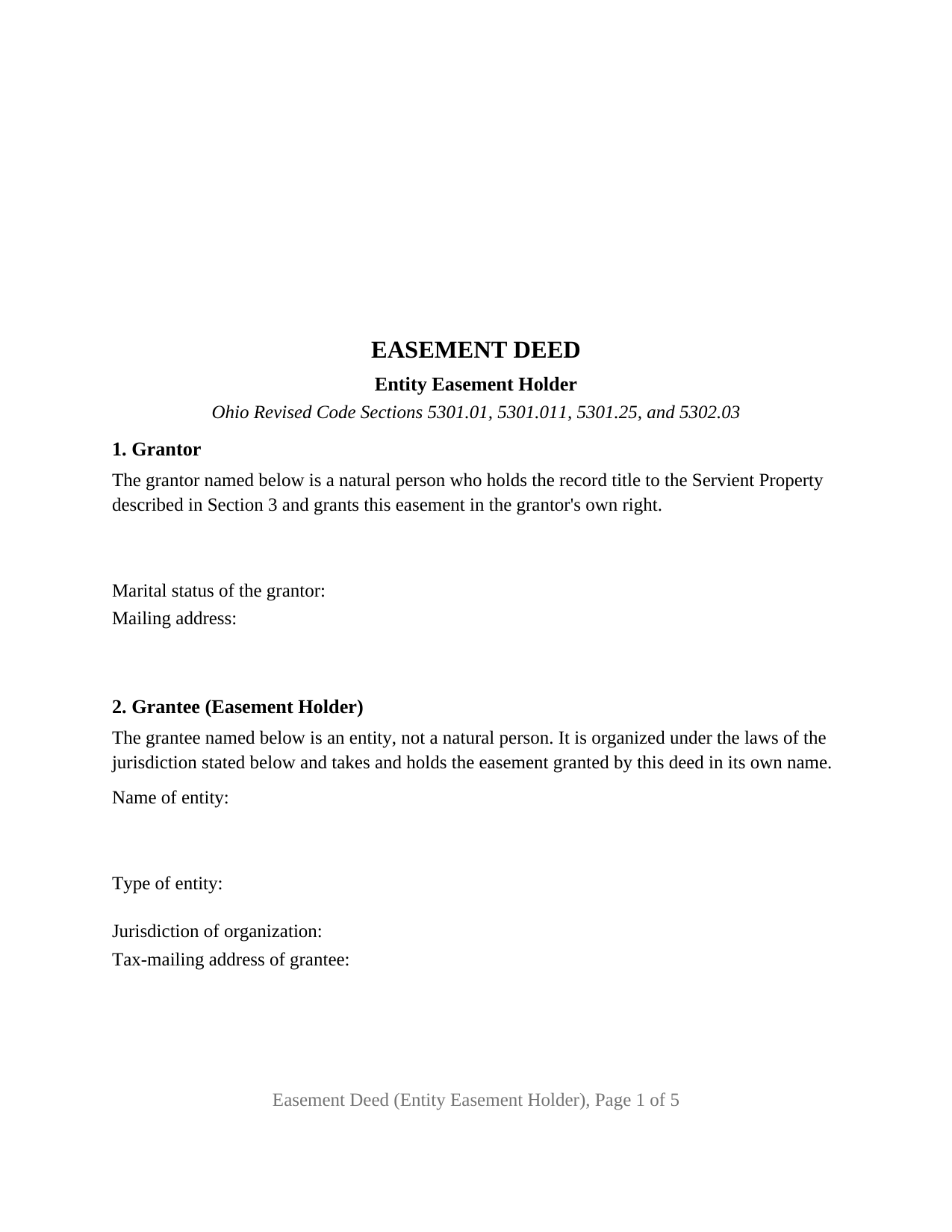
When the party taking an Ohio easement is a company rather than a person, the deed has to name an organization exactly, say what kind of organization it is, and speak of successors and assigns instead of heirs. This Ohio Easement Deed (Entity Easement Holder) is drawn for that grantee: a corporation, limited liability company, partnership, association, or other entity receiving a perpetual easement over part of a parcel and holding it in its own name. One natural-person owner of record is the grantor, and the deed carries a dower release for the grantor's spouse.
A grantee that is an organization
Section 2 of the deed prints, as fixed text, that the grantee is an entity and not a natural person, organized under the laws of the jurisdiction stated and taking the easement in its own name. Four entries follow: the entity's exact registered name, its type, its jurisdiction of organization, and the tax-mailing address Section 319.20 of the Ohio Revised Code asks the county auditor to carry for a grantee. Section 1706.04 makes a limited liability company a separate legal entity, and Section 1701.13(F)(1) lets a corporation acquire and hold any interest in property. The grantee does not sign; under Section 5301.01 the grantor signs and acknowledges.
Successors and assigns, appurtenant or in gross
The operative section grants to the grantee, its successors and assigns, a perpetual easement over, under, and across the described Easement Area for the stated purpose, with the right of entry reasonably necessary to exercise it. Where Section 5 names a Benefited Property, the easement is appurtenant to that land and runs with it; where Section 5 reads None, the easement is in gross, held by the entity in its own name, its rights extending to successors and assigns. In Stone Collector, Inc. v. N.E. Ohio Natural Gas Corp., 2023-Ohio-2650, the Eleventh District observed that easements of a commercial character, like a gas pipeline, are easements in gross, while repeating the description of an easement in gross as personal to its grantee; the deed's successors-and-assigns language is the parties' written statement on that point. The word grant carries no covenant of title under Section 5302.03, and the deed says so.
What the configuration recites, and what it does not
Section 1 recites exactly one grantor, a natural person holding the record title to the burdened land and granting in that person's own right; marital status is a factual entry because dower under Section 2103.02 reaches a married grantor's real property, and Section 8 has the spouse release all rights of dower in the Easement Area, with its own signature block and acknowledgment certificate, left empty for an unmarried grantor. A homeowner granting an underground fiber-optic corridor to a telecommunications company, a farm owner granting a pipeline right-of-way to a gas company, and a lot owner granting an access strip to an incorporated homeowners association present the pattern this deed recites. The form is not set up as a deed by two record owners, by an entity or trustee grantor, by an attorney-in-fact, or to a natural-person grantee.
The conveyance fee follows the price of the strip
Because an easement is often bought rather than given, the consideration entry sits inside the granting sentence, and that figure drives the auditor's paperwork. Section 322.01(D) defines a deed for county transfer-tax purposes as any instrument granting an interest in real property, which reaches a grant of easement. Section 319.54(G)(3)(p) exempts an easement or right-of-way whose value does not exceed one thousand dollars from the state conveyance fee; above that figure the grantor pays ten cents per hundred dollars of value, plus any county tax of up to thirty cents per hundred under Section 322.02, on a DTE 100 statement filed under Section 319.202. The deed is then recorded with the county recorder where the parcel lies, on pages laid out to Section 317.114 and carrying the Section 5301.011 prior instrument reference; under Section 5301.25 an unrecorded easement is fraudulent as to a later bona fide purchaser without knowledge of it.
The package contains the fillable easement deed form, a completed example in which a married Summit County homeowner grants a fiber-optic conduit easement to an Ohio limited liability company and her spouse signs the dower release, and the guide that walks through every numbered section, the dower release, notarization, and the auditor and recorder steps. The form, the example, and the guide describe the instrument and Ohio law in general terms; they are not legal advice.
Important: County-Specific Forms
Our easement deed (entity easement holder) forms are specifically formatted for each of the 88 counties in Ohio.
After selecting your county, you'll receive forms that meet all local recording requirements, ensuring your documents will be accepted without delays or rejection fees.