Ohio Easement Deed (Individual)
County Specific Legal Forms Validated as recently as October 28, 2026 by our Forms Development Team
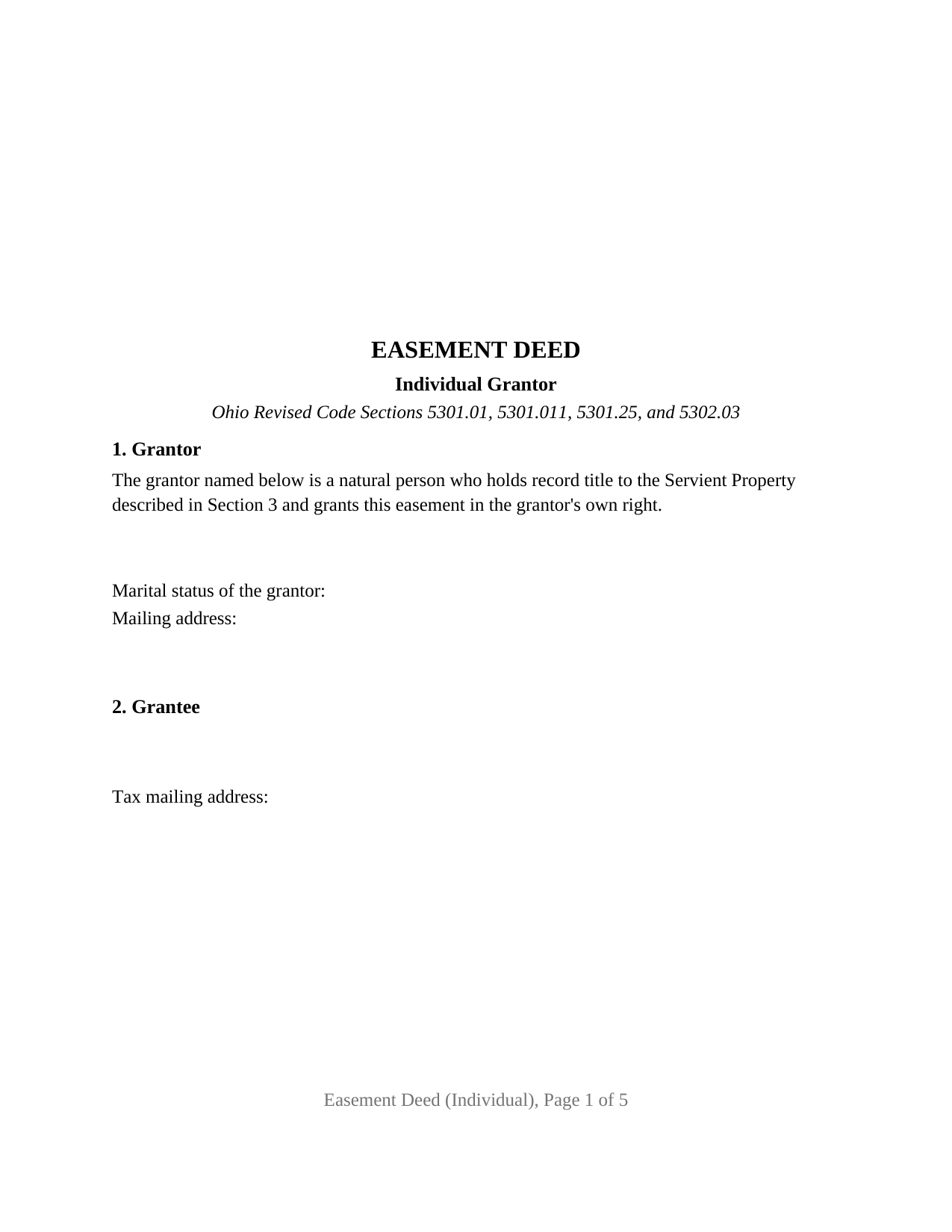
About the Ohio Easement Deed (Individual)
How to Use This Form
- Select your county from the list
- Download the county-specific form
- Fill in the required information
- Have the document notarized if required
- Record with your county recorder's office
What Others Like You Are Saying
"Straight forward easy to understand completing my document. The guide readily explained filing all p…"
"Always total satisfaction when information is needed. Request for information provided quickly from …"
"Great selection of documents. Properly formatted form also included great instructions and the examp…"
"nice & easy, site needs to have notification as to security of credit card info. who and how?"
"Straight forward, very fair price with excellent instructions and example. I am very pleased with yo…"
4.8/5 from 4,837 reviews. Read all
This Ohio Easement Deed (Individual) is built around one signature: the grantor is a single natural person who holds record title to the burdened land and grants the easement in the grantor's own right, with no co-owner, entity, trustee, or agent signing. Section 1 prints that configuration as fixed deed text; the open grantor entries are the name, the marital status, and a mailing address.
One grantor, with dower handled on the same deed
Ohio dower under Section 2103.02 of the Revised Code gives a spouse a life estate in one third of the real property of which the other spouse was seized as an estate of inheritance during the marriage, and property conveyed during the marriage stays subject to it unless the spouse has relinquished dower; Section 5301.04 applies the deed signing rules to a deed of any interest of a married person in real property. This form answers that with Section 10, a dower release headed Dower Release by Spouse of Grantor: the spouse's name goes in the blank, the printed sentence releases all rights of dower in the Easement Area, and the spouse signs on a Signature of Spouse line that is followed by the spouse's own acknowledgment certificate. The spouse is not a grantor and conveys nothing. When the grantor is unmarried, Section 10 and its certificate stay empty, and the marital status line in Section 1 reads unmarried.
A strip, a use, and the parcel it serves
The easement itself is defined by three entries. The Servient Property is the grantor's whole parcel, described as the grantor's own deed describes it, with the parcel number and the recording reference of that deed on the Prior Instrument Reference line that Section 5301.011 places in a recorded grant of easement. The Easement Area is the part of the parcel the easement occupies. The Benefited Property is the land the easement serves, and the deed's operative section makes the easement appurtenant to that land so it passes to each later owner of it; an entry of None in that section makes the easement one held in gross by the grantee personally. The grant is limited to the purpose the deed states. Uses of the strip that do not interfere with the easement stay with the grantor, and because Section 5302.03 implies no covenant from the word grant, the deed says so on its face and warrants nothing about title.
What this configuration is and is not set up as
The form recites exactly one record owner as grantor. A sole owner granting a buried storm drain line to the lot next door, and a widowed owner opening a walking path to a rear parcel, present the one-grantor pattern this deed recites; a married sole owner whose spouse signs Section 10 to release dower presents the same pattern with the dower block completed. A parcel held by two record owners, a grantor that is a corporation or limited liability company, a trustee conveying trust property, and an agent signing under a power of attorney are configurations this form is not set up as, each calling for different recitals and, for a representative signer, a different acknowledgment form under Section 147.55. The deed states no maintenance, cost sharing, or termination terms.
Notarization and the county recorder
The grantor acknowledges the deed before a notary public or another officer Section 5301.01 names, and the certificate on the form is the Ohio statutory short form for an individual under Section 147.55(A), completed by the officer with the contents Section 147.542 lists. The deed is then recorded with the county recorder where the burdened land lies; Section 5301.25 makes an unrecorded easement fraudulent as to a later purchaser of the land who buys without knowledge of it. The pages are laid out to the Section 317.114 standard, and the preparer's name Section 317.111 requires is on the last page. Whether the county auditor stamps an easement before the recorder takes it varies by county, and the guide describes the published practice of the largest counties.
Three items come in the package: the fillable Easement Deed (Individual) form, a completed example in which a married sole owner in Hamilton County grants a drainage easement and her spouse signs the dower block, and the guide covering each numbered section, the spouse's release, notarization, and recording. The form, the example, and the guide describe the instrument and Ohio law in general terms and are not legal advice.
Important: County-Specific Forms
Our easement deed (individual) forms are specifically formatted for each of the 88 counties in Ohio.
After selecting your county, you'll receive forms that meet all local recording requirements, ensuring your documents will be accepted without delays or rejection fees.