Ohio Grant Deed (Corporation Grantor)
County Specific Legal Forms Validated as recently as October 22, 2026 by our Forms Development Team
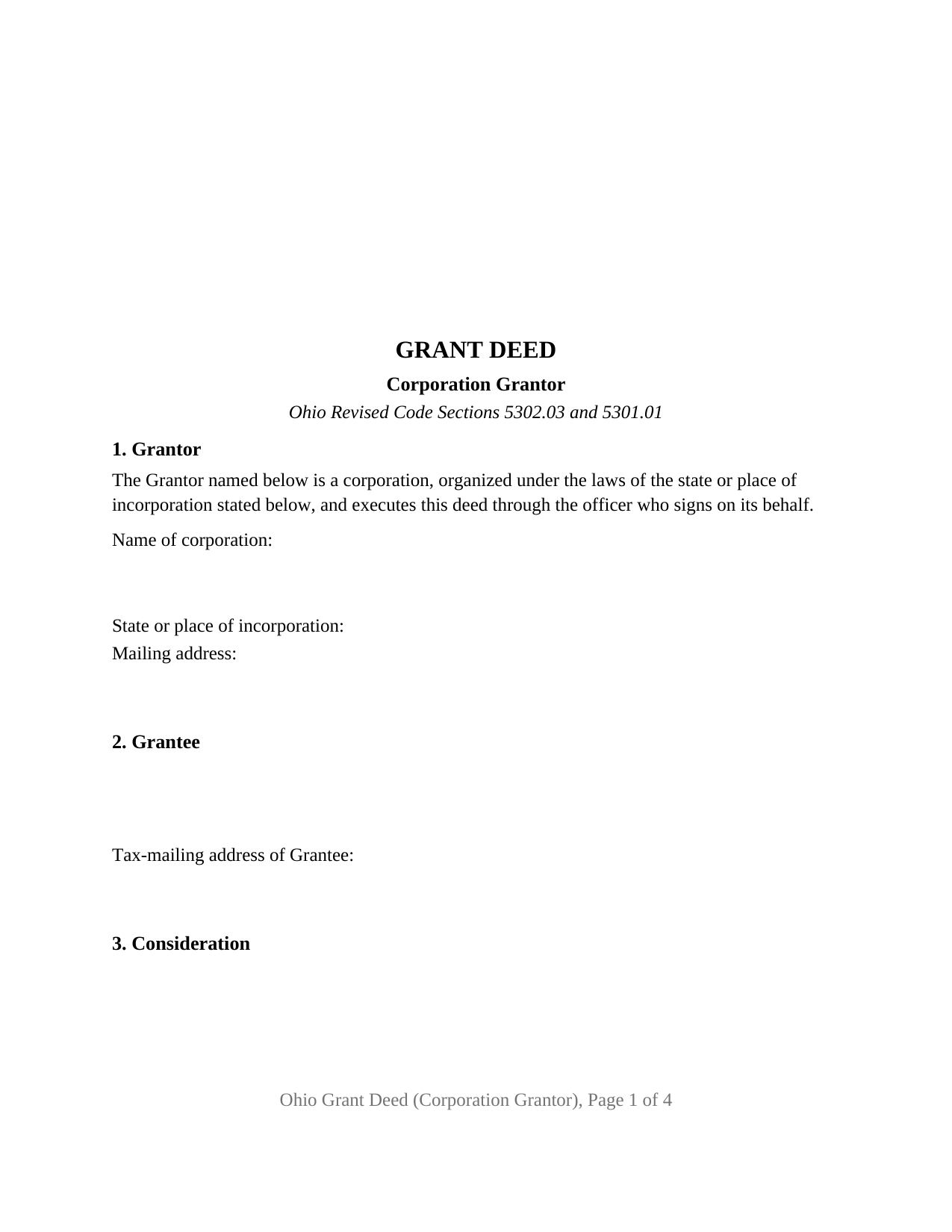
About the Ohio Grant Deed (Corporation Grantor)
How to Use This Form
- Select your county from the list
- Download the county-specific form
- Fill in the required information
- Have the document notarized if required
- Record with your county recorder's office
What Others Like You Are Saying
"Awesome same-day service!"
"Excellent service--I got just the information I needed quickly and reasonably priced. I am glad to k…"
"Very easy to find what I needed. Really liked the instructions included with the forms and also the …"
"it would be nice to have explanation of all the forms required. For a first time estate DPOA, I feel…"
"Exactly what I needed, at a reasonable cost."
4.8/5 from 4,829 reviews. Read all
When an Ohio corporation sells land, one officer signs for it, and the notary's certificate has to say so in the words the Revised Code prints for a corporation. This Ohio grant deed is built for exactly that signer: a corporation conveying real property through a single authorized officer, with grant as its operative word, no covenants of any kind, and the corporate acknowledgment of section 147.55(B) on its last page.
One officer, one signature, one certificate
The deed identifies the grantor by its corporate name, its state or place of incorporation, and its mailing address, and recites that it executes the deed through the officer who signs on its behalf. The signature section carries the corporation's name, a single block headed GRANTOR for the officer's signature, printed name, and date, and a line for the officer's title. Section 1701.64 of the General Corporation Law places the election of a corporation's officers with the directors and gives each officer the authority the directors determine, and section 1701.13 confirms the corporation's power to sell its property while providing that failure to affix a corporate seal does not affect the validity of any instrument. The deed carries no seal line; the authority behind the signature lives in the corporation's records, and a directors' resolution naming the signing officer commonly accompanies a corporate deed at an Ohio closing.
One acknowledgment certificate follows the statutory short form for a corporation: acknowledged before me by the named officer, with the officer's title, of the named corporation, a corporation of the stated place of incorporation, on behalf of the corporation. The certificate prints that sentence with its blanks in the statute's order, plus the venue, signature, printed name, seal, and commission lines section 147.542 requires.
No dower release on a corporate deed
Ohio's dower statute, section 2103.02, gives the spouse of a person who owned real property during the marriage a life interest in one third of it, and a married individual's deed carries a release of that interest. A corporation has no spouse, and the officer who signs for it owns none of the corporation's land, so this deed carries no spouse block and no dower release. The marital-status recital that follows a natural person's name in every Ohio statutory deed form has no place on this instrument, and the officer's own marital status is stated nowhere on it.
Grant, without a promise
Section 5302.03 makes grant a sufficient word of conveyance in Ohio and provides that no covenant is implied from it, and section 5301.02 passes the grantor's whole lawful interest through the conveyance. The deed states the result on its face, without covenants of any kind on the part of the Grantor, so the grantee takes what the corporation held, subject to the matters the deed lists. A board selling a warehouse to an unrelated buyer, a corporation distributing a parcel to a shareholder on dissolution, and a subsidiary conveying land to its parent present the pattern this deed recites; a limited liability company, a partnership, a trustee, an attorney-in-fact, or a natural person conveying in that person's own right presents a different signing structure the form is not set up for.
The grantee side and the county steps
The grantee block receives one or two grantees and whatever designation follows their names, including the survivorship words of section 5302.17; the completed example conveys to a married couple for their joint lives, remainder to the survivor of them. The deed carries the grantee's tax-mailing address and a Prior Instrument Reference under section 319.20, the survey statement of section 5301.25(B), and the preparer line section 317.111 requires. The county auditor receives the deed first with form DTE 100 or the exemption form DTE 100EX; two exemptions in section 319.54(G)(3) are particular to corporate grantors, a distribution in kind to a shareholder on reorganization or dissolution and a conveyance by a subsidiary to its parent for nominal consideration or the surrender of its stock. The recorder then records the deed in the section 317.114 format the form follows.
The package includes the fillable corporate grant deed, a completed example filled in for a Cuyahoga County fact pattern in which a Delaware corporation conveys a Parma residence, and a guide that walks through every numbered section, the corporate acknowledgment, the ways Ohio grantees may hold title, and the two county stops. This description and the guide explain the form and the Ohio statutes behind it in general terms; they are not legal advice.
Important: County-Specific Forms
Our grant deed (corporation grantor) forms are specifically formatted for each of the 88 counties in Ohio.
After selecting your county, you'll receive forms that meet all local recording requirements, ensuring your documents will be accepted without delays or rejection fees.