Ohio Grant Deed (Interspousal)
County Specific Legal Forms Validated as recently as October 22, 2026 by our Forms Development Team
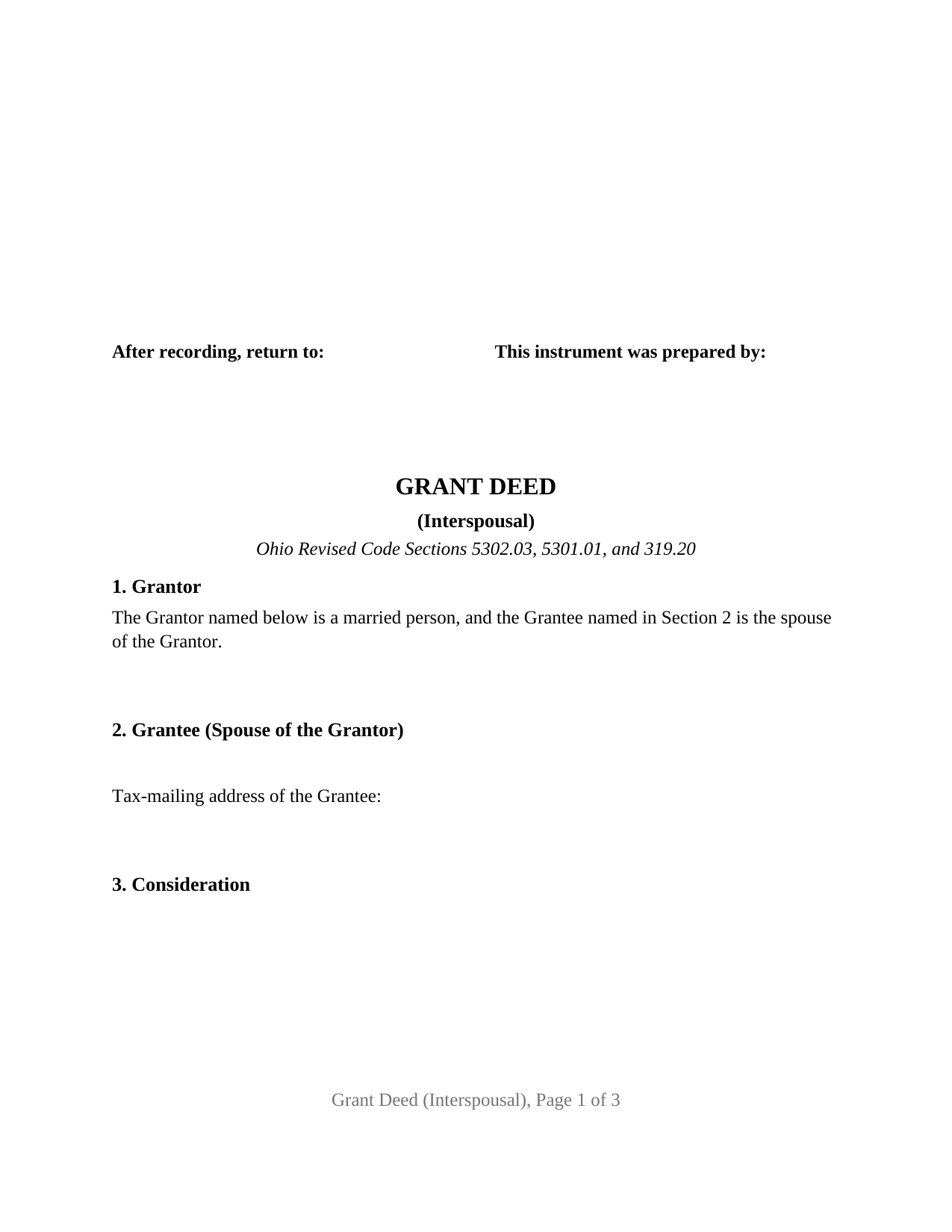
About the Ohio Grant Deed (Interspousal)
How to Use This Form
- Select your county from the list
- Download the county-specific form
- Fill in the required information
- Have the document notarized if required
- Record with your county recorder's office
What Others Like You Are Saying
"Very Easy to use, especially since the county recorder's office is closed due to COVID-19"
"Excellent site; easy to use"
"Very pleased. Responsive staff and fast recordation."
"Super easy to use. Very pleased. The turn around time was very fast. I have another one pending. Tha…"
"I am so happy with this service. I can not tell you. In about 30 minutes my records were recorded. E…"
4.8/5 from 4,829 reviews. Read all
When one Ohio spouse deeds real property to the other, the signature line that every other married grantor's deed carries is the one this deed leaves out. This Ohio grant deed is arranged for that transfer alone: a married grantor conveys to the grantor's own spouse, signs and acknowledges alone, and the deed explains on its face why no release of dower appears.
One signature line, and no dower release
Ohio keeps dower. Section 2103.02 of the Ohio Revised Code gives a spouse a life estate in one third of the real property of which the other spouse was seized during the marriage, which is why the Chapter 5302 statutory deed forms print a dower-release line for the grantor's wife or husband, and why Ohio title examiners treat a married grantor's deed without that release as an objection unless the omission is satisfactorily explained. On an interspousal transfer the person who would sign that line is the person receiving the property; the grantee takes the fee itself, and no third person holds dower through the marriage. This deed fixes the explanation as deed text: Section 1 recites that the Grantor is a married person and that the Grantee is the spouse of the Grantor, and the conveyance clause states that no release of dower by any other person is included. One GRANTOR signature block and one acknowledgment certificate follow, and the grantee signs nothing.
What the deed recites
The form recites one grantor, a married person, and one grantee, the spouse of the grantor, and it conveys all of the grantor's interest in the property. A spouse moving a house acquired before the marriage into the other spouse's name, a spouse conveying an undivided half interest so that title stands in one name, and a spouse making a gift of a parcel to the other spouse present the pattern this deed recites. With a single grantee the deed creates no cotenancy and no survivorship; the grantee holds in relation to anyone else of record exactly what the grantor held. The deed is not set up as a conveyance by two grantors, to someone other than the grantor's spouse, from one spouse to both spouses in survivorship form, or by a trustee, an entity, or an attorney-in-fact; the fixed recital would not describe any of those.
Grant, and nothing promised
The deed conveys with the word grant. Section 5302.03 makes grant a sufficient word of conveyance and provides that no covenant is implied from it, and this deed adds the statement the statutory quitclaim form carries, that it is made without covenants of any kind on the part of the Grantor. The grantee takes the grantor's interest as it stands, subject to whatever liens and matters of record bind it, and Section 3103.05 of the Revised Code lets a husband or wife enter into any transaction with the other spouse, subject to the rules governing confidential relations. The deed also carries the two items Section 319.20 requires for auditor transfer, the grantee's tax-mailing address and a Prior Instrument Reference to the grantor's source deed, and the preparer's name Section 317.111 requires.
The conveyance fee when spouses are the parties
Before the recorder will accept the deed, the county auditor endorses it under Section 319.202, and the deed arrives there with the conveyance fee statement, form DTE 100, or the exemption statement, form DTE 100EX. Two exemptions in Section 319.54(G)(3) reach a deed between spouses: division (d), a transfer made to evidence a gift between husband and wife, and division (m), a transfer for which no money or other valuable consideration readily convertible into money is paid and which is not a gift. A transfer between spouses for actual consideration pays the state fee of ten cents per hundred dollars of value and any county transfer tax under Chapter 322, and the auditor may ask for documents supporting a claimed exemption. The deed prints to the Section 317.114 format, three recorded pages with the three inch blank first-page margin the auditor and recorder stamp into, and its acknowledgment certificate carries the Section 147.55(A) short form.
The package contains the fillable interspousal grant deed, a completed example filled in for a Cuyahoga County transfer from husband to wife, and a guide that walks through each section, dower between spouses, the auditor's exemption codes, and the recording steps. The form, example, and guide describe the deed and the governing Ohio statutes in general terms; they are not legal advice.
Important: County-Specific Forms
Our grant deed (interspousal) forms are specifically formatted for each of the 88 counties in Ohio.
After selecting your county, you'll receive forms that meet all local recording requirements, ensuring your documents will be accepted without delays or rejection fees.