Ohio Grant Deed (Individual to Trust)
County Specific Legal Forms Validated as recently as October 22, 2026 by our Forms Development Team
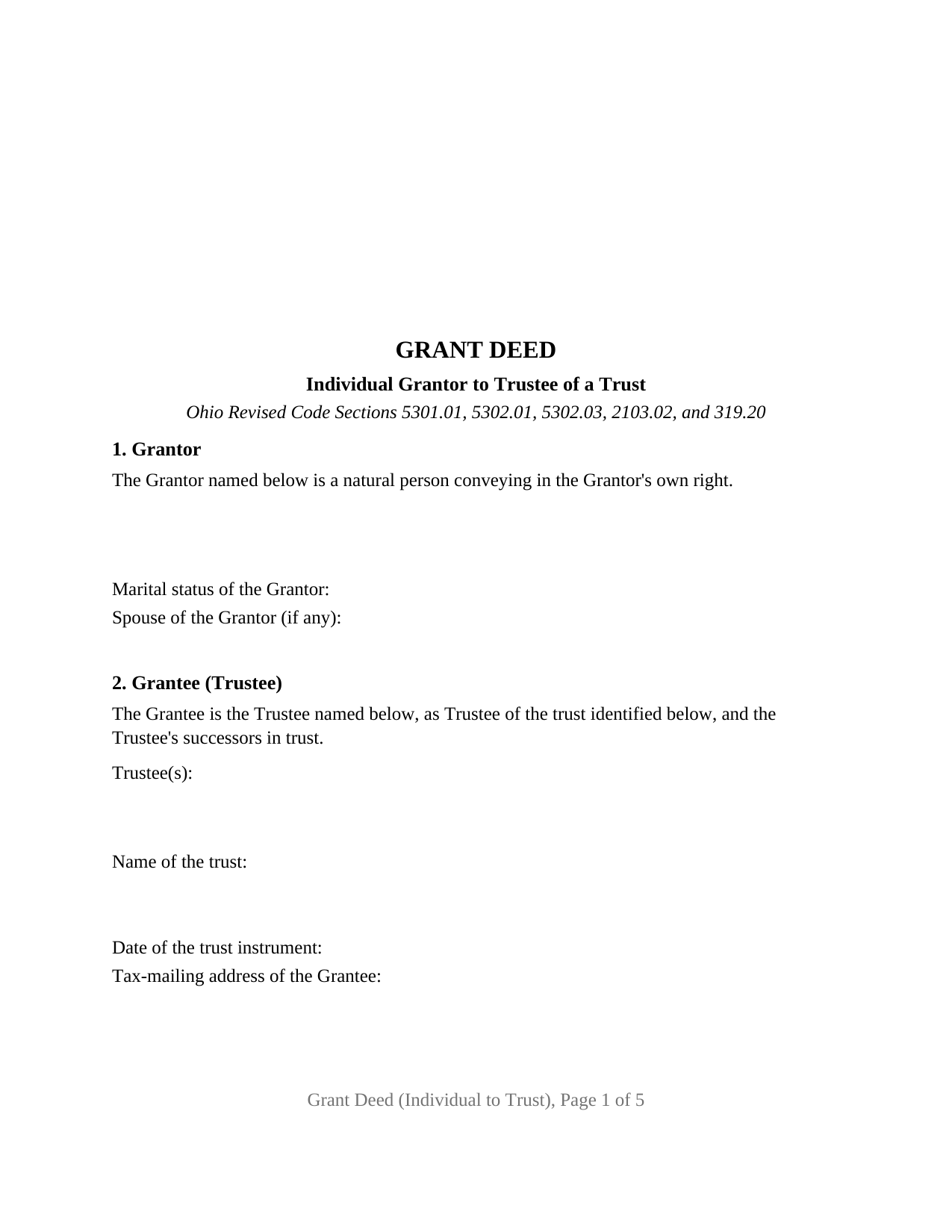
About the Ohio Grant Deed (Individual to Trust)
How to Use This Form
- Select your county from the list
- Download the county-specific form
- Fill in the required information
- Have the document notarized if required
- Record with your county recorder's office
What Others Like You Are Saying
"Site is SO easy to use. Thank you for such a valuable resource."
"Absolutely wonderful customer service. I am very pleased with the service I received and highly reco…"
"Very easy to navigate website. Quick filing, great communication. Saved me hundreds of dollars vs. f…"
"We have been very happy with all that Deeds have done very timely and helpful"
"Very Happy. Forms saved me from making some very silly mistakes had I done them on my own."
4.8/5 from 4,829 reviews. Read all
Funding a trust with Ohio real estate takes a deed to the trustee, and this Ohio grant deed is drafted for that one transfer: a single individual grantor conveying real property to the trustee of a named trust, and to the trustee's successors in trust, by the word grant and without covenants of any kind. A settlor moving a home into a revocable living trust is the transfer the form is built around.
A deed that names the trustee, not the trust
Ohio real property held in trust is titled in the trustee's name, so the grantee section of this deed asks for the trustee or co-trustees, the trust by its name, the date of the trust instrument, and the tax-mailing address the county auditor uses. The Revised Code has a cure for a recorded deed that names a trust instead of its trustee, section 5301.071(E), but the cure depends on a memorandum of trust describing the property being recorded in the same county, and the deed is drafted so the cure is never needed.
The memorandum of trust matters later. Section 5301.255, as amended by Senate Bill 101 effective June 16, 2026, provides that a memorandum of trust stating the trustee's name and address, the trust's date, and the trustee's powers over real property shall be of record when the trustee of a disclosed trust conveys any interest in real property. The memorandum is a separate instrument, recorded separately and not included in this package; the guide describes what it states.
Grant, with nothing promised
Section 5302.03 provides that grant is a sufficient word of conveyance and implies no covenant from it, and the deed says on its face that it is made without covenants of any kind on the part of the Grantor. The trustee takes the interest the grantor holds, as it stands, the ordinary posture of a transfer into the grantor's own trust, where a warranty would run from the settlor to the settlor's trustee.
One grantor, one marital status line, one spouse's release
The form recites exactly one grantor, a natural person conveying in the grantor's own right. The grantor's marital status is a factual entry after the name, in the place the section 5302.11 statutory form puts it, and a line for the grantor's spouse follows. Below the operative paragraph the deed carries two signature blocks, GRANTOR and SPOUSE OF GRANTOR, each with its own acknowledgment certificate in the section 147.55(A) short form, a layout choice rather than a statutory one. The spouse's block exists because section 2103.02 leaves a married owner's spouse with an inchoate life interest in one third of the owner's real property, an interest a lifetime conveyance carries along unless the spouse releases it; the deed states that the spouse who signs it releases all rights of dower in the Property, and an unmarried grantor leaves the spouse line, that block, and its certificate blank. A settlor conveying a residence to the settlor's own revocable trust, and a parent funding a trust for the parent's children with a parcel of land, present the one-grantor-to-trustee pattern this deed recites; two record owners conveying together, a trustee conveying out of a trust, and an attorney-in-fact signing for an owner present signing structures the form is not set up as.
The revocable trust exemption at the auditor
An Ohio deed goes to the county auditor before the recorder, with form DTE 100 or the exemption statement on form DTE 100EX, and section 317.22 keeps a deed out of the record until the auditor's stamp and transfer endorsement appear. Section 319.54(G)(3)(t) charges no conveyance fee on a transfer to a trustee of a trust when the grantor of the trust has reserved an unlimited power to revoke it, and section 5806.02(A) makes a trust created on or after January 1, 2007 revocable unless its terms expressly say otherwise. The deed carries the grantee's tax-mailing address and a Prior Instrument Reference because section 319.20 has the auditor transfer the parcel from an instrument bearing both, and its pages follow the section 317.114 format.
The package carries the fillable grant deed, a completed example worked through a Hamilton County transfer to a revocable living trust, and a guide that covers each numbered section, trust title beside Ohio's other forms of ownership, the spouse's dower release, and the auditor and recorder steps. The description and the guide treat the form and the Ohio statutes in general terms; neither is legal advice.
Important: County-Specific Forms
Our grant deed (individual to trust) forms are specifically formatted for each of the 88 counties in Ohio.
After selecting your county, you'll receive forms that meet all local recording requirements, ensuring your documents will be accepted without delays or rejection fees.