Ohio Grant Deed (LLC Grantor)
County Specific Legal Forms Validated as recently as October 22, 2026 by our Forms Development Team
About the Ohio Grant Deed (LLC Grantor)
How to Use This Form
- Select your county from the list
- Download the county-specific form
- Fill in the required information
- Have the document notarized if required
- Record with your county recorder's office
What Others Like You Are Saying
"Good documents good price saved me a lot of money and time."
"Why is Dade County not listed for the Lady Bird Deed?"
"excellent transaction...very informative prior to purchase.."
"The certification of trust looks fine to me. I printed it and filled it out and had it notarized tod…"
"Application is not well laid out. I guess it does the job but leaves a lot to be desired. Hard to fo…"
4.8/5 from 4,829 reviews. Read all
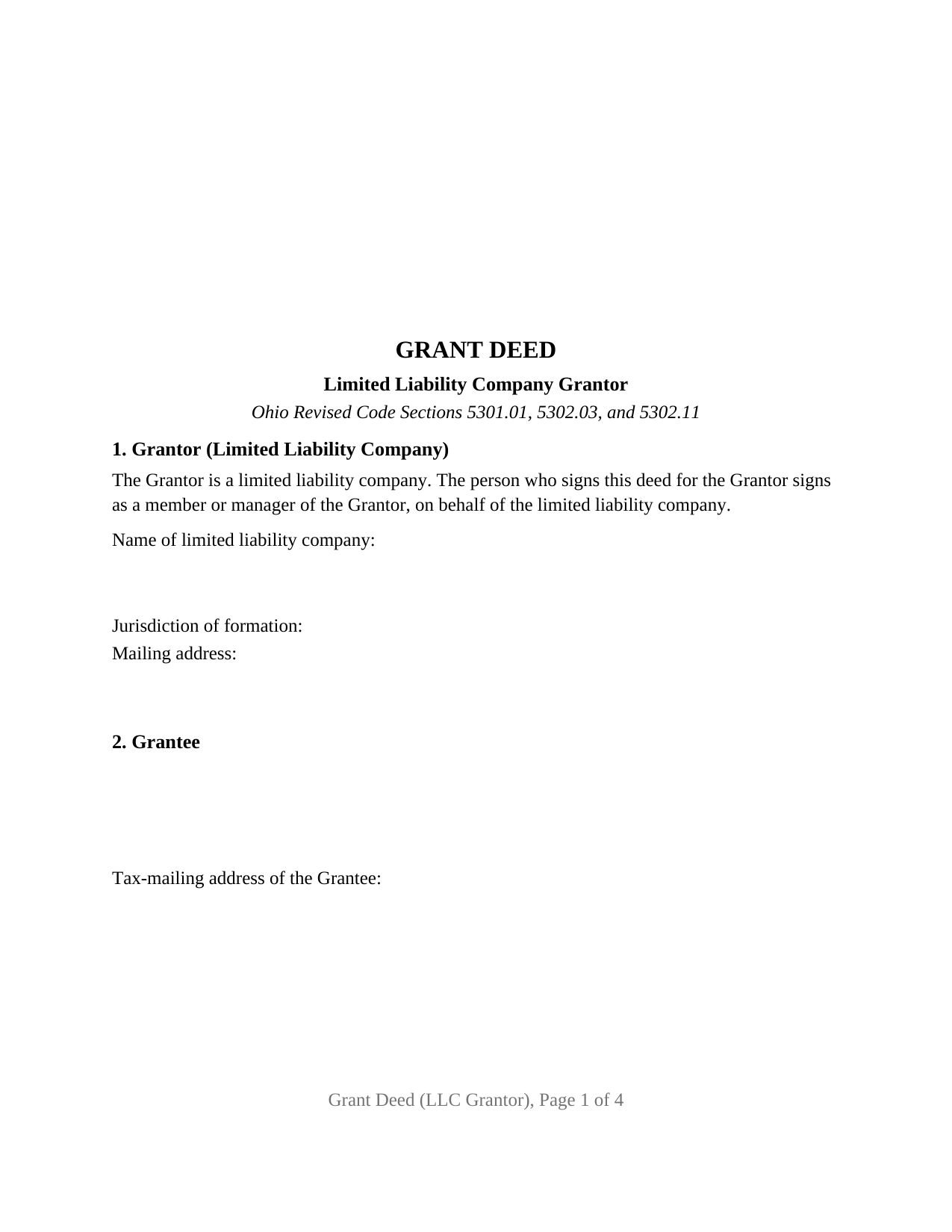
A limited liability company can own Ohio real estate in its own name, but it cannot hold a pen. This Ohio grant deed is drawn for that grantor: the company is named in the grantor section, one member or manager signs on its behalf, and one notary certificate in the Ohio statutory short form for a limited liability company closes the instrument. The deed conveys the company's interest to one or two grantees with the word grant as its operative word and without warranty covenants.
Who signs for the company
Chapter 1706 of the Revised Code, the Ohio Revised Limited Liability Company Act, answers the question every entity deed raises. Section 1706.18 provides that no person has the power to bind a limited liability company except as the operating agreement authorizes, as the members acting under section 1706.30 authorize, as a statement of authority filed under section 1706.19 provides, or as other law provides. The signature block on this deed is headed GRANTOR, BY ITS MEMBER OR MANAGER, with the company's name above it and the signer's title below, and Section 1 recites that the signer acts as a member or manager on behalf of the company. The authority itself lives in the operating agreement, a consent of the members, or a statement of authority on file with the Ohio Secretary of State.
A certificate that names the company twice
Ohio prints a separate acknowledgment form for each representative capacity, and section 147.55(C) is the one for a limited liability company. The certificate on this deed carries that form word for word: acknowledged on the stated date by the named member or managing member and title, of the named company, a limited liability company formed in the stated jurisdiction, on behalf of the limited liability company. The notary completes the venue, the date, and those three entries, then signs, affixes a seal, and states the commission expiration as section 147.542 requires; an acknowledgment taken outside Ohio before an officer authorized there is recognized under section 147.51.
No spouse, no dower line
Dower under section 2103.02 is a spouse's life estate in one third of the real property of which the other spouse was seized during the marriage. A limited liability company has no spouse, so this deed carries no marital status recital and no dower release.
Grant, and nothing promised
Under section 5302.03 the word grant conveys without any other words and implies no covenant; the covenant phrase that follows it is what makes an Ohio deed a general warranty, limited warranty, or fiduciary deed. This deed follows the structure of the section 5302.11 form and states that form's covenant posture on its face: the deed is made without covenants of any kind on the part of the Grantor.
What this deed recites
The form recites exactly one grantor, a limited liability company, with one signature block and one acknowledgment certificate. Its grantee section is open: one or two grantees, with whatever designation of ownership follows their names, from the tenancy in common section 5302.19 supplies by default to the survivorship words of section 5302.17. An Ohio limited liability company selling a rental house to a buyer, and a company distributing a parcel to its members at the end of its business, present the entity-grantor pattern this deed recites. A deed by a natural person, by two grantors, by a corporation, partnership, or trustee, or by an attorney-in-fact follows a different signing structure and a different section 147.55 certificate, and the form is not set up for three or more grantees.
Through the auditor, then to the recorder
Section 319.20 is the reason the deed carries the grantee's tax-mailing address and a Prior Instrument Reference to the deed by which the company took title: the county auditor needs both to transfer the parcel, and section 317.22 keeps the recorder from recording the deed until the auditor has stamped it. The conveyance fee statement, form DTE 100, or the exemption statement, form DTE 100EX, travels with the deed to the auditor.
The package contains the fillable grant deed for a limited liability company grantor, a completed example filled in for a fictional Franklin County company, and a guide covering each numbered section, the ways Ohio grantees may hold title, the Chapter 1706 authority rules, and the auditor and recorder steps. The description on this page and the guide describe the form and the Ohio statutes that govern it in general terms and are not legal advice.
Important: County-Specific Forms
Our grant deed (llc grantor) forms are specifically formatted for each of the 88 counties in Ohio.
After selecting your county, you'll receive forms that meet all local recording requirements, ensuring your documents will be accepted without delays or rejection fees.