Ohio Grant Deed (Individual Grantor by Attorney-in-Fact or POA)
County Specific Legal Forms Validated as recently as October 22, 2026 by our Forms Development Team
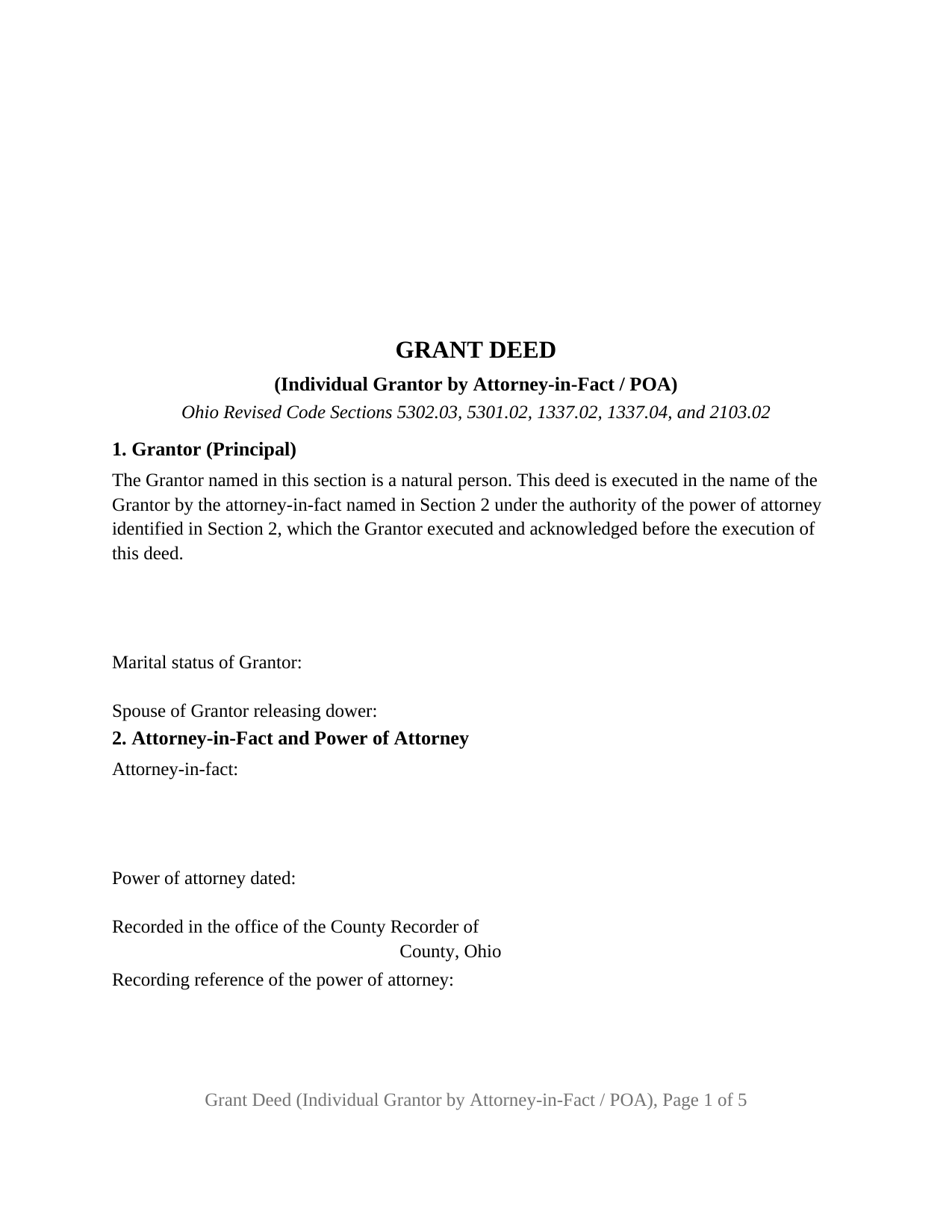
About the Ohio Grant Deed (Individual Grantor by Attorney-in-Fact or POA)
How to Use This Form
- Select your county from the list
- Download the county-specific form
- Fill in the required information
- Have the document notarized if required
- Record with your county recorder's office
What Others Like You Are Saying
"i also need a "NOTE" and this trust deed is not exactly what i wanted. it may work but not…"
"One of the best downloads ever. Very easy to do. For the price, well worth it. Thanks"
"Not knowing I could down load these forms, I first went to the local recording office thinking I cou…"
"No choice since the county does not seem to provide info you supplied."
"I needed to cut and paste my phone number with the dashes in order to use this website with my iPhon…"
4.8/5 from 4,832 reviews. Read all
When the owner of Ohio real property cannot sign a deed, an attorney-in-fact signs it for them, and the deed then carries three things an ordinary deed does not: the owner's name as grantor, the agent's signature in that name, and a recorded power of attorney ahead of it in the county records. This Ohio grant deed is built for that configuration: one individual Grantor conveying by an attorney-in-fact, with the word grant and no covenant, and a separate line for the Grantor's spouse to release dower.
The power of attorney goes on record first
Section 1337.04 of the Ohio Revised Code, rewritten by Senate Bill 94 in 2024, fixes the sequence: the power of attorney is executed and acknowledged by the principal before the deed, and recorded with the county recorder of the county where the land lies before the deed is recorded, a power recorded the same day counting as recorded first. Section 2 of the deed identifies that recorded power by date, county, and recording reference, so the recorder, the auditor, and a later title examiner find the agent's authority on the deed itself. The power itself answers to Ohio's Uniform Power of Attorney Act: general authority over real property under section 1337.45 reaches conveying with or without covenants, a gift takes an express grant under section 1337.42, and section 1337.30 ends the agent's authority at the principal's death.
Signing in the Grantor's name
Section 1337.02 requires a deed made under a power of attorney to contain the grantor's name and provides that it conveys the grantor's interest as fully as one the grantor signed in person. In the block headed ATTORNEY-IN-FACT FOR GRANTOR the agent signs as the statutory power of attorney form in section 1337.60 prints: the principal's name, by the agent's signature, as agent, with the agent's own name printed beneath. The acknowledgment that follows is not the ordinary one: it carries the section 147.55(E) short form, acknowledged by the agent as attorney in fact on behalf of the named principal, a certificate shape section 1337.03 confirms does not make the deed defective.
A spouse signs for dower in person
The Grantor's power of attorney authorizes the agent to act for the Grantor and no one else, and the dower interest section 2103.02 gives the Grantor's spouse in one third of the real property the Grantor was seized of during the marriage is the spouse's own. The deed therefore carries a second block, headed SPOUSE OF GRANTOR, in which the spouse signs in the spouse's own right and acknowledges in the section 147.55(A) individual short form, and its operative text states that each spouse of the Grantor who signs releases all rights of dower in the Property. For an unmarried Grantor that block and its certificate stay blank.
What this configuration recites
The form recites exactly one Grantor, a natural person, whose deed is executed in the Grantor's name by the attorney-in-fact named in Section 2 under the power of attorney identified there. It carries two signature blocks and two acknowledgment certificates of different statutory forms, and its grantee section receives one or two grantees with whatever designation of ownership follows their names. An adult child selling a parent's home under a durable power of attorney, and an agent conveying for an owner who is overseas, present the pattern this deed recites. A Grantor signing in person, two grantors, an entity or trustee grantor, an agent holding powers from both spouses, and three or more owners on either side each present a signing structure the form is not set up as.
Grant without covenants, then auditor, then recorder
The conveyance itself is the plain Ohio grant: section 5302.03 makes grant a sufficient word of conveyance and implies no covenant from it, and the deed states that it is made without covenants of any kind on the part of the Grantor. After signing, the deed goes to the county auditor with form DTE 100 or DTE 100EX for the fee and transfer endorsement, then to the recorder.
The package includes the fillable grant deed, a completed example filled in for a realistic Hamilton County fact pattern with the power of attorney recorded ahead of the deed, and a guide that walks through every numbered section, the Chapter 1337 rules on an agent's authority, the two certificates, and the recording steps. This description and the guide describe the form and the governing Ohio statutes in general terms; they are not legal advice.
Important: County-Specific Forms
Our grant deed (individual grantor by attorney-in-fact or poa) forms are specifically formatted for each of the 88 counties in Ohio.
After selecting your county, you'll receive forms that meet all local recording requirements, ensuring your documents will be accepted without delays or rejection fees.