Ohio Survivorship Deed (Corporation Grantor)
County Specific Legal Forms Validated as recently as October 21, 2026 by our Forms Development Team
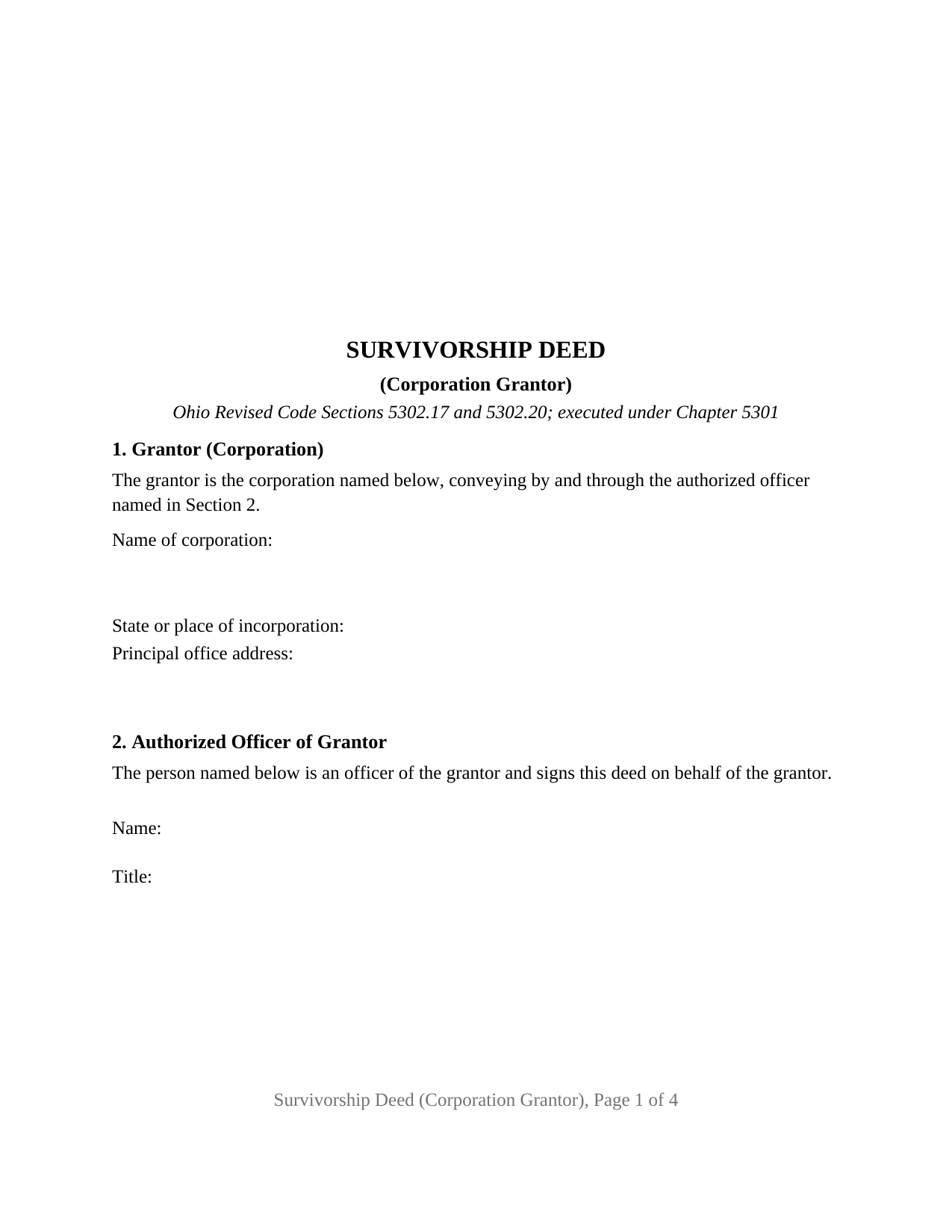
About the Ohio Survivorship Deed (Corporation Grantor)
How to Use This Form
- Select your county from the list
- Download the county-specific form
- Fill in the required information
- Have the document notarized if required
- Record with your county recorder's office
What Others Like You Are Saying
"Being a first timer, I was hesitant at first to use the service. I was genuinely surprised at how ea…"
"Fonts for all fields are not the same. Collin County has a specified size it wants in all fields. Ot…"
"Deeds.com was a money saver for me. It made a daunting task of preparing a Quit Claim Deed a very si…"
"Very helpful and quick responses"
"So far so good. I will let you know after a successful recordation of the deed."
4.8/5 from 4,829 reviews. Read all
On this Ohio survivorship deed, the grantor is a corporation and the signature is an officer's. Section 2 names that officer and the officer's title, the signature block is captioned GRANTOR (by its authorized officer), and the acknowledgment certificate is the corporate short form of Ohio Revised Code Section 147.55(B), in which the officer acknowledges the deed on behalf of the corporation. Two grantees take for their joint lives, remainder to the survivor of them, with general warranty covenants, so the whole title rests in the survivor at the first death.
A corporation signs through its officer
Section 1701.13(F)(1) gives an Ohio corporation authority to sell and transfer property, and Section 1701.64 provides that its officers are elected by the directors and hold the authority the directors determine. The deed names the signing officer and title in a numbered section of its own and recites that the officer signs on the corporation's behalf. No corporate seal is called for; Section 1701.13(B) provides that failure to affix one does not affect the validity of any instrument. A sale of all or substantially all of a corporation's assets outside its regular course of business takes the shareholder authorization of Section 1701.76, a matter of the corporation's own records.
The dower line that is not there
The statutory form in Section 5302.17 prints a line for the grantor's spouse to release dower, because Ohio keeps dower under Section 2103.02. A corporation has no spouse. This deed replaces the release line with one fixed sentence in the conveyance paragraph, that the grantor is a corporation and has no spouse and that no release of dower accompanies the deed, and it carries no spouse signature block and no second certificate.
The configuration the deed recites
Section 1 recites, as fixed deed text, that the grantor is the corporation named there, conveying by and through the authorized officer named in Section 2; the blanks are the corporation's name, its state or place of incorporation, and its principal office address. Section 2 recites that the person named is an officer of the grantor and signs the deed on its behalf; the blanks are the officer's name and title. Section 3 names two grantees, each entered with the marital status the statutory form prints after a grantee's name, and the tax-mailing address the county auditor needs under Section 319.20. The instrument carries exactly one signature block and one certificate.
A corporate seller conveying a house to two buyers who take with survivorship, a builder conveying a finished home to a couple, and a family corporation distributing a lot to two relatives present the pattern this deed recites. It is not set up as a deed from a limited liability company, a partnership, a trustee, or a natural person, each of which takes a different short form under Section 147.55, nor as a deed from two grantors or to one grantee or to three or more.
What the officer's signature conveys
The granting clause follows the Section 5302.17 form: the corporation, by and through its authorized officer, grants the property for valuable consideration paid, with general warranty covenants, to the two grantees for their joint lives, remainder to the survivor of them. Under Section 5302.20 those words make the two grantees survivorship tenants, each holding an equal share while both live, with the decedent's title vesting in the survivor at the first death outside probate. The general warranty covenants of Section 5302.06 are the corporation's promises of seisin, freedom from encumbrances, good right to convey, and warranty against the lawful claims of all persons, carved back by the matters listed in Section 5.
The corporate acknowledgment, then the auditor
Section 5301.01 requires the grantor's signing and its acknowledgment; no subscribing witnesses are required on an Ohio deed. The signed deed goes first to the county auditor with the DTE 100 conveyance fee statement under Section 319.202; Section 317.22 keeps it out of the recorder's office until the auditor's stamp and endorsement are on its face. Its pages follow the Section 317.114 format standard, and the preparer's name that Section 317.111 requires appears beside the return address block.
The package contains the fillable deed in this corporation grantor configuration, a completed example filled in for a Montgomery County sale by an Ohio corporation, and the guide, which explains each section and the path from auditor to recorder. This description and the guide describe the form and the Ohio statutes behind it in general terms only; they are not legal advice.
Important: County-Specific Forms
Our survivorship deed (corporation grantor) forms are specifically formatted for each of the 88 counties in Ohio.
After selecting your county, you'll receive forms that meet all local recording requirements, ensuring your documents will be accepted without delays or rejection fees.