Ohio Survivorship Deed (Trustee Grantor)
County Specific Legal Forms Validated as recently as October 22, 2026 by our Forms Development Team
About the Ohio Survivorship Deed (Trustee Grantor)
How to Use This Form
- Select your county from the list
- Download the county-specific form
- Fill in the required information
- Have the document notarized if required
- Record with your county recorder's office
What Others Like You Are Saying
"You saved me $275.00 perfect! Thank you!!"
"Excellent site, super fast responses to messages, and great patience with a newbie user. Couldn't be…"
"I found just what I needed at a very good price."
"Love this site! They are very fast in retrieving information. Will use this site again. Thank You fo…"
"Has no problems at all, everything was perfect. TB"
4.8/5 from 4,829 reviews. Read all
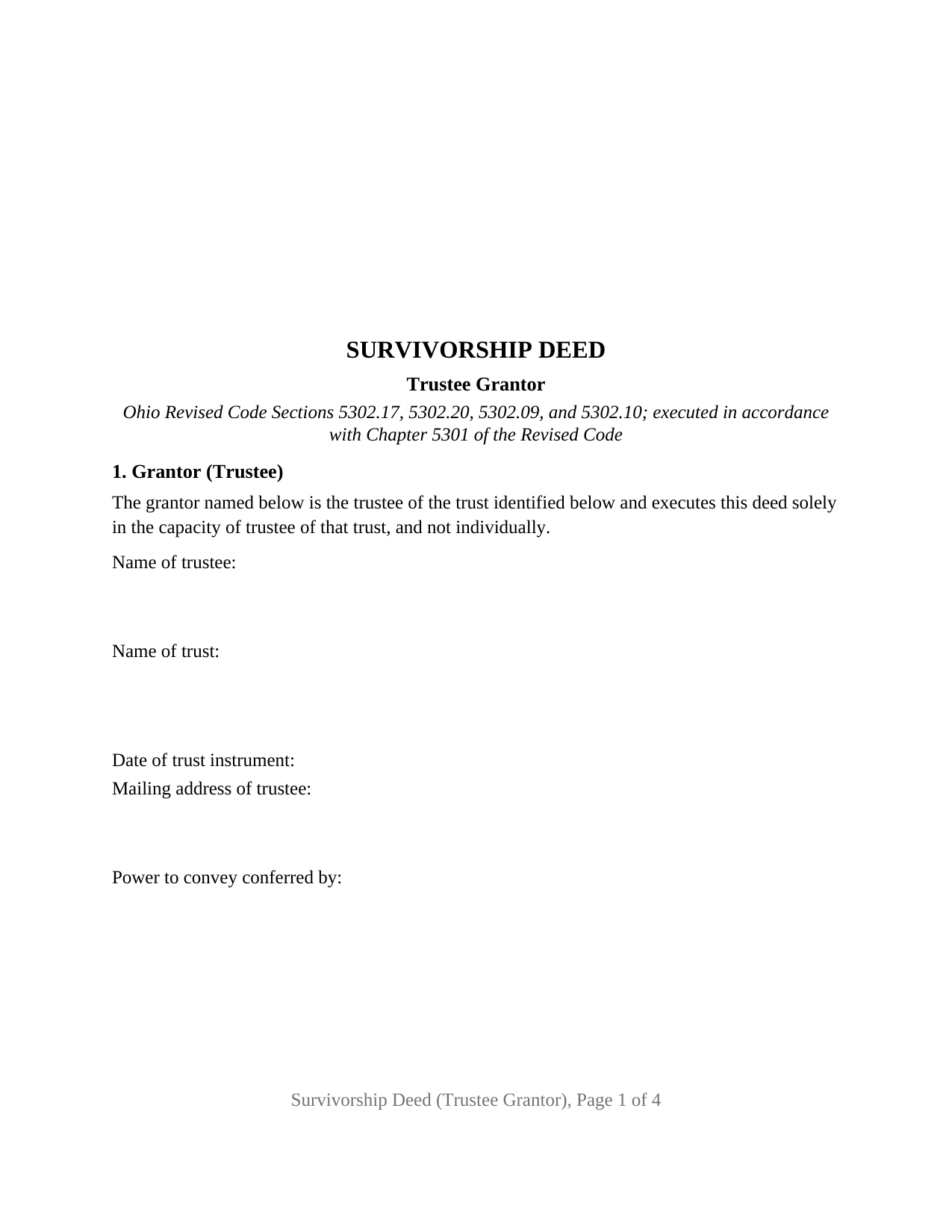
On this Ohio survivorship deed the person who signs holds the title but none of the benefit of it: a trustee, conveying real property held in trust to two grantees who take as survivorship tenants, the whole title resting in the survivor at the first death. Section 1 recites that the grantor executes it solely as trustee and not individually, Section 2 points to the memorandum of trust of record, the granting clause carries fiduciary covenants rather than warranty covenants, and the one acknowledgment certificate is the short form Ohio Revised Code Section 147.55(F) prints for a trustee.
A trustee's covenants, not a warranty
The survivorship form in Section 5302.17 leaves its covenant placeholder open, and the fiduciary deed form in Section 5302.09, which names a trustee among the fiduciaries who use it, fills that placeholder with the words grants, with fiduciary covenants. Section 5302.10 gives the phrase its force: the grantor covenants that the grantor is duly appointed, qualified, and acting in the fiduciary capacity the deed describes, is duly authorized to make the sale and conveyance, and has complied with the governing statutes. Those are covenants about the trustee's office; the seisin, encumbrance, and defense promises of a general warranty deed are not among them.
The memorandum of trust the deed points to
Since June 16, 2026, Section 5301.255(A), as amended by Senate Bill 101 of the 136th General Assembly, has provided that a memorandum of trust or other qualifying instrument shall be of record when the trustee of a disclosed trust conveys any interest in real property. Section 2 of this deed carries the recording reference of that instrument, which is prepared and recorded separately and is not included in this package; Section 5301.071(F), added by the same act, treats a trustee's recorded conveyance as not defective for want of the memorandum once it has been of record for more than four years.
Why no spouse signs
A trustee holds trust property in a fiduciary capacity, the fiduciary deed form prints no marital status and no dower line, and this deed prints none. Under Section 5301.03 the word trustee after a grantee's name in a recorded deed, without other recorded language showing the trust, gives no notice that a trust exists, and under Section 2103.021 such a grantee's conveyance to a bona fide purchaser passes title free of the grantee's spouse's dower unless the spouse first recorded an affidavit of the claimed interest. Dower of a settlor's spouse is a matter of the deed that put the property into the trust, not of this one.
What the trustee's deed recites
Section 1 carries the trustee's name, the trust's name and date, the trustee's mailing address, and the source of the power to convey, read with Sections 5808.15 and 5808.16 of the Ohio Trust Code. Section 3 names two grantees with the tax-mailing address Section 319.20 requires, and Section 7 conveys to them for their joint lives, remainder to the survivor of them, so that under Section 5302.20 the whole title vests in the survivor at the first death without probate. A settlor serving as trustee of a revocable living trust selling a rental house out of the trust to two investors, and a successor trustee distributing the family home after the settlor's death to the settlor's son and daughter-in-law as survivorship tenants, present the pattern this deed recites. The form is not set up as a deed two co-trustees both sign, as a deed from a trust named in place of its trustee, as a deed from an individual, a company, or an attorney-in-fact, or as a deed to one grantee or to three or more.
Fee or exemption at the auditor's counter
A trustee's sale for a price goes to the county auditor with form DTE 100 and the conveyance fee of Section 319.54(G)(3); a distribution to the trust's beneficiaries after the trust became irrevocable at the grantor's death is exempt under division (v) and is stated on form DTE 100EX instead. The auditor's stamp and transfer endorsement precede the recorder's acceptance under Section 317.22.
The package includes the fillable survivorship deed form in this trustee grantor configuration, a completed example filled in for a Montgomery County sale by the trustee of a family revocable trust, and the guide, which covers each section, the memorandum of trust, dower, and the auditor and recorder steps. This description and the guide describe the form and the Ohio statutes behind it in general terms; they are not legal advice.
Important: County-Specific Forms
Our survivorship deed (trustee grantor) forms are specifically formatted for each of the 88 counties in Ohio.
After selecting your county, you'll receive forms that meet all local recording requirements, ensuring your documents will be accepted without delays or rejection fees.