Ohio Survivorship Deed (Married Grantor with Non-Owner Spouse Joinder)
County Specific Legal Forms Validated as recently as October 21, 2026 by our Forms Development Team
About the Ohio Survivorship Deed (Married Grantor with Non-Owner Spouse Joinder)
How to Use This Form
- Select your county from the list
- Download the county-specific form
- Fill in the required information
- Have the document notarized if required
- Record with your county recorder's office
What Others Like You Are Saying
"Thank you, for help."
"This is the first time I am filling out a legal form downloaded from a website. Throughly impressed …"
"I was able to use your website for the purpose I was looking for. I was able to conclude the transac…"
"So far so good!"
"Assuming that the downloads went without a hitch, the system was easy to follow and execute."
4.8/5 from 4,829 reviews. Read all
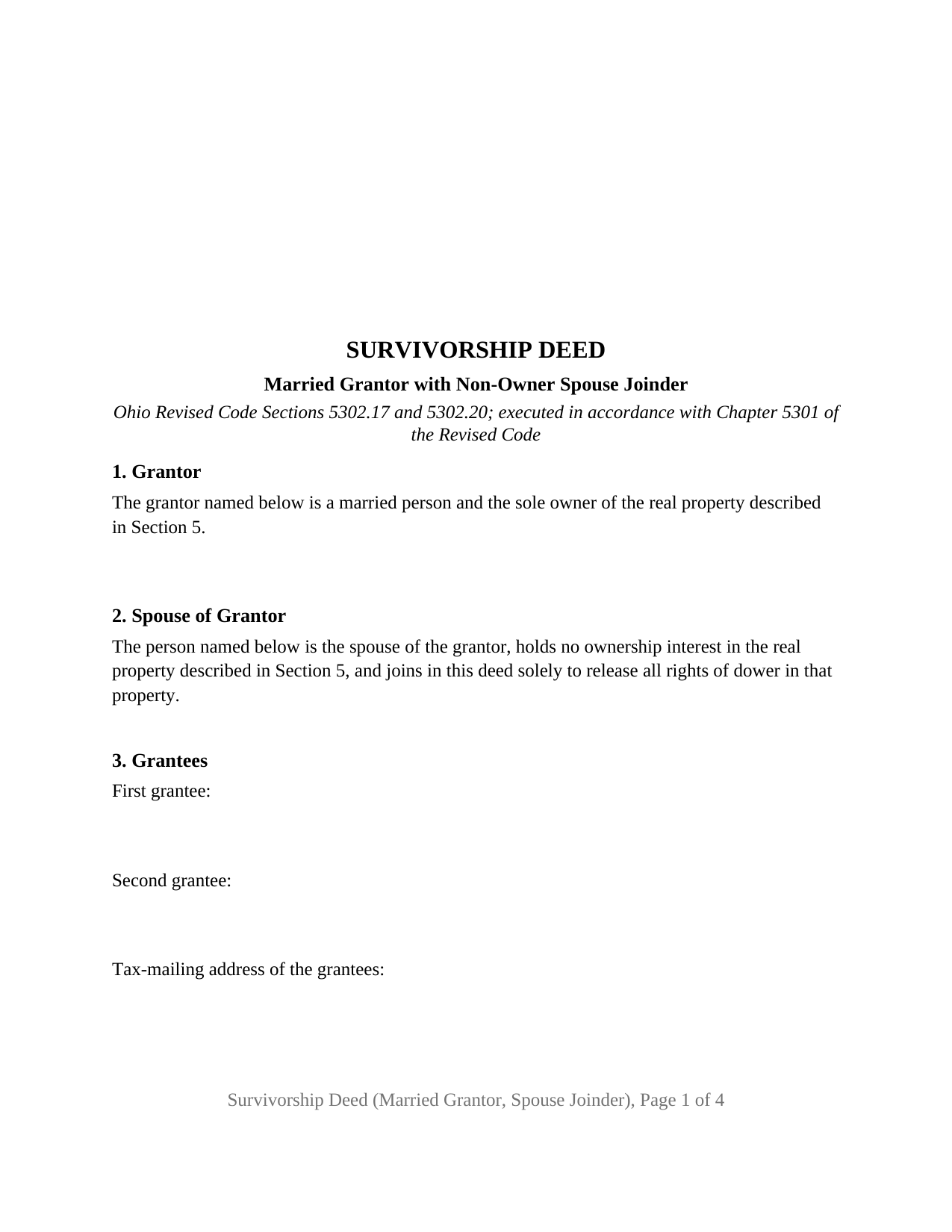
On this Ohio survivorship deed, the second signature belongs to someone who owns nothing. The grantor is a married person who holds the property alone; the grantor's spouse has no title to convey but signs solely to release dower, and the deed carries that spouse into Section 2, a SPOUSE OF GRANTOR signature block, and a second acknowledgment certificate. Two grantees take as survivorship tenants under Ohio Revised Code Section 5302.17, so the survivor holds the whole title when the first grantee dies. This form prepares that deed, with general warranty covenants, for Ohio real property.
Why a spouse who owns nothing still signs
Ohio kept dower. Section 2103.02 endows a spouse with a life estate in one third of the real property of which the other spouse was seized as an estate of inheritance during the marriage, and preserves it in property the owner conveyed during the marriage unless the other spouse relinquished it. A deed from a married sole owner that the spouse never signed leaves an inchoate dower claim behind it. Section 5301.04 applies the signing and acknowledgment rules of Section 5301.01 to a deed of a married person's interest, and Section 5301.071(A) cures a recorded conveyance that omits a specific release where the spouse executed it under Section 5301.01. The statutory form prints a line for the release; this deed fills it with a fixed sentence in Section 7, the spouse of the grantor named in Section 2 releases all rights of dower therein, and has the spouse sign and acknowledge.
The configuration the deed recites
Section 1 recites, as fixed deed text, that the grantor is a married person and the sole owner of the described property; the only blank is the grantor's name and address. Section 2 recites that the person named is the spouse of the grantor, holds no ownership interest in the property, and joins solely to release all rights of dower; the only blank is the spouse's name. Section 3 names two grantees and the tax-mailing address Section 319.20 puts on an instrument presented for auditor transfer. Section 8 carries two signature blocks, GRANTOR and SPOUSE OF GRANTOR, each followed by its own certificate in the Section 147.55(A) short form wording, so the two may acknowledge on different dates or before different officers.
A married homeowner selling a house titled in that owner's name alone to a buying couple, and a married parent who inherited a property individually and conveys it to two adult children, present the pattern this deed recites. It is not set up as a deed from two spouses who both hold title, from an unmarried owner, from a trustee or an attorney-in-fact, or to one grantee or to three or more.
What the two grantees receive
The granting clause in Section 7 conveys to the first grantee and the second grantee, for their joint lives, remainder to the survivor of them, which under Section 5302.20(A) makes them survivorship tenants. At the first death the decedent's title vests in the survivor under Section 5302.20(B), outside probate. Section 5302.17 does not condition the survivorship on the grantees being married, and the deed creates no estate by the entireties, which Section 5302.21 preserves only for deeds recorded before April 4, 1985. The general warranty covenants, which Section 5302.06 reads as covenants of seisin, freedom from encumbrances, good right to convey, and warranty against the lawful claims of all persons, are the grantor's alone, carved back by the matters listed in Section 6; the release of dower is the spouse's act.
Auditor first, recorder second
A sale from a married sole owner to a couple is a fee-paid conveyance: the DTE 100 statement goes to the county auditor under Section 319.202 with the state fee under Section 319.54(G)(3) and any county permissive tax under Chapter 322. Under Section 317.22 the recorder accepts the deed only after the auditor's stamp and transfer endorsement are on it, and some counties, Hamilton among them, route the description through the county engineer first. The deed follows the Section 317.114 format standard and carries the Section 317.111 preparer statement.
The package includes the fillable survivorship deed form in this married grantor and spouse joinder configuration, a completed example filled in for a Hamilton County sale, and the guide, which explains each section and the path from auditor to recorder. This description and the guide treat the form and the Ohio statutes behind it in general terms only; they are not legal advice.
Important: County-Specific Forms
Our survivorship deed (married grantor with non-owner spouse joinder) forms are specifically formatted for each of the 88 counties in Ohio.
After selecting your county, you'll receive forms that meet all local recording requirements, ensuring your documents will be accepted without delays or rejection fees.