Ohio Survivorship Deed (Tenants in Common to Survivorship Tenants)
County Specific Legal Forms Validated as recently as October 21, 2026 by our Forms Development Team
About the Ohio Survivorship Deed (Tenants in Common to Survivorship Tenants)
How to Use This Form
- Select your county from the list
- Download the county-specific form
- Fill in the required information
- Have the document notarized if required
- Record with your county recorder's office
What Others Like You Are Saying
"All instructions and forms are very easy to read and fill-out. Thank you"
"Fast service. From the time I sent my Quit Claim Deed to deeds.com, and six hours later my deed was …"
"Easier than I expected. I followed the downloaded examples step by step, and before I knew it, the f…"
"good forms thanks, irene"
"No Brainer. Easy to use. Good service. I recommend this."
4.8/5 from 4,829 reviews. Read all
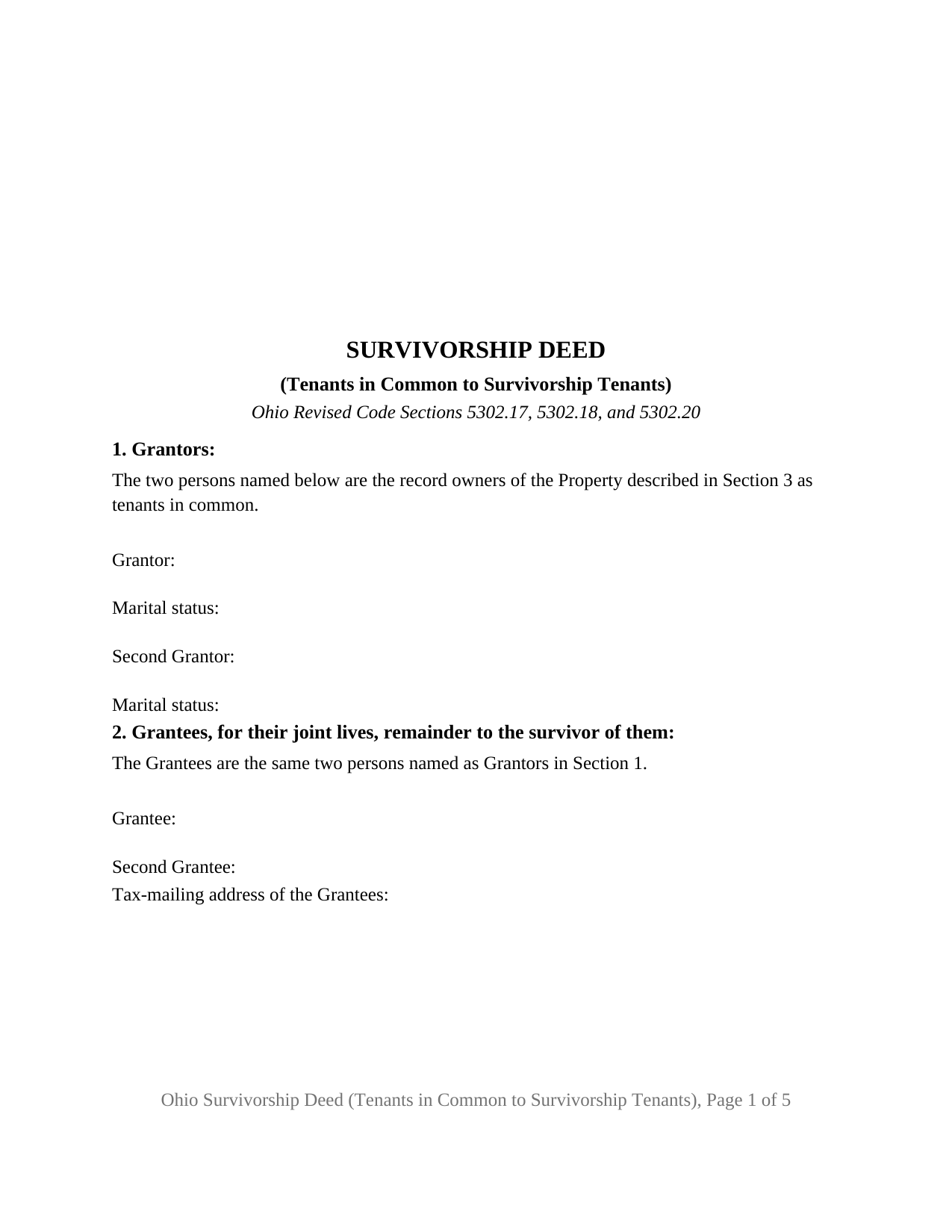
Two people who already own Ohio real property together as tenants in common can give their title a right of survivorship without bringing in anyone else: they sign a survivorship deed to themselves. This form prepares that deed for two existing co-owners, the same two persons appearing as grantors and as grantees, so that at the first death the property passes to the survivor by the deed itself rather than through probate.
A tenancy in common that was never meant to be one
Ohio Revised Code Section 5302.19 makes tenancy in common the default: a deed to two or more persons that does not use survivorship language vests each of them with an undivided interest, and that interest passes at death through the owner's estate. Spouses who bought a home under a deed naming them without the survivorship words, siblings who inherited a parcel together, and partners who took title jointly years ago often discover, usually when an estate plan is being put together, that their deed carries no survivorship at all. The remedy is not a correction, because the original deed did exactly what it said. The remedy is a new conveyance.
A grantor who is also a grantee
Section 5302.18, in force since April 4, 1985, provides that a deed in which a grantor is also a grantee is effective to convey the grantor's interest to all of the grantees in the proportion and manner the deed indicates. That section is what lets two co-owners convey to themselves, and this deed cites it in its conveyance paragraph. The granting clause then uses the operative words of the statutory survivorship form in Section 5302.17, to the grantees for their joint lives, remainder to the survivor of them, and Section 5302.20 supplies the result: the two hold as survivorship tenants in equal shares, and on the death of either, title vests in the survivor as sole title holder. The second paragraph of Section 5302.17 speaks to co-owners who already held before April 1985; Section 5302.18 reaches everyone since.
What the deed recites
Section 1 names the two grantors with the marital status the statutory form calls for and states, as fixed deed text, that they are the record owners of the property as tenants in common. Section 2 names the same two persons as grantees under the survivorship heading, with the tax-mailing address Section 319.20 requires for the auditor's transfer. The conveyance paragraph grants with general warranty covenants, provides that each grantor conveys that grantor's entire interest to both grantees under Section 5302.18, and provides that each grantor, by signing, releases all rights of dower in the interest conveyed by the other grantor, the release Section 2103.02 makes relevant when the two grantors are married to each other. Both grantors sign, and the form carries a separate acknowledgment certificate for each in the wording of the short form in Section 147.55(A). Two spouses whose vesting deed omitted survivorship, and two unmarried co-owners consolidating a shared title into a survivorship tenancy, present the pattern this deed recites. The form is not set up as a conveyance that adds a new owner, as a deed by three or more co-owners, as a deed with unequal survivorship shares, or as a deed carrying a dower release by a spouse who is not on the title.
An exempt conveyance at the auditor's counter
Because the transfer runs between persons under Section 5302.18, Section 319.54(G)(3) exempts it from the state conveyance fee, at division (n) and again at division (x), and Section 322.01 keeps it outside the county permissive transfer tax as well. The grantee files form DTE 100EX, the statement of reason for exemption, in place of a statement of value, and the auditor's stamp and transfer endorsement then let the recorder accept the deed under Section 317.22. The deed is laid out to the Section 317.114 standard, its first page opening with the three inch blank margin the auditor and recorder stamp into, and it carries the preparer statement Section 317.111 requires; the recording fee under Sections 317.32 and 317.36 runs by the page.
The package contains the fillable deed, a completed example prepared for two Hamilton County spouses converting a tenancy in common they took in 2014, and a guide covering each section, dower, the auditor's exemption, and recording. The description and the guide are general accounts of the form and the Ohio statutes behind it, not legal advice.
Important: County-Specific Forms
Our survivorship deed (tenants in common to survivorship tenants) forms are specifically formatted for each of the 88 counties in Ohio.
After selecting your county, you'll receive forms that meet all local recording requirements, ensuring your documents will be accepted without delays or rejection fees.