Ohio Survivorship Deed (Individual Grantor by Attorney-in-Fact - POA)
County Specific Legal Forms Validated as recently as October 21, 2026 by our Forms Development Team
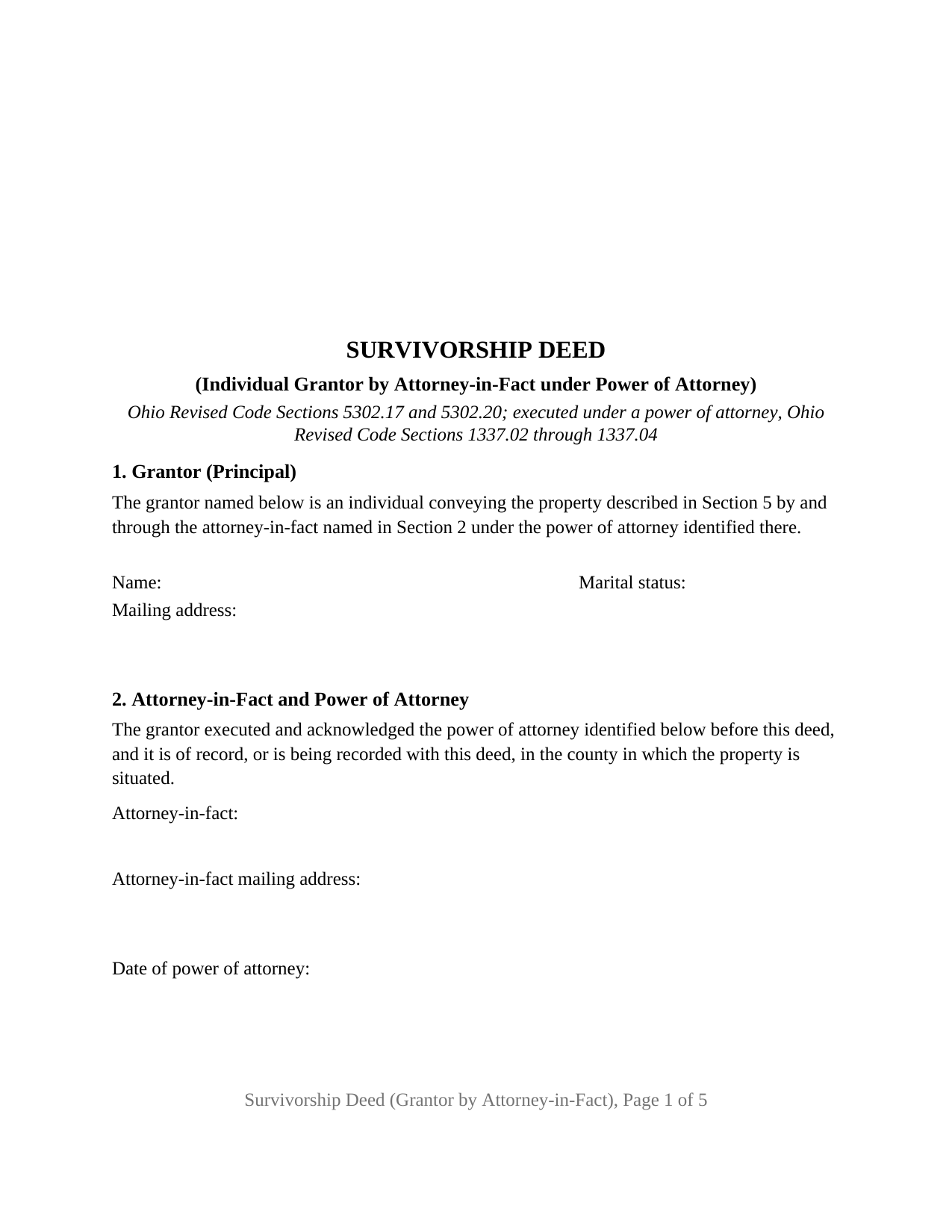
About the Ohio Survivorship Deed (Individual Grantor by Attorney-in-Fact - POA)
How to Use This Form
- Select your county from the list
- Download the county-specific form
- Fill in the required information
- Have the document notarized if required
- Record with your county recorder's office
What Others Like You Are Saying
"Quick and easy! Took the hassle out of trying to locate information during this quarantine."
"Easy to use and get forms I needed. Corporate need for an invoice/receipt could be a bit easier - ha…"
"Deed.com is an amazing site. After calling many places and going on many websites to figure out what…"
"thanks for providing my with exactly what I needed, almost instantly!"
"The process was incredibly simple from start to finish. Someone from the team even sent a message to…"
4.8/5 from 4,829 reviews. Read all
On this Ohio survivorship deed, the grantor's name is on the deed but the grantor's hand is not. An attorney-in-fact signs for the grantor under a power of attorney, and the deed is built around that fact: Section 2 identifies the agent and the recorded power of attorney, the first signature block is captioned ATTORNEY-IN-FACT FOR GRANTOR, and its acknowledgment certificate is the attorney-in-fact short form of Ohio Revised Code Section 147.55(E). Two grantees take as survivorship tenants under Section 5302.17, with general warranty covenants, so the whole title rests in the survivor when the first of them dies.
A deed the grantor does not sign
Section 1337.02 provides that a deed made under a power of attorney must contain the grantor's name and conveys the grantor's interest as fully as a deed signed in person. Section 1337.04, rewritten in 2024, adds two timing rules: the power of attorney is executed and acknowledged by the principal before the deed, and it is recorded in the county where the property lies before the deed is recorded, or on the same day. Section 1337.03 forgives drafting slips such as the attorney's name subscribed in place of the principal's.
What the agent may do comes from the power of attorney itself. General authority over real property under Section 1337.45 includes selling and conveying with or without covenants. Section 1337.42(A) holds back a short list of acts for an express grant, among them making a gift and creating or changing rights of survivorship, and Section 1337.42(B) keeps an agent who is not the principal's ancestor, spouse, or descendant from creating an interest in the agent's own favor unless the document says otherwise.
The configuration the deed recites
Section 1 recites, as fixed deed text, that the grantor is an individual conveying by and through the attorney-in-fact named in Section 2 under the power of attorney identified there; the blanks are the grantor's name, marital status, and mailing address. Section 2 names the agent, the date of the power of attorney, and its recording reference. Section 3 names the grantor's spouse, if any, and Section 6 provides that the spouse, by signing, releases all rights of dower therein, the Section 2103.02 release; the power of attorney is the grantor's and dower is the spouse's own interest, so the spouse signs and acknowledges personally in a SPOUSE OF GRANTOR block with its own Section 147.55(A) certificate, left blank when the grantor is unmarried. Section 4 names two grantees with the tax-mailing address the county auditor needs under Section 319.20.
An owner living out of state whose agent signs at a closing for two buyers, and an owner in a care facility whose agent under a durable power of attorney conveys the house to two grandchildren, present the pattern this deed recites. It is not set up as a deed the grantor signs personally, by two grantors, by an entity, trustee, or guardian, to one grantee or to three or more, or with the agent as a grantee.
What the agent conveys and what the survivor keeps
The granting clause in Section 6 follows the Section 5302.17 form: the grantor, by and through the attorney-in-fact, for valuable consideration paid, grants, with general warranty covenants, to the first grantee and the second grantee, for their joint lives, remainder to the survivor of them. Section 5302.20 makes the two grantees survivorship tenants and vests the decedent's share in the survivor at the first death without probate. The general warranty covenants of Section 5302.06 are the grantor's promises made through the agent, and the matters listed in Section 5 are carved out of them.
Two instruments at the recorder, in order
The deed goes first to the county auditor with the DTE 100 conveyance fee statement, or the DTE 100EX where a Section 319.54(G)(3) exemption applies, for the fee, the transfer, and the auditor's stamp; Section 317.22 keeps an unstamped deed out of the record. At the recorder, Section 1337.04 wants the power of attorney of record ahead of the deed and Section 317.111 wants the preparer's name on it.
The package includes the fillable survivorship deed form in this attorney-in-fact configuration, a completed example filled in for a Cuyahoga County sale signed by the owner's daughter as agent, and the guide, which explains each section and the auditor and recorder steps. This description and the guide describe the form and the Ohio statutes behind it in general terms only; they are not legal advice.
Important: County-Specific Forms
Our survivorship deed (individual grantor by attorney-in-fact - poa) forms are specifically formatted for each of the 88 counties in Ohio.
After selecting your county, you'll receive forms that meet all local recording requirements, ensuring your documents will be accepted without delays or rejection fees.