Ohio Trustee Deed (Corporation Grantee)
County Specific Legal Forms Validated as recently as October 23, 2026 by our Forms Development Team
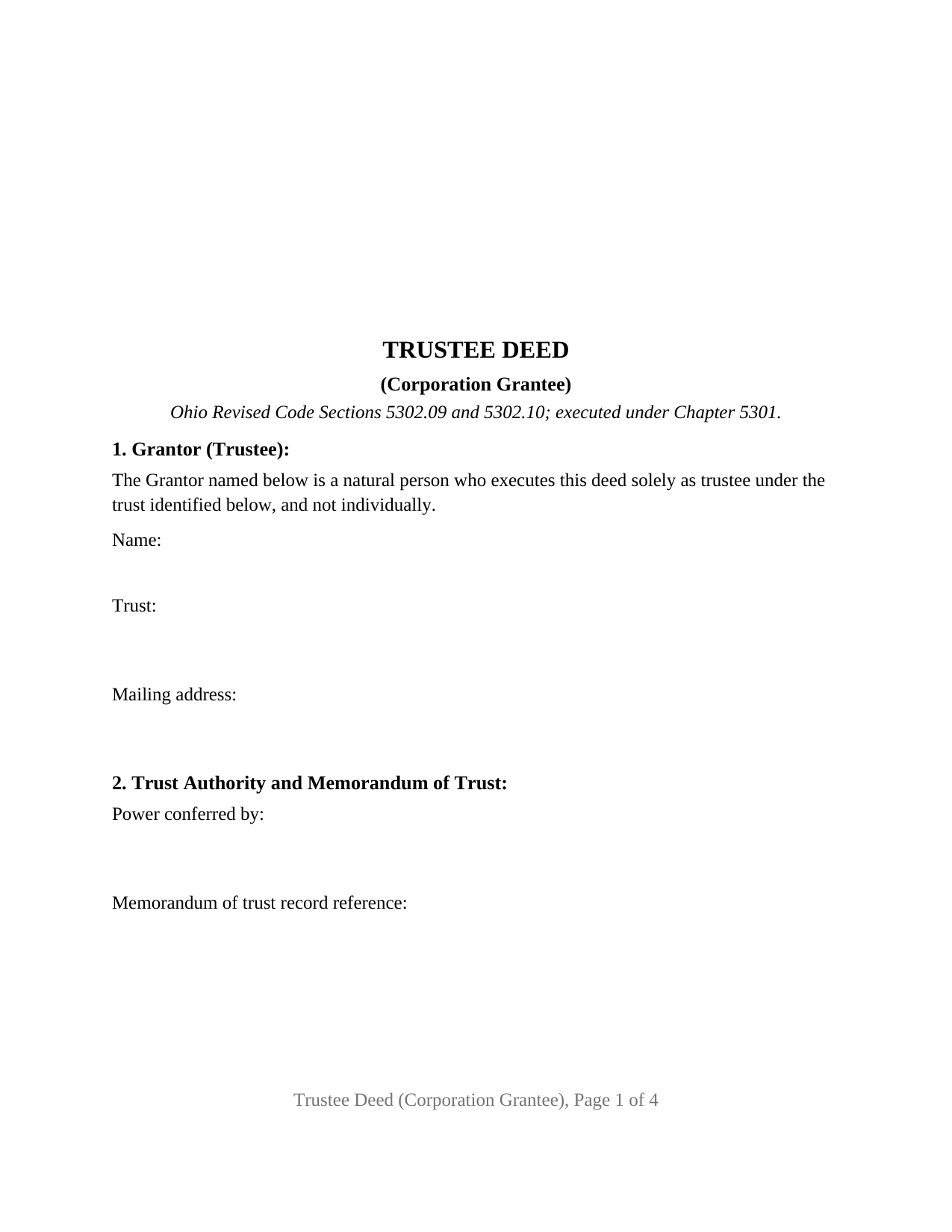
About the Ohio Trustee Deed (Corporation Grantee)
How to Use This Form
- Select your county from the list
- Download the county-specific form
- Fill in the required information
- Have the document notarized if required
- Record with your county recorder's office
What Others Like You Are Saying
"How easy was this. I was pleasantly surprised by the speed and price. Saved me several days of snail…"
"I am happy that I found Deeds.com. It provided me with all the information I needed to prepare a qui…"
"I was able to find the Certificate of Trust after a little searching. Once found, the remainder of t…"
"This site is very easy to use."
"The Deeds.com site made is relatively simple to download a Beneficiary Deed form specific to St Loui…"
4.8/5 from 4,832 reviews. Read all
When an Ohio trust sells or transfers real estate to a corporation, the instrument of record is a trustee deed signed by the trustee alone, in a fiduciary capacity, with the corporation itself as grantee. This Ohio Trustee Deed (Corporation Grantee) prepares that deed in the statutory form of Ohio Revised Code Section 5302.09, conveying with fiduciary covenants to a single corporate grantee named by its exact corporate name, its jurisdiction of incorporation, and its tax-mailing address.
A deed signed by the trustee, received by the corporation
The deed recites one grantor: a natural person who executes the deed solely as trustee under an identified trust and not individually. The trustee's name, the trust's name and date, and the trustee's mailing address are the entries; the fiduciary capacity is fixed deed text, and the conveyance section repeats that the trustee executes the deed in that capacity and not individually. One signature block follows, for the trustee, and one acknowledgment certificate follows it, drawn with the short form Section 147.55(F) prints for a trustee, so the notary names the signer by name and title of position.
The grantee side recites a corporation organized under the laws of a stated jurisdiction. No officer of the corporation signs a trustee deed and no acceptance block appears on it; Section 1701.13(F)(1) gives a corporation authority to acquire and hold property within the purposes stated in its articles, and the deed names the corporation as the party that takes. A trust selling a parcel to an unrelated company, a family trust moving a building into the family's operating corporation, and a trust distributing real estate to a corporate beneficiary all present this trustee-to-corporation pattern. A conveyance to a limited liability company, an individual, or another trust is not the pattern this deed recites.
What fiduciary covenants promise
A deed in substance following the Section 5302.09 form, duly executed under Chapter 5301, has the force and effect of a deed in fee simple to the grantee. The words with fiduciary covenants carry the meaning Section 5302.10 gives them: the trustee covenants that the trustee is duly appointed, qualified, and acting in the fiduciary capacity the deed describes, is duly authorized to make the sale and conveyance, and has complied with the statutes governing the sale. Those are covenants about the trustee's own position and authority, not about the title. The deed's authority blank identifies the trust provision granting the power of sale together with Sections 5808.15 and 5808.16(B) of the Ohio Trust Code, which confer it by default.
The memorandum of trust that must be of record
Ohio changed the rule for trustee conveyances in 2026. Section 5301.255, as amended by Senate Bill 101 of the 136th General Assembly effective June 16, 2026, provides that a memorandum of trust or other instrument meeting that section shall be of record when any interest in real property is conveyed by the trustee of a disclosed trust. The memorandum states the trustee's name and address, the date of the trust, and the trust's powers and restrictions concerning real property. It is a separate instrument, recorded apart from the deed and not included in this package; the deed carries a blank for its recording reference.
Survey statement, prior instrument, and the auditor's desk
The sentence A survey of this property was made by, with a blank for the surveyor's name, is the statement Section 5301.25(B) deems sufficient when a survey of the land conveyed was made, and the Prior Instrument Reference identifies the deed to the trustee by instrument number or volume and page, as Section 319.20 requires before the county auditor transfers the parcel. The deed goes to the auditor first, with the conveyance fee statement on form DTE 100 or the exemption statement on form DTE 100EX, and only a deed bearing the auditor's stamp and transfer endorsement is admitted to record under Section 317.22.
The package includes the fillable trustee deed form, a completed example filled in for a realistic Franklin County sale from a family trust to an Ohio corporation, and a guide to every numbered section, the signing rules, and the auditor and recorder requirements. This description and the guide describe the form and the governing Ohio statutes in general terms; they are not legal advice.
Important: County-Specific Forms
Our trustee deed (corporation grantee) forms are specifically formatted for each of the 88 counties in Ohio.
After selecting your county, you'll receive forms that meet all local recording requirements, ensuring your documents will be accepted without delays or rejection fees.