Ohio Trustee Deed (Successor Trustee)
County Specific Legal Forms Validated as recently as October 23, 2026 by our Forms Development Team
About the Ohio Trustee Deed (Successor Trustee)
How to Use This Form
- Select your county from the list
- Download the county-specific form
- Fill in the required information
- Have the document notarized if required
- Record with your county recorder's office
What Others Like You Are Saying
"Good!!"
"The download of forms, etc. was easy and the guides that were provided were good, but more informati…"
"works nice"
"So far excellent service - I made a boo boo on the deed - no problem they made the change before the…"
"This was easy!!"
4.8/5 from 4,829 reviews. Read all
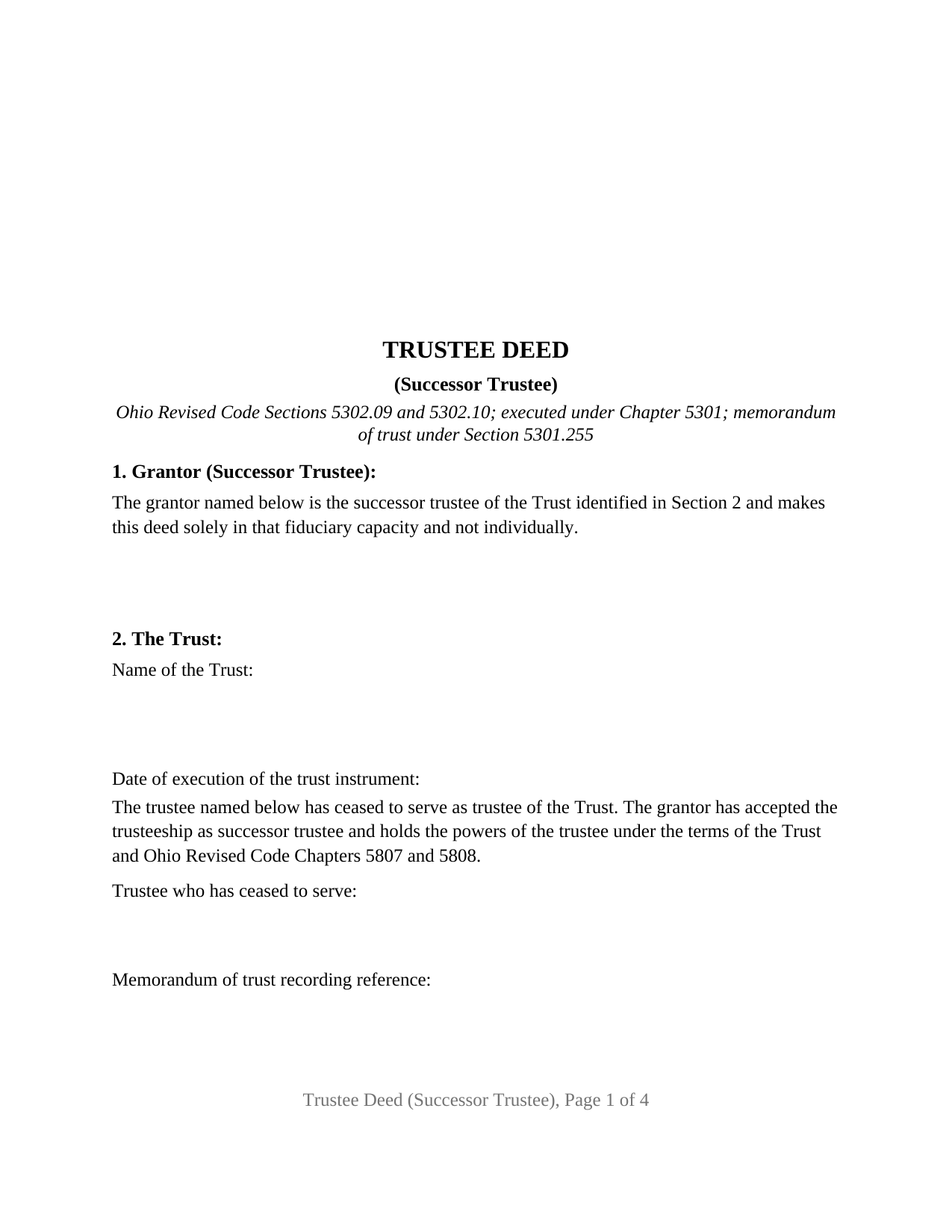
When the trustee named in an Ohio trust dies, resigns, or can no longer serve, the person who steps into the office signs the deed that moves the trust's real estate out of the trust. This Ohio Trustee Deed (Successor Trustee) is drawn for that signer: one successor trustee conveying property the trust holds, with the fiduciary covenants of Ohio Revised Code Sections 5302.09 and 5302.10, reciting the succession on its face and referring to the memorandum of trust that Ohio requires to be of record when a trustee conveys.
A deed that names the trustee who left and the trustee who signs
Section 5302.09 prints Ohio's fiduciary deed form, which names a trustee among the fiduciaries it covers. A deed by a successor has one more thing to show: how the signer came to hold the office. This form carries that in Section 2 as fixed deed text, stating that the named prior trustee has ceased to serve and that the grantor has accepted the trusteeship as successor trustee and holds the trustee's powers under the terms of the trust and Chapters 5807 and 5808. The power source line then identifies the trust article that names the successor and confers the power to sell, or the appointment or court order under which the successor serves, the routes Section 5807.04(C) lists for filling a vacancy.
Fiduciary covenants, not a title warranty
The operative words are grants, with fiduciary covenants. Under Section 5302.10 those words covenant that the grantor is duly appointed, qualified, and acting in the fiduciary capacity the deed describes, is duly authorized to make the sale and conveyance, and has complied with the statutes governing the sale. They say nothing about the condition of the title. The deed states that it carries no covenant other than the fiduciary covenants, and Section 5302.09 gives a deed in substance following its form the force and effect of a deed in fee simple.
The memorandum of trust of record
Section 5301.255, as amended effective June 16, 2026, provides that a memorandum of trust or other qualifying instrument shall be of record when any interest in real property is conveyed by the trustee of a disclosed trust. Where the memorandum recorded when the trust took title names a trustee who has since ceased to serve, Ohio practice is for the successor trustee to record a new or supplemental memorandum before the deed. This deed carries a blank for that recording reference; the memorandum is a separate instrument, recorded separately and not included in this package.
Who signs, and what the deed recites
The form prints one signature block, headed GRANTOR (Successor Trustee), and one acknowledgment certificate using the Section 147.55(F) short form for a trustee. An adult child named in a parent's revocable living trust as successor trustee, selling the family home after the parent's death, and a bank trust department distributing a parcel to the beneficiaries after an individual trustee resigned, present the pattern this deed recites. The deed is not set up as a deed by two cotrustees, by the trustee originally named in the trust instrument, or by an attorney in fact signing for a trustee. The grantee block takes one or more grantees with the vesting words the entry supplies.
Before the recorder, the auditor
Under Section 317.22 an Ohio deed of absolute conveyance is not recorded until the county auditor has stamped it and endorsed it transferred or transfer not necessary, so the signed deed and the conveyance fee statement (DTE 100) or exemption statement (DTE 100EX) go to the auditor first. Section 319.54(G)(3) exempts certain trust transfers from the conveyance fee, including a distribution to beneficiaries under provisions that became irrevocable at the grantor's death; a sale to a purchaser for consideration pays it. The deed is laid out to the Section 317.114 standard format, with the three-inch blank top margin on the first page and twelve-point type, so it records without the nonstandard-format fee.
The package contains the fillable trustee deed form, a completed example filled in for a Franklin County fact pattern, and the guide that walks through each section, the succession and memorandum of trust statutes, signing, and recording. The description and the guide describe the form and the governing Ohio statutes in general terms and are not legal advice.
Important: County-Specific Forms
Our trustee deed (successor trustee) forms are specifically formatted for each of the 88 counties in Ohio.
After selecting your county, you'll receive forms that meet all local recording requirements, ensuring your documents will be accepted without delays or rejection fees.