Ohio Trustee Deed (Married Co-Trustees)
County Specific Legal Forms Validated as recently as October 23, 2026 by our Forms Development Team
About the Ohio Trustee Deed (Married Co-Trustees)
How to Use This Form
- Select your county from the list
- Download the county-specific form
- Fill in the required information
- Have the document notarized if required
- Record with your county recorder's office
What Others Like You Are Saying
"works nice"
"Great service got everything I needed with a click of a tab. Thank You..."
"What a great set of documents, including instructions and examples. Also has a set of bonus document…"
"Easy to use website. Found what I was looking for."
"This platform made electronic filing of a lien easy and quick. I was able to accomplish everything f…"
4.8/5 from 4,832 reviews. Read all
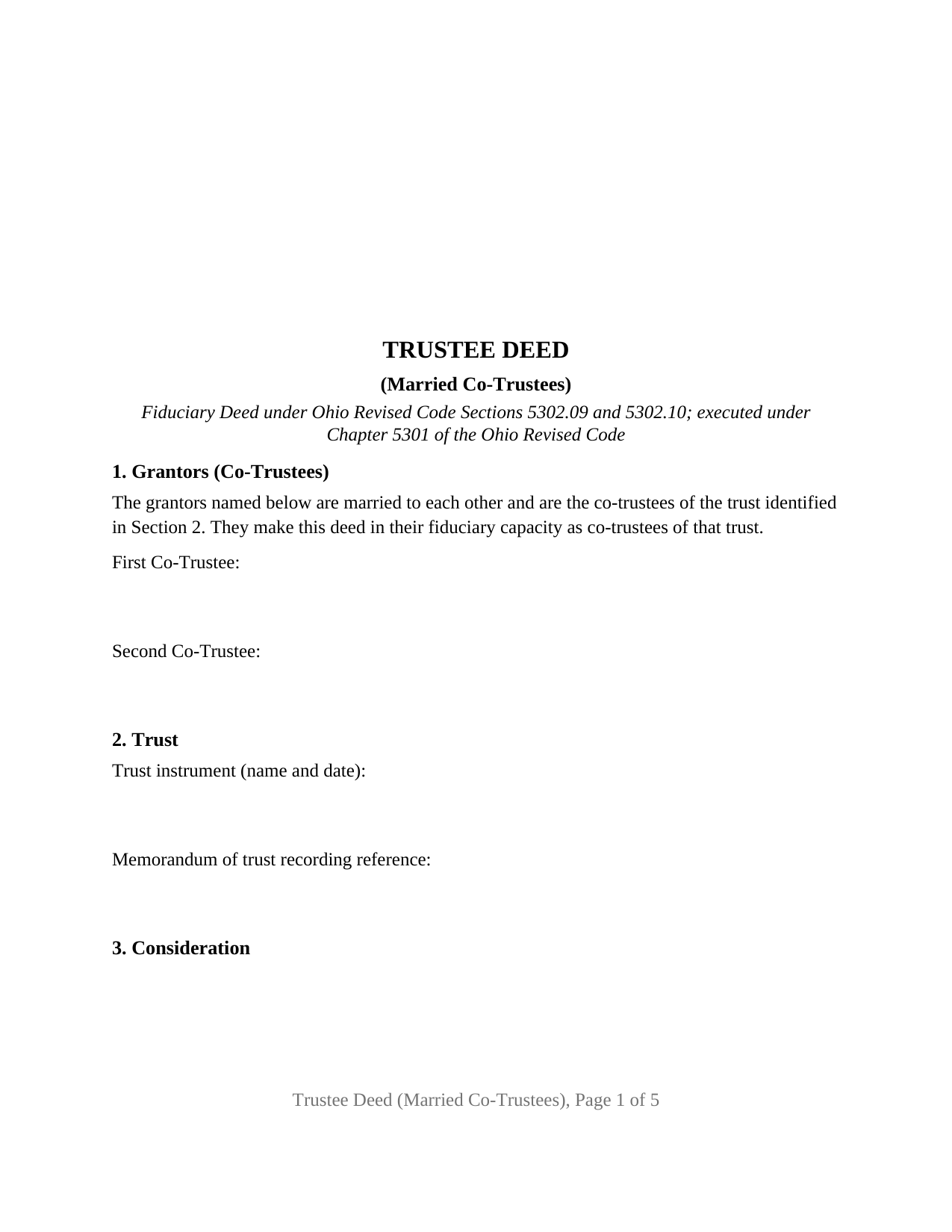
Two spouses who serve together as co-trustees of their trust sign this Ohio Trustee Deed to convey real property out of the trust. The form is built for exactly that configuration: one trust, two co-trustees who are married to each other, both signing in their fiduciary capacity, with the fiduciary covenants that Ohio Revised Code Sections 5302.09 and 5302.10 attach to a fiduciary deed. The marriage and the co-trusteeship are fixed deed text; the names, the trust, the grantee, the property, and the consideration are the blanks.
Two signatures, one trust
Section 5807.03(C) of the Ohio Trust Code requires each cotrustee to participate in a trustee's function unless unavailable or properly delegated. The deed therefore carries a signature block for each co-trustee, headed First Co-Trustee and Second Co-Trustee, with the capacity stated under each signature, and each signature is followed by its own acknowledgment certificate in the Ohio short form for a trustee under Section 147.55(F). The spouses may acknowledge before different officers on different days; that pairing is how the form is laid out, not a requirement of Ohio law.
What fiduciary covenants promise
A deed in substance following Section 5302.09, duly executed under Chapter 5301, has the force and effect of a deed in fee simple with covenants that the grantor was duly appointed, qualified, and acting in the fiduciary capacity the deed describes, was duly authorized to make the sale and conveyance, and complied with the statutes governing the sale. Those are promises about the trustees' office and authority, not the title covenants of a general warranty deed; because Section 5302.03 provides that the word grant implies no covenant by itself, the phrase with fiduciary covenants, carried verbatim in the operative section, supplies them.
The memorandum of trust travels with the deed
Since June 16, 2026, Section 5301.255, as amended by Senate Bill 101 of the 136th General Assembly, provides that a memorandum of trust shall be of record when any interest in real property is conveyed by the trustee of a disclosed trust. Section 2 of this deed identifies the trust instrument and carries a line for the memorandum's recording reference, so the recorded deed points to the recorded authority behind it.
Marriage, dower, and the release the deed carries
Ohio remains a dower state. Section 2103.02 gives a spouse an estate for life in one third of the real property of which the other spouse was seized as an estate of inheritance during the marriage, and Ohio's statutory deed forms carry a spousal dower release for that reason. On this deed each co-trustee is the other's spouse, so the operative section includes a release by each co-trustee of all right and expectancy of dower, if any, in the property, and both spouses sign and acknowledge the same instrument. Section 5301.071(A) separately provides that a recorded conveyance is not defective because dower was not specifically released where the spouse executed the instrument. The release reaches whatever dower exists, and the deed states no conclusion about whether dower attached to a parcel held in trust.
The configuration this deed recites
The form recites exactly two co-trustees of one trust, married to each other, conveying the trust's interest in a single Ohio parcel. Spouses selling a residence held in their joint revocable living trust, and co-trustee spouses distributing a parcel to an adult child under the trust's terms, present the pattern this deed recites. The form is not set up as a deed by a sole trustee, by unmarried co-trustees, by three or more trustees, by a corporate trustee, or by a successor trustee acting after a settlor's death, and it is not a deed conveying property into a trust. The grantee block takes one or two grantees with any Ohio vesting designation; the completed example conveys to a married couple for their joint lives, remainder to the survivor of them, the survivorship form of Section 5302.17. The deed goes to the county auditor for the conveyance fee statement and transfer endorsement under Sections 319.202 and 317.22 before the recorder records it, and it is laid out to the Section 317.114 recording format.
The package includes the fillable trustee deed form, a completed example filled in for a Franklin County fact pattern, and the guide that walks through each section and the auditor and recorder steps. This description and the guide describe the form and the governing Ohio statutes in general terms; they are not legal advice.
Important: County-Specific Forms
Our trustee deed (married co-trustees) forms are specifically formatted for each of the 88 counties in Ohio.
After selecting your county, you'll receive forms that meet all local recording requirements, ensuring your documents will be accepted without delays or rejection fees.