Ohio Trustee Deed (Corporate Trustee)
County Specific Legal Forms Validated as recently as October 23, 2026 by our Forms Development Team
About the Ohio Trustee Deed (Corporate Trustee)
How to Use This Form
- Select your county from the list
- Download the county-specific form
- Fill in the required information
- Have the document notarized if required
- Record with your county recorder's office
What Others Like You Are Saying
"Looks like it will be helpful in preparing deeds for distant counties"
"Everything I had hoped for. Easy and formatted correctly."
"The support received was far above expectations."
"Very Happy. Forms saved me from making some very silly mistakes had I done them on my own."
"Wow that was easy"
4.8/5 from 4,829 reviews. Read all
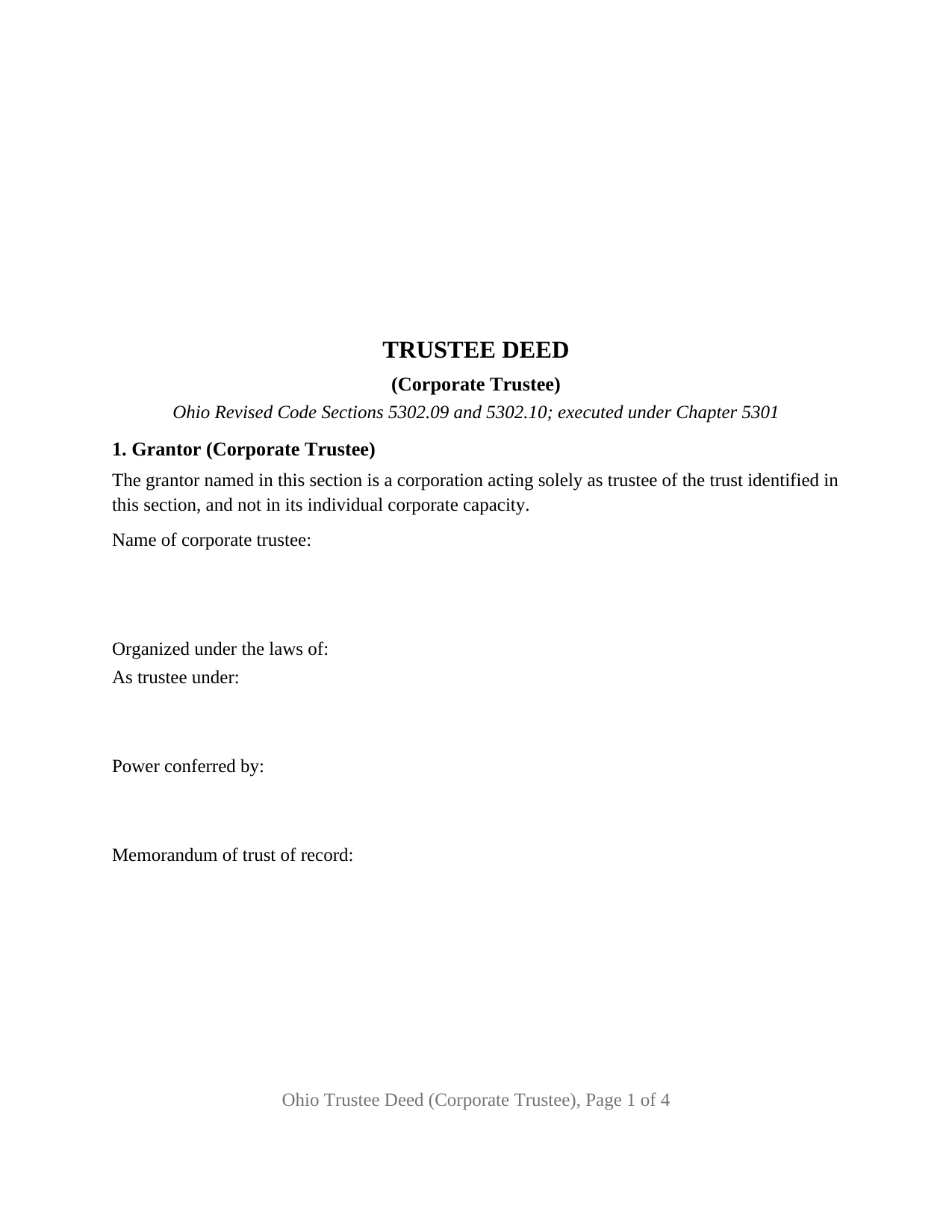
When a bank or trust company holds Ohio real estate as trustee and conveys it, a corporate officer signs the deed, and the deed carries the fiduciary covenants of Ohio Revised Code Section 5302.09 rather than the warranties of an owner's deed. This Ohio trustee deed is set up for exactly that configuration: one corporate trustee, one authorized officer signing on its behalf, and one acknowledgment certificate in the Ohio statutory short form for a corporation.
A deed signed by an officer, given by a trustee
The form recites that the grantor is a corporation acting solely as trustee of the identified trust and not in its individual corporate capacity. Section 1 names the corporate trustee, its state or place of incorporation, the trust under which it acts, the source of its power to convey, and the recorded memorandum of trust. Section 7 separates the two identities the way a corporate signature block does: the corporation is named as the grantor, as Trustee, and the signature, printed name, and title lines belong to the trust officer who signs for it. The record patterns that present this configuration include a trust department selling a parcel after a settlor's death and a corporate successor trustee conveying property an individual trustee once managed.
Fiduciary covenants, not title warranties
Ohio's statutory fiduciary deed grants with fiduciary covenants, and Section 5302.10 says what those words mean: the grantor covenants that it is duly appointed, qualified, and acting in the fiduciary capacity the deed describes, that it is duly authorized to make the sale and conveyance, and that it has complied with the statutes governing its proceedings in the sale. Those covenants speak to the trustee's authority, not to the state of the title. Section 3 of the deed therefore lists the encumbrances, reservations, and exceptions the conveyance is subject to, and the operative section follows the statutory form's own sequence.
The memorandum of trust of record
Section 5301.255, as amended effective June 16, 2026, provides that a memorandum of trust or an equivalent instrument shall be of record when any interest in real property is conveyed by the trustee of a disclosed trust. The memorandum is prepared and recorded separately and is not included in this package. The deed carries a line for the memorandum's recording reference, so the two instruments read together in the recorder's index.
Who may serve as a corporate trustee in Ohio
Chapter 1111 of the Revised Code limits trust business in Ohio to corporations: a licensed state bank, a bank or corporation of another state or country authorized to accept and execute trusts, or a national bank or federal savings association with fiduciary powers from the Office of the Comptroller of the Currency. The corporation form of acknowledgment on this deed, under Section 147.55(B), fits each of them. A natural person serving as a family trustee is outside Chapter 1111 and outside the configuration this form recites.
Auditor first, then recorder
An Ohio deed of absolute conveyance goes to the county auditor before the recorder will accept it. The grantee files the conveyance-fee statement, DTE 100, or the DTE 100EX exemption statement, and the auditor endorses the deed and transfers the parcel. The state conveyance fee is ten cents for each one hundred dollars of value, with a county permissive transfer tax of up to thirty cents more; a trustee's sale to a purchaser pays the fee on the price, while Section 319.54(G)(3) exempts transfers into a revocable trust, back to the settlor, and out to beneficiaries. The layout follows Section 317.114: a three-inch blank top margin on the first recorded page for the county stamps, one-inch side and bottom margins, and a one and one-half inch top margin on later pages.
The package includes the fillable trustee deed, a completed example filled in for a realistic Franklin County sale by a trust company, and the guide that walks through every numbered section, the acknowledgment, the memorandum of trust, and the auditor and recorder steps. This description and the guide describe the form and the governing Ohio statutes in general terms; they are not legal advice.
Important: County-Specific Forms
Our trustee deed (corporate trustee) forms are specifically formatted for each of the 88 counties in Ohio.
After selecting your county, you'll receive forms that meet all local recording requirements, ensuring your documents will be accepted without delays or rejection fees.