Ohio Trustee Deed (Trustee Grantee)
County Specific Legal Forms Validated as recently as October 23, 2026 by our Forms Development Team
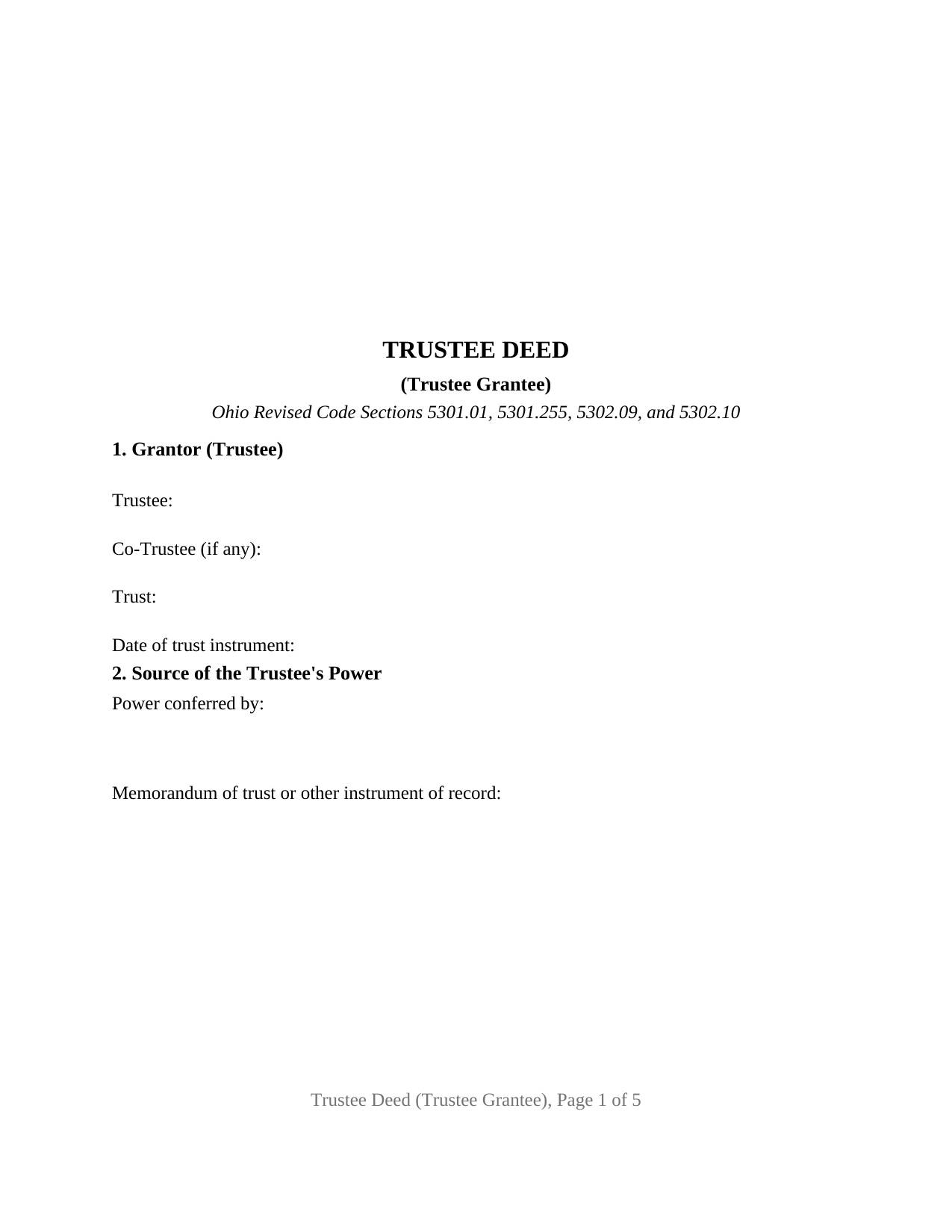
About the Ohio Trustee Deed (Trustee Grantee)
How to Use This Form
- Select your county from the list
- Download the county-specific form
- Fill in the required information
- Have the document notarized if required
- Record with your county recorder's office
What Others Like You Are Saying
"Ive been looking for a complete packet with all the forms needed!!"
"I loved using this process to record my deeds. it was fast and everytime I sent a message I received…"
"Excellent service. Easy to use. Thank you."
"I really appreciate your forms according to South Dakota laws and statues. Your forms allow me to ef…"
"Very easy to use... awaiting info"
4.8/5 from 4,829 reviews. Read all
When Ohio real estate moves from one trust to another, both names on the record are fiduciary ones: the trustee of the first trust conveys, and the grantee takes title as trustee of the second. This Ohio Trustee Deed (Trustee Grantee) is drafted for exactly that configuration. It carries the grantor's fiduciary capacity, the grantee's trustee capacity, and the words grants, with fiduciary covenants, that Ohio Revised Code Section 5302.09 prints in its statutory deed of a trustee.
A deed with a trustee on both sides
This deed is narrower than a trustee deed to an individual. The grantee section fixes the receiving party as a trustee, identifying the person by name, the trust under which that person holds, and the date of the trust instrument, and the conveyance sentence grants to that person as trustee of that trust. Trust title is the only vesting the form carries; the beneficial interests stay in the second trust's own instrument, which the deed does not set out.
The patterns that produce this deed in the Ohio record are a trustee distributing a parcel to the trustee of a separate trust created for one beneficiary, under the trust's own terms or under the further-trust power in Section 5808.18; trustees of two family trusts selling or exchanging a parcel between the trusts; and a trustee conveying to the trustee of a new or restated trust. The completed example shows the first of these.
What the fiduciary covenants promise
Section 5302.10 gives the phrase its meaning: the grantor covenants that the grantor is duly appointed, qualified, and acting in the fiduciary capacity the deed describes, is duly authorized to make the sale and conveyance, and has complied with the governing statutes. That is a promise about the trustee's office and authority, not about the chain of title, so the grantee trustee takes the interest the first trust held, subject to the encumbrances, reservations, and exceptions the deed lists.
The memorandum of trust the statute now requires
Since June 16, 2026, Section 5301.255 provides that a memorandum of trust, or another instrument meeting the section, shall be of record when any interest in real property is conveyed by the trustee of a disclosed trust. The memorandum is signed and acknowledged by the trustee and states the trustee's name and address, the date the trust was executed, and the trust's powers over real property with any restrictions on them. This deed gives that instrument its own line: Section 2 identifies the memorandum for the grantor trust by its recording reference, beside the trust article and Ohio Trust Code sections from which the power to convey comes. The memorandum is a separate instrument, recorded apart from this package.
One trustee or two co-trustees
The form carries a TRUSTEE signature block and a CO-TRUSTEE (if applicable) block, each followed by its own acknowledgment certificate printed in the Section 147.55(F) short form for a trustee. A trust with one trustee uses the first block and leaves the second empty; a trust with two co-trustees who join under Section 5807.03 uses both, and the separate certificates let the two acknowledge on different dates or before different officers. The deed recites no marital status, because the trustee conveys as trustee and not individually. The form is not set up as a conveyance to an individual taking in his or her own name, as a deed from an individual owner into a trust, as a deed for three or more co-trustees, or as a deed signed by an officer for a corporate trustee.
Auditor first, then recorder
An Ohio deed is presented to the county auditor with the DTE 100 conveyance fee statement, or the DTE 100EX exemption statement, before the recorder will accept it; Section 319.54(G)(3) lists the exempt transfers, several of which concern trusts. The deed carries the grantee's tax-mailing address and prior instrument reference that Section 319.20 requires, the preparer statement Section 317.111 requires, and the survey statement Section 5301.25(B) places in a deed when a survey was made.
The package includes the fillable trustee deed, a completed example filled in for a realistic Franklin County fact pattern, and a guide that walks through every numbered section, signing, and recording. This description and the guide describe the form and the governing Ohio statutes in general terms; they are not legal advice.
Important: County-Specific Forms
Our trustee deed (trustee grantee) forms are specifically formatted for each of the 88 counties in Ohio.
After selecting your county, you'll receive forms that meet all local recording requirements, ensuring your documents will be accepted without delays or rejection fees.