Ottawa County Transfer on Death Deed (Sole Owner, Multiple Beneficiaries (Equal Shares)) Form
Last validated November 21, 2026 by our Forms Development TeamFormatted for recording in Ottawa County, for property anywhere in the county: rural and unincorporated areas as well as Afton, Bluejacket, Cardin, Commerce, Fairland, Miami, North Miami, Picher and 2 more.
- 3 documents included
- Immediate PDF download
- Formatting guarantee
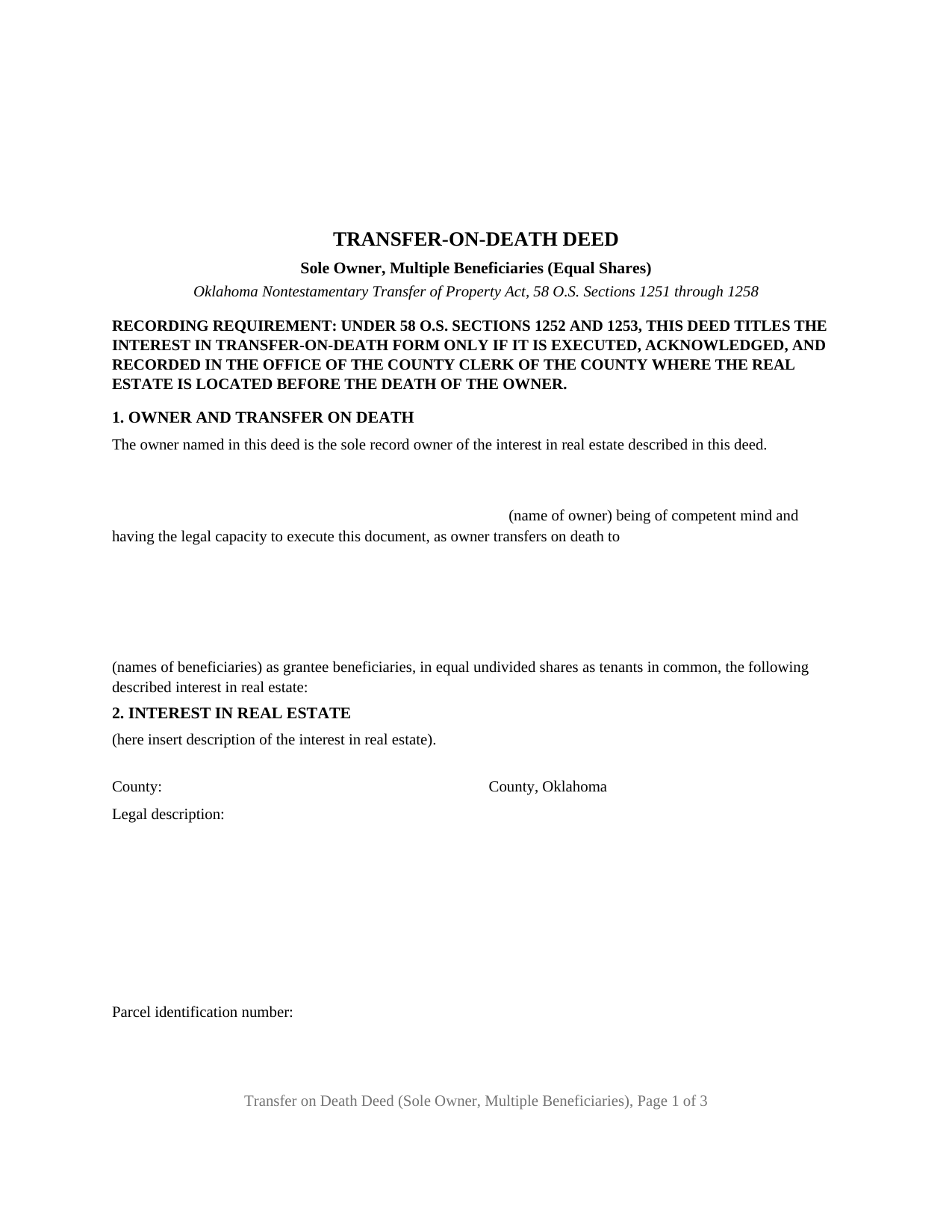
Ottawa County Transfer on Death Deed (Sole Owner, Multiple Beneficiaries (Equal Shares)) Form
Fill in the blank Transfer on Death Deed (Sole Owner, Multiple Beneficiaries (Equal Shares)) form formatted to comply with all Oklahoma recording and content requirements.
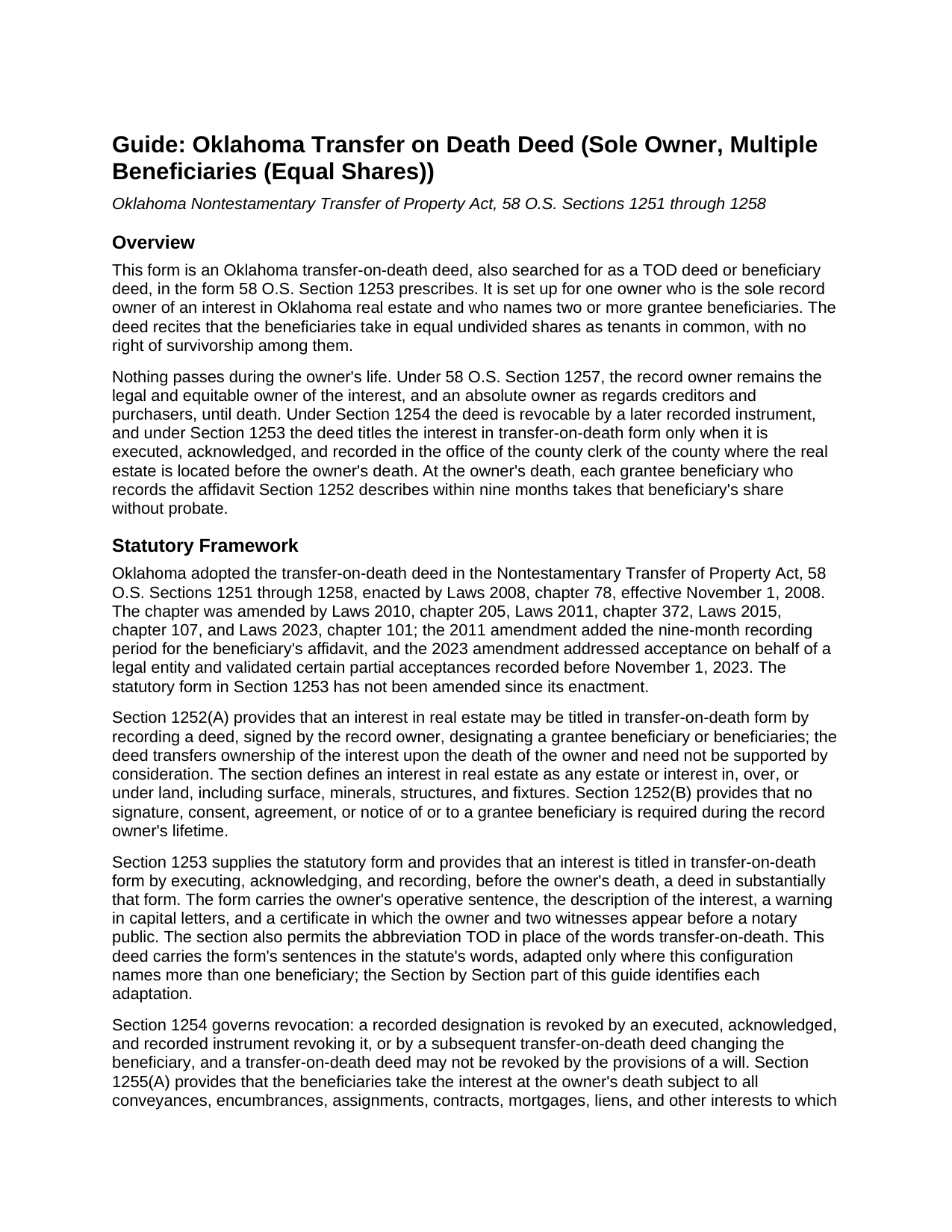
Ottawa County Transfer on Death Deed (Sole Owner, Multiple Beneficiaries (Equal Shares)) Guide
Line by line guide explaining every blank on the Transfer on Death Deed (Sole Owner, Multiple Beneficiaries (Equal Shares)) form.
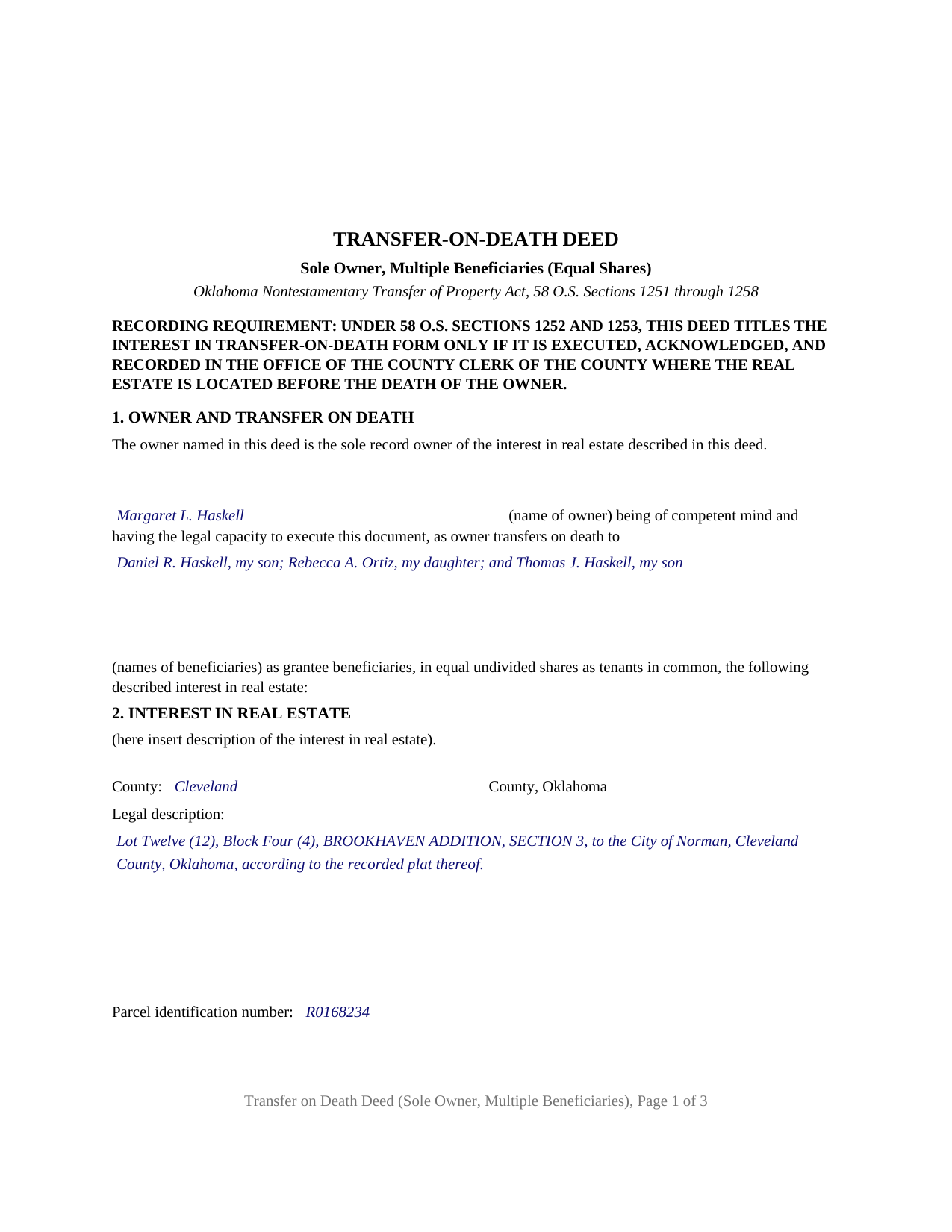
Ottawa County Completed Example of the Transfer on Death Deed (Sole Owner, Multiple Beneficiaries (Equal Shares)) Document
Example of a properly completed Oklahoma Transfer on Death Deed (Sole Owner, Multiple Beneficiaries (Equal Shares)) document for reference.
All 3 documents above included • One-time purchase • No recurring fees
Immediate Download • Secure Checkout
Additional Oklahoma and Ottawa County documents included at no extra charge:
Where to Record Your Documents
Ottawa County Clerk
Miami, Oklahoma 74354-7008
Hours: 9:00 to 5:00 M-F
Phone: (918) 542-3332
Recording Tips for Ottawa County:
- Bring your driver's license or state-issued photo ID
- Ensure all signatures are in blue or black ink
- Ask if they accept credit cards - many offices are cash/check only
- Check that your notary's commission hasn't expired
- Documents must be on 8.5 x 11 inch white paper
Cities and Jurisdictions in Ottawa County
Properties in any of these areas use Ottawa County forms:
- Afton
- Bluejacket
- Cardin
- Commerce
- Fairland
- Miami
- North Miami
- Picher
- Quapaw
- Wyandotte
Hours, fees, requirements, and more for Ottawa County
How do I get my forms?
Forms are available for immediate download after payment. The Ottawa County forms will be in your account ready to download to your computer. An account is created for you during checkout if you don't have one. Forms are NOT emailed.
Are these forms guaranteed to be recordable in Ottawa County?
Yes. Our form blanks are guaranteed to meet or exceed the applicable formatting requirements used for recording in Ottawa County, including margin requirements, font requirements, and other layout standards. This guarantee applies to formatting, not to the legal sufficiency of information entered by the user or the suitability of a form for a particular transaction.
Can I reuse these forms?
Yes. You can reuse the forms for your personal use. For example, if you have multiple properties in Ottawa County you only need to order once.
What do I need to use these forms?
The forms are PDFs that you fill out on your computer. The free Adobe Acrobat Reader is recommended, and most PDF apps also work. You do NOT enter your property information online - you download the blank forms and complete them privately on your own computer.
Are there any recurring fees?
No. This is a one-time purchase. Nothing to cancel, no memberships, no recurring fees.
How much does it cost to record in Ottawa County?
Recording fees in Ottawa County vary. Contact the recorder's office at (918) 542-3332 for current fees.
Questions answered? Let's get started!
One Oklahoma owner, two or more beneficiaries, and a deed that divides the property among them in equal shares at the owner's death: that is the configuration this Oklahoma transfer on death deed recites. It is built on the statutory form in 58 O.S. Section 1253 for an owner who is the sole record owner of the real estate, and the deed fixes the beneficiaries' shares as equal undivided shares as tenants in common, so that each beneficiary takes a separate, equal fraction at the death and none of them takes a deceased beneficiary's fraction by survivorship.
Equal shares, each beneficiary standing alone
Oklahoma's Nontestamentary Transfer of Property Act permits a transfer on death deed, sometimes searched for as a TOD deed or beneficiary deed, to designate a grantee beneficiary or beneficiaries (58 O.S. Section 1252(A)). The chapter states no default for how several beneficiaries share, and Oklahoma's co-ownership statute, 60 O.S. Section 74, creates a joint tenancy only when the instrument expressly declares one. This deed therefore says what the shares are. After the beneficiaries' names, the deed prints that they take as grantee beneficiaries, in equal undivided shares as tenants in common. Three beneficiaries take one third each; four take one quarter each.
The consequence of that wording appears if a beneficiary dies first. Under 58 O.S. Section 1255(B), where one or more of the grantee beneficiaries dies before the owner, the transfer to that beneficiary lapses, and the chapter supplies no substitute taker. The statute treats beneficiaries designated as joint tenants with right of survivorship differently, keeping the joint tenancy alive for those living at the owner's death; this deed makes no such designation, and the guide describes the lapse rule beside the equal-shares recital so the two are read together.
One owner, the statutory form, three signatures at the notary
The deed recites that the owner named in it is the sole record owner of the interest, and it carries exactly one owner signature line. The operative sentence is the statute's own: the named owner, being of competent mind and having the legal capacity to execute the document, as owner transfers on death to the named grantee beneficiaries the described interest in real estate. The warning the form prints after the description follows in capital letters, in the statute's words, stating that the deed is revocable, transfers no ownership until the owner's death, and revokes all prior beneficiary designations by this owner for this interest.
What makes the Oklahoma form distinctive is its certificate. The Section 1253 form has the owner and two witnesses appear together before a notary public: the owner declares that the deed is a revocable transfer on death of the described real estate, the witnesses declare that the owner asked them to sign and that they signed in the owner's and the notary's presence, and all three subscribe and acknowledge the deed before the notary, whose signature, seal, and commission expiration date close the certificate. The deed prints that certificate as the form prints it, with the owner's and witnesses' signature lines inside it, under the venue line The State of Oklahoma. Ordinary Oklahoma deeds require no witnesses (16 O.S. Section 2); the two witnesses on this deed are the statutory form's own structure.
Recorded before death, accepted after it
Two recording events frame an Oklahoma transfer on death deed. The first is the owner's: under Section 1253 the interest is titled in transfer-on-death form only when the deed is executed, acknowledged, and recorded with the county clerk of the county where the real estate is located before the owner's death. The deed carries that condition on its face as a recording notice. Until the death, nothing changes: under Section 1257 the owner remains the legal and equitable owner of the interest, free to sell or mortgage it, and under Section 1254 the owner may revoke the recorded designation by a later recorded instrument, which a will cannot do.
The second recording event belongs to the beneficiaries. Under Section 1252(C) and (D), each designated grantee beneficiary who wishes to accept executes an affidavit affirming the owner's death, whether the beneficiary and the owner were married at the time of death, and the legal description, attaches a copy of the death certificate, and records the affidavit within nine months of the owner's death, failing which that interest reverts to the owner's estate. With several beneficiaries named in equal shares, each records an acceptance for that beneficiary's own share. The acceptance affidavit is prepared after the death and is not included in this package.
What the counter reads
The form is laid out to 19 O.S. Section 298: a two-inch top margin on every page, one-inch margins elsewhere, clearly legible type, a specific legal description, and the mailing address of the person to whom the clerk returns the recorded deed. The county clerk's fee under 28 O.S. Section 32 is uniform statewide, eight dollars for the first page and two dollars for each additional page plus a ten-dollar preservation fee. The land-ownership affidavit that 60 O.S. Section 121 attaches to most deeds does not apply, because Section 121(C)(3) excludes transfer-on-death deeds from it. The deed also carries a blank for the county's parcel identification number, which a county that has adopted a parcel identifier system under 19 O.S. Section 299 requires on every instrument it records.
The homestead question the statute leaves open
Oklahoma Constitution Article XII, Section 2 and 16 O.S. Section 4 provide that no deed, mortgage, or contract relating to the homestead is valid unless both husband and wife subscribe it. The Nontestamentary Transfer of Property Act does not say whether that rule reaches a transfer on death deed, which transfers no ownership during the owner's life. This deed follows the statutory form, with one owner signature line and no signature line for a spouse who is not a record owner, and the guide sets out the constitutional and statutory text on the question in full.
The package includes the fillable transfer on death deed form, a completed example filled in for a realistic Oklahoma fact pattern with three equal-share beneficiaries, and the guide that walks through each section, the signing ceremony the statutory form prescribes, the recording rules, and the beneficiaries' acceptance after death. This description and the guide describe the form and the governing Oklahoma statutes in general terms; they are not legal advice.
Important: Your property must be located in Ottawa County to use these forms. Documents should be recorded at the county recording office listed above.
This Transfer on Death Deed (Sole Owner, Multiple Beneficiaries (Equal Shares)) meets all recording requirements specific to Ottawa County.
Our Promise
The documents you receive here are guaranteed to meet or exceed the applicable Ottawa County recording format requirements. If there is a rejection caused by our formatting, we will correct the issue or refund your payment. This guarantee applies to document formatting only and does not extend to information entered by the user, the selection of the form, or the legal effect of the completed document.
Save Time and Money
Get your Ottawa County Transfer on Death Deed (Sole Owner, Multiple Beneficiaries (Equal Shares)) form done right the first time with Deeds.com Uniform Conveyancing Blanks. At Deeds.com, we understand that your time and money are valuable resources, and we don't want you to face a penalty fee or rejection imposed by a county recorder for submitting nonstandard documents. We constantly review and update our forms to meet rapidly changing state and county recording requirements for roughly 3,500 counties and local jurisdictions.
4.8 out of 5 - ( 4,862 Reviews )
James N. 2 out of 5 stars
The purchasing process was very slick and my credit card was charged IMMEDIATELY. The deliver went well as the link was provided immediately. However I asked a question via the "Contact Us" link and days later I get a survey but no reply. I may have been directed to the wrong forms via my County and I wanted to confirm that...but still no answer. What would that deserve as a rating???
Also, your history on our site shows no messages sent via our contact us page.
james e. 5 out of 5 stars
Would be nice if these things downloaded with the type of document rather than a number
Thank you for your feedback. We really appreciate it. Have a great day!
Christine H. 5 out of 5 stars
Easy to use. Customer service is very responsive!
Thank you!
catherine c. 5 out of 5 stars
very efficient with communication and follow-up(s) will be using again, thank you!:)
Thank you!
Steve M. 5 out of 5 stars
I was only able to download the QC form. Had to print the other docs
Thank you for your feedback. We really appreciate it. Have a great day!
Cynthia G. 5 out of 5 stars
Thank you for this service, very helpful
We appreciate your business and value your feedback. Thank you. Have a wonderful day!
Loretta W. 5 out of 5 stars
Thank you for your excellent service
We appreciate your business and value your feedback. Thank you. Have a wonderful day!
Bethany F. 5 out of 5 stars
quick and easy to use
Thank you!
Norma C. 5 out of 5 stars
Great service and process for recording deeds quickly and easily. Also impressed with prompt replies to messages providing clear and specific instructions/guidance.
We appreciate your business and value your feedback. Thank you. Have a wonderful day!
Deborah P. 5 out of 5 stars
Very helpful! Easy and clear guidance. Good examples on sample forms.
We appreciate your business and value your feedback. Thank you. Have a wonderful day!
William S C. 5 out of 5 stars
The Lady Bird Deed appears to be fine with me as are the instructions. However, there apparently are no specific laws in Texas addressing them other than they are OK. The problem is that lenders are surely going to use them as triggers for their due on sale clauses, especially as the current small mortgage rates begin to increase. The solution to that seems to be to sign and have them notarized, but not to record them unless the holder needs to enforce the provisions. It seems to me that you should consider your solution to that problem in your instructions.
Thank you for your feedback. We really appreciate it. Have a great day!
Stephen M. 5 out of 5 stars
The process to record took five minutes of my time, and within 45 minutes, my document was recorded! Simple, efficient and affordable! Thanks!
Thank you for your feedback. We really appreciate it. Have a great day!
Kathy H. 5 out of 5 stars
Very accommodating and self explanatory.
It was a pleasure serving you. Thank you for the positive feedback!
Bea Lou H. 5 out of 5 stars
easy access and easy to find what I was looking for. Thank you
Thank you for your feedback. We really appreciate it. Have a great day!
Arnie M. 5 out of 5 stars
I found this to be a great experience, it was Fairley easy to upload my documents and your customer service was awsome.
We appreciate your business and value your feedback. Thank you. Have a wonderful day!