Columbia County Transfer on Death Deed (Sole Owner, Primary and Alternate Beneficiary) Form
Last validated November 22, 2026 by our Forms Development TeamFormatted for recording in Columbia County, for property anywhere in the county: rural and unincorporated areas as well as Clatskanie, Columbia City, Deer Island, Rainier, Saint Helens, Scappoose, Vernonia, Warren.
- 3 documents included
- Immediate PDF download
- Formatting guarantee
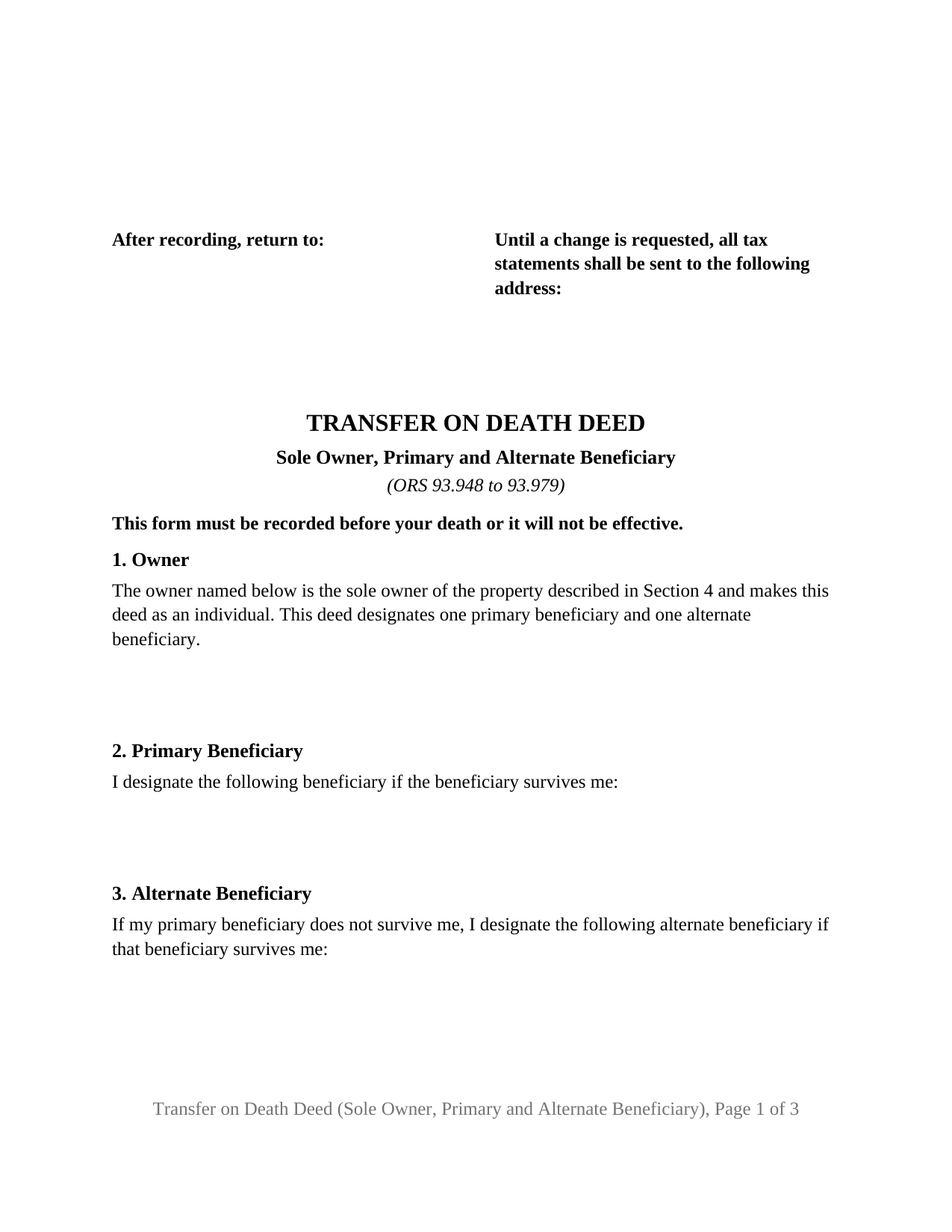
Columbia County Transfer on Death Deed (Sole Owner, Primary and Alternate Beneficiary) Form
Fill in the blank Transfer on Death Deed (Sole Owner, Primary and Alternate Beneficiary) form formatted to comply with all Oregon recording and content requirements.
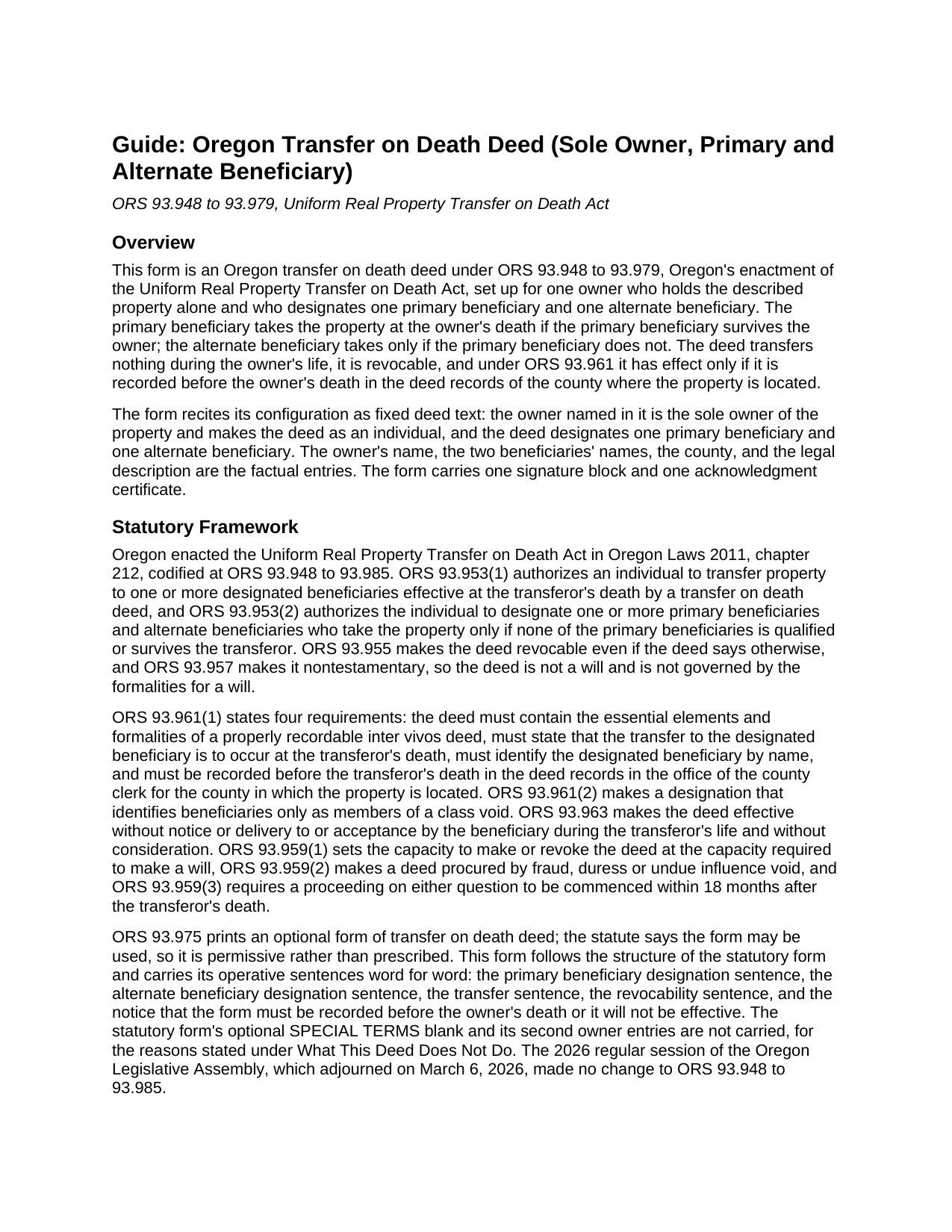
Columbia County Transfer on Death Deed (Sole Owner, Primary and Alternate Beneficiary) Guide
Line by line guide explaining every blank on the Transfer on Death Deed (Sole Owner, Primary and Alternate Beneficiary) form.
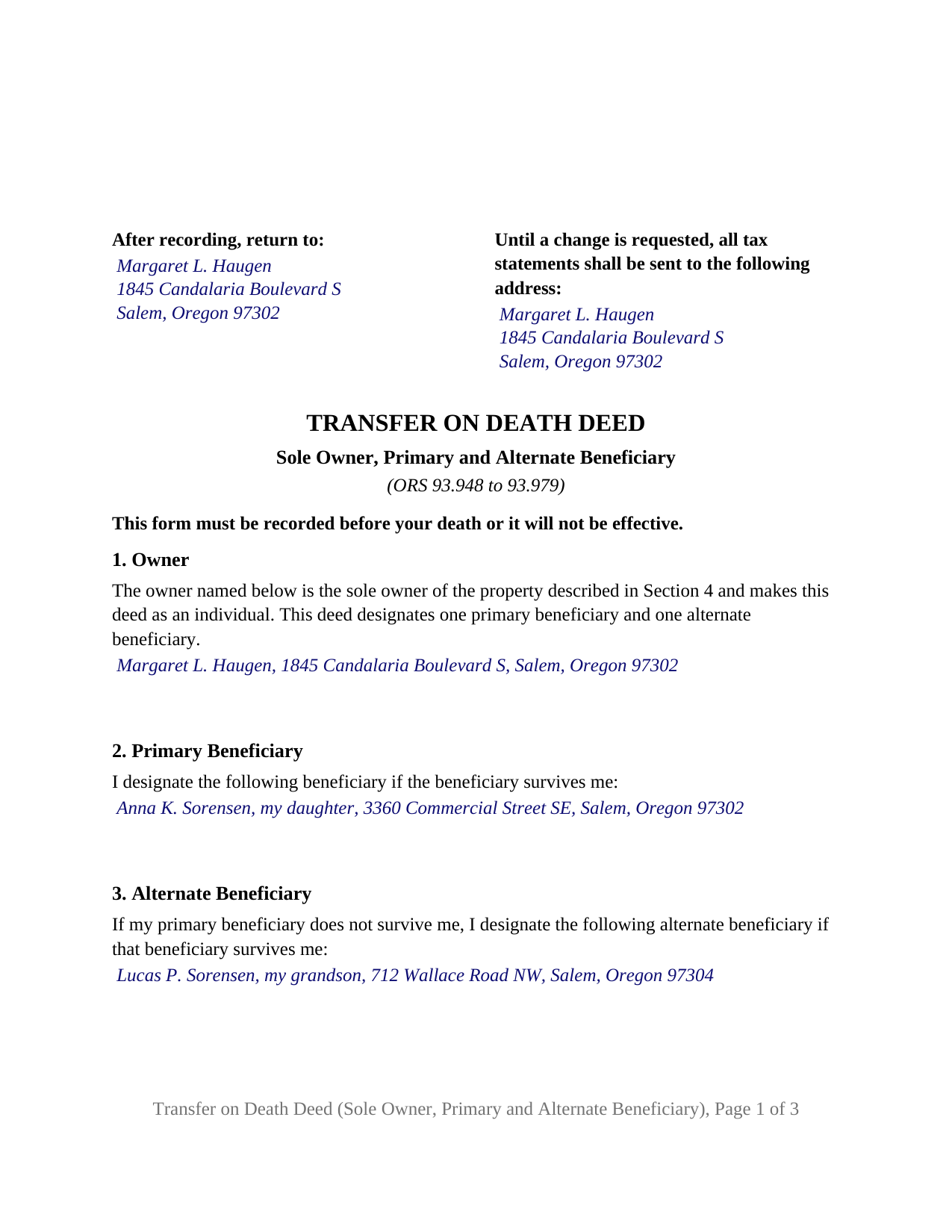
Columbia County Completed Example of the Transfer on Death Deed (Sole Owner, Primary and Alternate Beneficiary) Document
Example of a properly completed Oregon Transfer on Death Deed (Sole Owner, Primary and Alternate Beneficiary) document for reference.
All 3 documents above included • One-time purchase • No recurring fees
Immediate Download • Secure Checkout
Additional Oregon and Columbia County documents included at no extra charge:
Where to Record Your Documents
Columbia County Clerk
St. Helens, Oregon 97051
Hours: Mon-Fri 8:30 to 5:00 / Recording: 9:00 to 4:00
Phone: (503) 397-3796
Recording Tips for Columbia County:
- Bring your driver's license or state-issued photo ID
- Ensure all signatures are in blue or black ink
- Request a receipt showing your recording numbers
- Ask about accepted payment methods when you call ahead
- Ask for certified copies if you need them for other transactions
Cities and Jurisdictions in Columbia County
Properties in any of these areas use Columbia County forms:
- Clatskanie
- Columbia City
- Deer Island
- Rainier
- Saint Helens
- Scappoose
- Vernonia
- Warren
Hours, fees, requirements, and more for Columbia County
How do I get my forms?
Forms are available for immediate download after payment. The Columbia County forms will be in your account ready to download to your computer. An account is created for you during checkout if you don't have one. Forms are NOT emailed.
Are these forms guaranteed to be recordable in Columbia County?
Yes. Our form blanks are guaranteed to meet or exceed the applicable formatting requirements used for recording in Columbia County, including margin requirements, font requirements, and other layout standards. This guarantee applies to formatting, not to the legal sufficiency of information entered by the user or the suitability of a form for a particular transaction.
Can I reuse these forms?
Yes. You can reuse the forms for your personal use. For example, if you have multiple properties in Columbia County you only need to order once.
What do I need to use these forms?
The forms are PDFs that you fill out on your computer. The free Adobe Acrobat Reader is recommended, and most PDF apps also work. You do NOT enter your property information online - you download the blank forms and complete them privately on your own computer.
Are there any recurring fees?
No. This is a one-time purchase. Nothing to cancel, no memberships, no recurring fees.
How much does it cost to record in Columbia County?
Recording fees in Columbia County vary. Contact the recorder's office at (503) 397-3796 for current fees.
Questions answered? Let's get started!
A named fallback is the point of this Oregon transfer on death deed. The form is written for one owner who holds Oregon real property alone and who designates one primary beneficiary to take the property at the owner's death, plus one alternate beneficiary who takes only if the primary beneficiary does not survive the owner. Under ORS 93.948 to 93.979, Oregon's Uniform Real Property Transfer on Death Act, that second name is what keeps the deed working when the first name fails, and this configuration puts both names in the record on one instrument.
Why the alternate is a different kind of designation
ORS 93.953(2) lets an individual designate primary beneficiaries and alternate beneficiaries, and it draws the line between them in a single clause: an alternate takes the property only if none of the primary beneficiaries is qualified or survives the transferor. The alternate is therefore not a co-beneficiary and holds no share beside the primary. While the primary beneficiary is alive, the alternate designation is dormant; at the owner's death it operates in exactly one circumstance, the primary beneficiary's failure to survive or to qualify. The deed carries the two designation sentences the statutory form in ORS 93.975 prints, word for word: the owner designates the primary beneficiary if that beneficiary survives the owner, and designates the alternate if the primary does not survive and the alternate does. Each sentence sits over its own named-beneficiary blank, and the operative transfer sentence that follows, also the statutory form's own, sends the owner's interest to the beneficiaries as designated above.
How the designation resolves at death
ORS 93.969(1)(a) supplies the mechanism. A designated beneficiary's interest is transferred if the beneficiary survives the transferor and lapses if the beneficiary does not. On this deed that produces three outcomes and no others. A surviving primary beneficiary takes the owner's interest, and the alternate's name never operates. A primary beneficiary who died before the owner leaves a lapsed designation, and the surviving alternate takes instead. Where neither survives, both designations lapse and the property stays in the owner's estate to pass by will or intestacy, because the deed names no one else. Survival itself is measured by statute: ORS 93.969(1) is subject to Oregon's survivorship rules, ORS 112.570 names a transfer on death deed as a governing instrument for those rules, and ORS 112.578 deems a beneficiary to have died first unless survival by at least 120 hours is shown by clear and convincing evidence, subject to the exceptions ORS 112.586 lists for instruments that address simultaneous death or set their own survival period. This form sets none, so the statutory measure applies to both names as written.
Oregon also writes a divorce rule into the chapter. Under ORS 93.981, a divorce or annulment after the deed is recorded revokes every provision in favor of the former spouse unless the deed evidences a different intent, and the former spouse is treated as not having survived. A former spouse named as the primary beneficiary on this form is therefore treated as having failed to survive, and the alternate takes if the alternate survives the owner. A beneficiary may also disclaim under ORS 93.971, and a primary beneficiary who disclaims is a primary beneficiary who is not qualified, which is the other door through which ORS 93.953(2)(b) sends the property to the alternate.
The configuration this deed recites
The deed prints its configuration as fixed text rather than leaving it to a selector. The owner named in Section 1 is recited as the sole owner of the property and as making the deed as an individual, and the deed states that it designates one primary beneficiary and one alternate beneficiary. There is one signature block under the heading OWNER and one acknowledgment certificate, drawn with the ORS 194.285(1) short form sentence and a reserved area for the notarial officer's official stamp under ORS 194.280(3). The form prints no marital status and asks for none, because Oregon has no community property regime and ORS 112.685 abolished dower and curtesy; a spouse who is not on the title is not a transferor under ORS 93.949(7) and has no signature line. Either beneficiary may be a natural person, a trust named through its trustee, or an entity by its legal name, each identified by name as ORS 93.961(1)(c) requires, since a designation to a class is void under ORS 93.961(2).
A parent naming one adult child with a grandchild behind that child, an owner naming a sibling with a niece or nephew as the fallback, and an owner naming a partner with a charity as the alternate present the pattern this deed recites: one sole owner, one first name, one second name. The deed is not set up as a designation of two or more primary beneficiaries, of two or more alternates, or of shares; it omits the optional SPECIAL TERMS blank the statutory form prints, so the chapter's survival, lapse and alternate rules apply with no provision varying them. Two owners on one instrument, an owner holding as a tenant by the entirety or other joint owner within ORS 93.949(3), an owner that is an entity or a trustee, and an owner signing through an attorney-in-fact are configurations outside what this form recites.
Recording is the condition, and the first page is built for it
Under ORS 93.961(1)(d) the deed takes effect only if it is recorded, before the owner dies, with the county clerk of the county where the land lies; the statutory form's own warning to that effect is printed directly under the title, the one notice the recorded instrument keeps. The owner's position is otherwise untouched: ORS 93.967 provides that during the owner's life the deed does not affect the owner's right to transfer or encumber the property, creates no interest in either beneficiary, and does not affect public or medical assistance eligibility. ORS 93.955 keeps the deed revocable, and ORS 93.965 limits revocation to a later acknowledged and recorded instrument, so replacing either name means recording a new deed or an instrument of revocation, prepared separately and not included in this package, rather than editing the recorded one.
Oregon's recording statute, ORS 205.234, places the transaction name, the indexed party names, the return address and the ORS 93.260 tax statement address on the first page, and this form lays recorded page one out to that inventory: the return block and the tax statement block above the title, then the owner, the primary beneficiary and the alternate beneficiary, with two inches open at the top for the clerk's recording label. The recorded instrument runs three pages. Fees are set county by county; Marion County, the county of the completed example, published $86 for a one page deed plus $5 for each additional page as of November 2026.
The download delivers the fillable Oregon transfer on death deed, also searched as a beneficiary deed or TOD deed, with its non-recorded instructions cover page, a completed example filled in for a fictional Marion County owner naming her daughter as primary beneficiary and her grandson as alternate, and a guide that explains each section of the form against the statutes it rests on. This description and the guide are general information about the form and Oregon law, not legal advice, and neither applies the law to anyone's particular facts.
Important: Your property must be located in Columbia County to use these forms. Documents should be recorded at the county recording office listed above.
This Transfer on Death Deed (Sole Owner, Primary and Alternate Beneficiary) meets all recording requirements specific to Columbia County.
Our Promise
The documents you receive here are guaranteed to meet or exceed the applicable Columbia County recording format requirements. If there is a rejection caused by our formatting, we will correct the issue or refund your payment. This guarantee applies to document formatting only and does not extend to information entered by the user, the selection of the form, or the legal effect of the completed document.
Save Time and Money
Get your Columbia County Transfer on Death Deed (Sole Owner, Primary and Alternate Beneficiary) form done right the first time with Deeds.com Uniform Conveyancing Blanks. At Deeds.com, we understand that your time and money are valuable resources, and we don't want you to face a penalty fee or rejection imposed by a county recorder for submitting nonstandard documents. We constantly review and update our forms to meet rapidly changing state and county recording requirements for roughly 3,500 counties and local jurisdictions.
4.8 out of 5 - ( 4,862 Reviews )
Brenda S. 5 out of 5 stars
Awesome forms, filled them out on my computer, printed them out complete, notarized, recorded, wonderful process. THANKS
Thank you for the kind words Brenda. Have a great day!
Robert W. 5 out of 5 stars
Exactly what I needed. Thank you
Thank you!
Christine G. 5 out of 5 stars
. Easy to use.
Thank you for your feedback. We really appreciate it. Have a great day!
Emy G. 5 out of 5 stars
I don’t have to hire a lawyer to fill up my “Death Upon Death form because the deed.com guide me on how to fill it up.
Thank you for your kind words and for choosing us.
Lori G. 5 out of 5 stars
thank you for all your help and patience. I would highly recommend Deeds.com to everyone. Sincerely, Lori G.
Thank you!
Dretha W. 5 out of 5 stars
Ordered the fill in the blank form for a deed. Very professional looking but more importantly, correct for my recording office. It was recorded with no question. The guide was a big help in completed the deed.
Great to hear Dretha. We appreciate you taking the time to leave your feedback. Have a wonderful day!
Lola C. 5 out of 5 stars
The process was efficient, from initiation to follow up took two days. This was a step in the right direction that was without delay or frustration occurring with other steps in filing.
We appreciate your review and your business. Thank you.
Angela W. 5 out of 5 stars
All went well.
Thank you for your feedback. We really appreciate it. Have a great day!
Harry B. 5 out of 5 stars
I received exactly what I was looking for on Deeds.com. Not only that, but this website provided instructions for form completion, and an example of a completed form. I'm certainly glad I chose this website.
Thank you for your feedback. We really appreciate it. Have a great day!
ROBERT H. 5 out of 5 stars
No review provided.
Thank you!
Lloyd S. 5 out of 5 stars
What a great website. It does Pasco County PROUD !!
Thank you!
Julie C. 5 out of 5 stars
The process worked great! It's a great solution for recording documents at the county during the pandemic and in the future if you don't want to leave home!!
Thank you!
Cameron Z. 5 out of 5 stars
Outstanding!! The guidelines and example pages were clear and easy to comprehend. Saved me 410 dollars over having to hire a lawyer.
Great to hear — thank you for taking the time to write a review.
Brian S. 3 out of 5 stars
PDF fields change font sizes leading to an unprofessional-appearing printed page. The examples for "Convey to" section don't include how to specify just one person instead of a married couple. Maybe that is simple but it would help to spell it out in an example. Haven't submitted to County Recorder yet, so will find out if it is acceptable.
Thank you for the feedback Brian.
The font issue is caused by using a PDF viewer other than Adobe Acrobat Reader. Our form fields are set to a uniform 12-point font, but non-Adobe viewers often render form fields inconsistently. Opening and printing the form with the free Adobe Acrobat Reader will resolve that.
Regarding the examples, that's a fair point, we'll look at expanding them.
Stephen M. 5 out of 5 stars
Easy to sign up and create an account. Lots of options.
Thank you!