Montgomery County Personal Representative Deed Form
Last validated October 8, 2026 by our Forms Development TeamFormatted for recording in Montgomery County, for property anywhere in the county: rural and unincorporated areas as well as Abington, Ambler, Arcola, Ardmore, Audubon, Bala Cynwyd, Blue Bell, Bridgeport and 70 more.
- 3 documents included
- Immediate PDF download
- Formatting guarantee
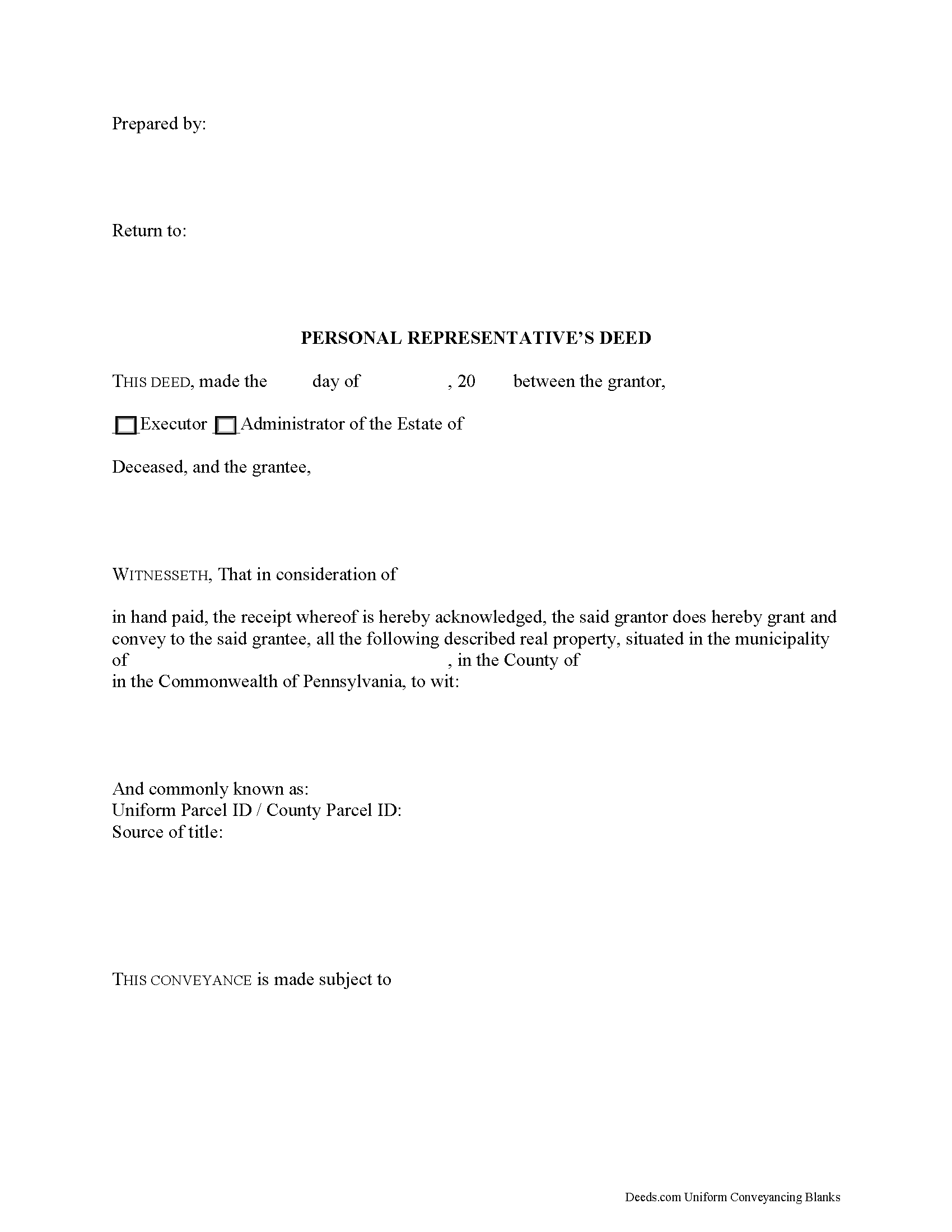
Montgomery County Personal Representative Deed Form
Fill in the blank form formatted to comply with all recording and content requirements.
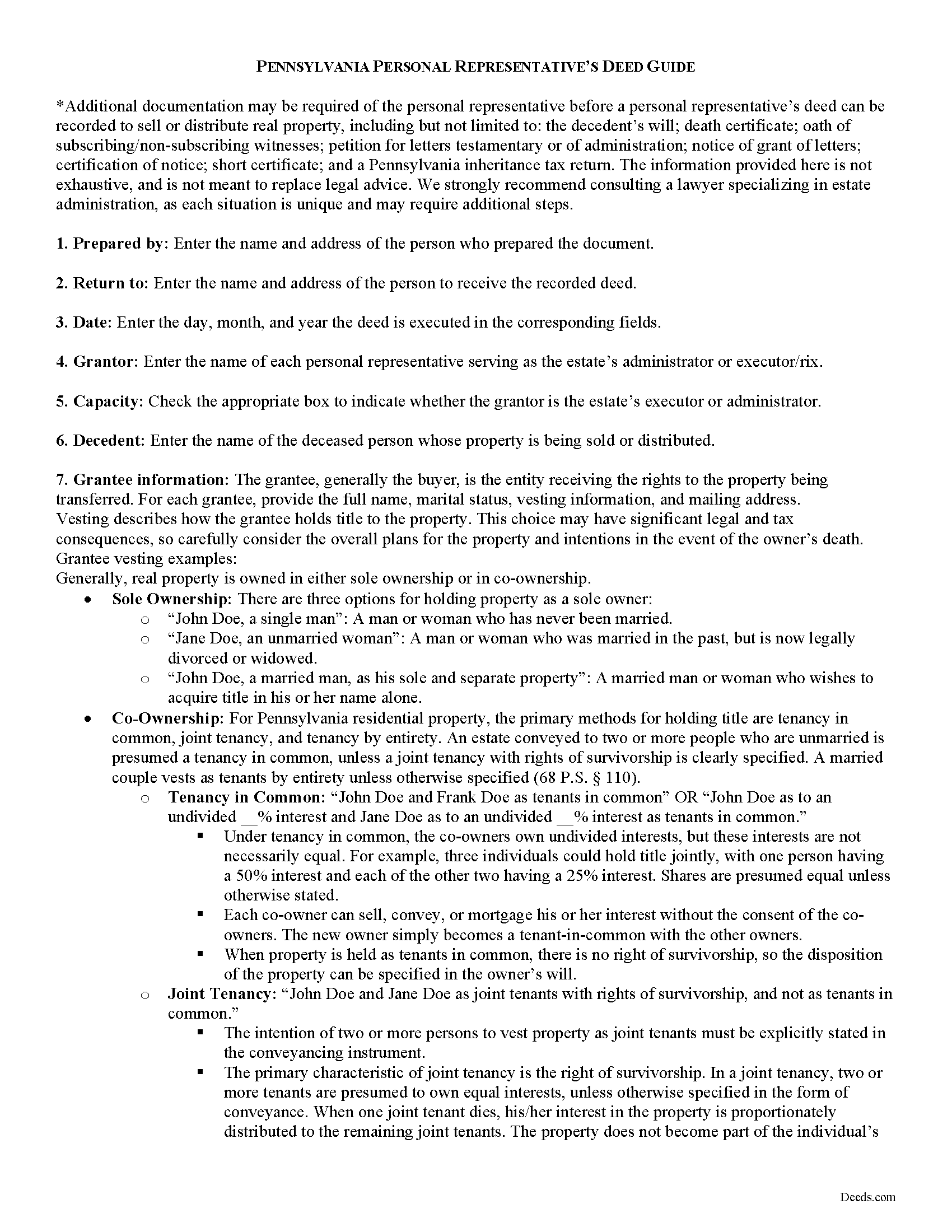
Montgomery County Personal Representative Deed Guide
Line by line guide explaining every blank on the form.
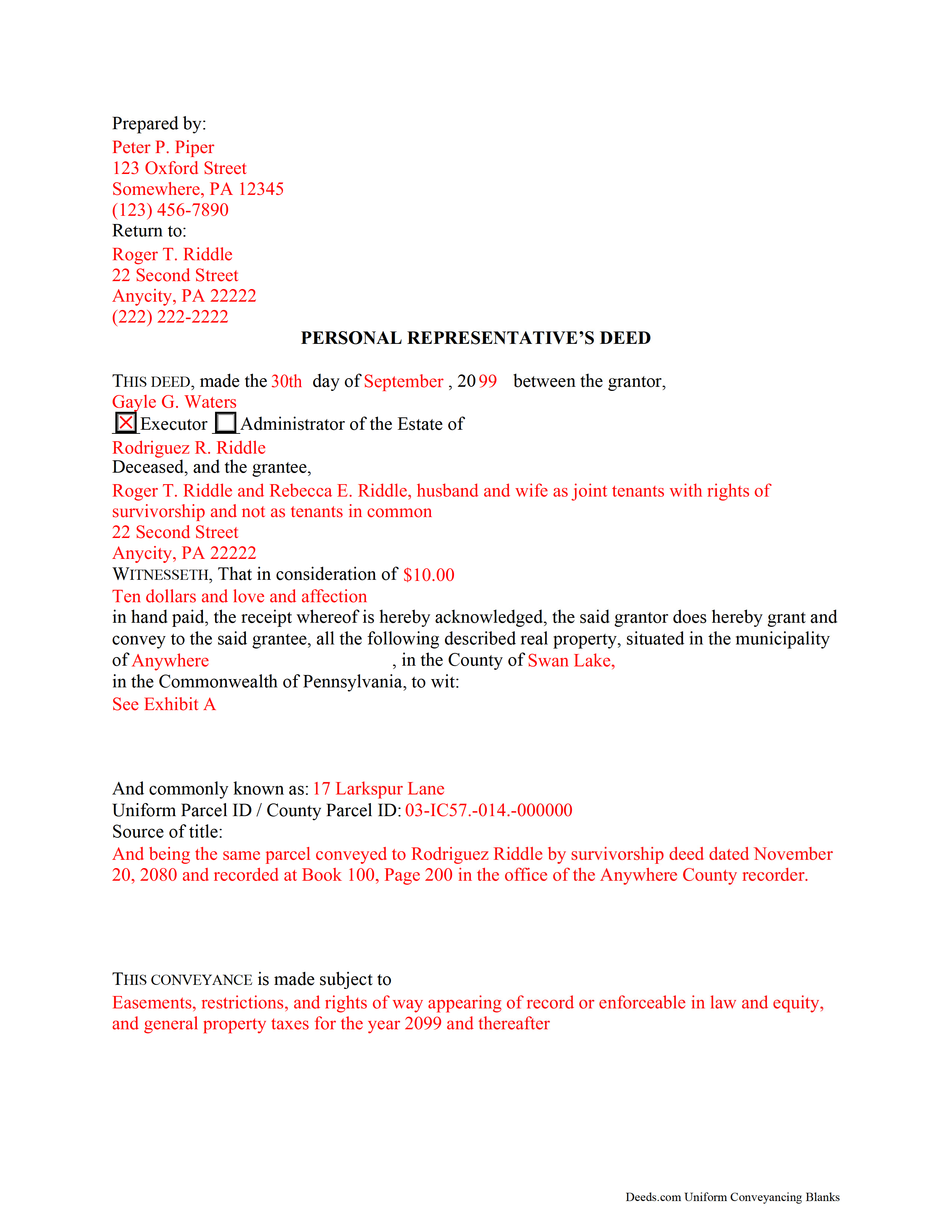
Montgomery County Completed Example of the Personal Representative Deed Document
Example of a properly completed form for reference.
All 3 documents above included • One-time purchase • No recurring fees
Immediate Download • Secure Checkout
Additional Pennsylvania and Montgomery County documents included at no extra charge:
Where to Record Your Documents
Montgomery County Recorder of Deeds
Norristown, Pennsylvania 19404-0311
Hours: 8:30 to 4:15 M-F
Phone: (610) 278-3289
Recording Tips for Montgomery County:
- Bring your driver's license or state-issued photo ID
- Ensure all signatures are in blue or black ink
- Both spouses typically need to sign if property is jointly owned
- Bring extra funds - fees can vary by document type and page count
- Check margin requirements - usually 1-2 inches at top
Cities and Jurisdictions in Montgomery County
Properties in any of these areas use Montgomery County forms:
- Abington
- Ambler
- Arcola
- Ardmore
- Audubon
- Bala Cynwyd
- Blue Bell
- Bridgeport
- Bryn Athyn
- Cedars
- Cheltenham
- Collegeville
- Colmar
- Conshohocken
- Creamery
- Dresher
- Eagleville
- Earlington
- East Greenville
- Elkins Park
- Fairview Village
- Flourtown
- Fort Washington
- Franconia
- Frederick
- Gilbertsville
- Gladwyne
- Glenside
- Green Lane
- Gwynedd
- Gwynedd Valley
- Harleysville
- Hatboro
- Hatfield
- Haverford
- Horsham
- Huntingdon Valley
- Jenkintown
- King Of Prussia
- Kulpsville
- Lafayette Hill
- Lansdale
- Lederach
- Mainland
- Merion Station
- Mont Clare
- Montgomeryville
- Narberth
- Norristown
- North Wales
- Oaks
- Oreland
- Palm
- Pennsburg
- Perkiomenville
- Plymouth Meeting
- Pottstown
- Red Hill
- Royersford
- Salford
- Salfordville
- Sassamansville
- Schwenksville
- Skippack
- Souderton
- Spring House
- Spring Mount
- Sumneytown
- Telford
- Tylersport
- Valley Forge
- West Point
- Willow Grove
- Worcester
- Woxall
- Wyncote
- Wynnewood
- Zieglerville
Hours, fees, requirements, and more for Montgomery County
How do I get my forms?
Forms are available for immediate download after payment. The Montgomery County forms will be in your account ready to download to your computer. An account is created for you during checkout if you don't have one. Forms are NOT emailed.
Are these forms guaranteed to be recordable in Montgomery County?
Yes. Our form blanks are guaranteed to meet or exceed the applicable formatting requirements used for recording in Montgomery County, including margin requirements, font requirements, and other layout standards. This guarantee applies to formatting, not to the legal sufficiency of information entered by the user or the suitability of a form for a particular transaction.
Can I reuse these forms?
Yes. You can reuse the forms for your personal use. For example, if you have multiple properties in Montgomery County you only need to order once.
What do I need to use these forms?
The forms are PDFs that you fill out on your computer. The free Adobe Acrobat Reader is recommended, and most PDF apps also work. You do NOT enter your property information online - you download the blank forms and complete them privately on your own computer.
Are there any recurring fees?
No. This is a one-time purchase. Nothing to cancel, no memberships, no recurring fees.
How much does it cost to record in Montgomery County?
Recording fees in Montgomery County vary. Contact the recorder's office at (610) 278-3289 for current fees.
Questions answered? Let's get started!
Using a Personal Representative's Deed in Pennsylvania
--
The information provided in this article is not meant to be exhaustive, and should not take the place of legal advice. We strongly recommend consulting a lawyer when administering an estate, as each situation is unique. Personal representatives have a fiduciary duty to serve in the estate's best interests, and are "personally liable for undue mistakes made in the administration of the decedent's estate" [1].
--
When Pennsylvania residents die, their estate is admitted to probate, regardless of whether they left a will. A will is a legal document whereby a person (testator) gives directions for the distribution of personal assets upon death, and identifies who will administer the estate. Probate is the legal process of distributing assets. In the Commonwealth of Pennsylvania, this process, also referred to as estate administration, is governed by Title 20 et seq. of the Pennsylvania Code (Decedents, Estates, and Fiduciaries).
A probate case begins with the Register of Wills for the county where the deceased claimed permanent residence. Those with property situated in two or more counties also require ancillary probate proceedings. The decedent's will, if one exists, is recorded at this time, along with supporting documents (ex. death certificate, affidavit of subscribing or non-subscribing witness, petition for grant of letters). Pennsylvania implements an expedited probate for estates valued under $50,000.
Upon petition for grant of letters, the Register of Wills issues letters of administration or letters testamentary, depending on whether the decedent died testate (with a will) or intestate (without a will). The letters are a document granting formal authority to the fiduciary who will administer the estate, and are filed as part of the probate case. Fiduciaries may also obtain a short certificate from the Register certifying their capacity to administer the decedent's estate.
This fiduciary is known generally as a "personal representative," or more specifically as either an executor (or executrix, if female) or an administrator. The term "executor" is used when the decedent died with a will and named an executor. The term "administrator" is used when (1) the decedent died without a will (2) the decedent died testate but failed to name an executor in the will, or (3) the decedent died with a will and named an executor, but the executor failed or ceased service. In short, an executor is someone designated by will as the personal representative, whereas an administrator is someone appointed by the Register.
All assets owned solely by the decedent must go through probate. Concerning real property, when the decedent vests title as a sole owner or as a tenant in common, the real property will need to go through probate before it can be distributed by the personal representative. Real property vested with rights of survivorship between or among joint tenants or between husband and wife as tenants by the entirety automatically vests in the surviving joint tenant(s) or spouse. Property held in trust may also avoid probate.
The personal representative has several responsibilities as fiduciary, including submitting a comprehensive inventory of the estate, filing a Pennsylvania Inheritance Tax Return, giving notice to beneficiaries, and paying any debts, before any distribution of assets can occur. Depending on the situation, this process may take several months, so seek legal advice to ensure that all requisite steps are met.
When the decedent leaves instructions for the succession of real property, the named beneficiaries in the will are called devisees. When there is no will, Pennsylvania laws of intestacy determine the succession of the decedent's real property, with title flowing to the decedent's heirs at law. Depending on the situation, the personal representative may sell the decedent's real property [2].
In Pennsylvania, both executors and administrators use the personal representative's deed to distribute or sell real property. As with other types of deeds executed by grantors in a representative capacity (such as trustee's deeds), the personal representative's deed in Pennsylvania typically carries a special warranty, covenanting that the grantor will warrant and defend the property against the lawful claims and demands of the grantor or grantors, and all persons claiming or to claim by, through, or under him or them (21 P.S. 6). The special warranty is fitting for grantors who are transferring property indirectly, or on behalf of, an estate, as they may not have comprehensive knowledge of the title's history prior to the decedent's death.
The deed identifies the acting personal representative as either an executor or administrator, as well as the decedent and date of death. In addition to the grantee and vesting information, legal description of the subject property, and title derivation required for documents pertaining to interests in real property, the personal representative's deed cites the date of the testator's will, if any; the date of probate; the county of probate; the file or case number; and the name of the personal representative.
The deed is signed by the acting representative in the presence of a notary public and recorded in the county Register of Deeds in which the subject real property is situated. Additional notices may be required in Pennsylvania concerning coal and mine subsidence, and supporting documents such as a death certificate and a short certificate may be required to verify the personal representative's authority to convey real property.
To formally close probate, the personal representative must file a report of completion with the register of wills.
If administration of estate not complete within two years of the decedent's date of death, the personal representative may have to file a status report with Register of Wills.
See more forms relating to estate administration at http://www.revenue.pa.gov/FormsandPublications/FormsforIndividuals/Pages/Inheritance-Tax.aspx#.WFABK-YrLIU.
Contact a lawyer with questions regarding estate administration and probate in Pennsylvania.
[1] http://www.whiteandwilliams.com/resources-alerts-Personal-Representatives-and-Fiduciaries-Executors-Administrators-and-Trustees-and-Their-Duties.html
[2] http://www.stallardlawoffice.com/single-post/2015/09/19/Posts-on-Pennsylvania-Real-Property-Title-Death-Wills-and-Joint-Ownership
(Pennsylvania PRD Package includes form, guidelines, and completed example)
Important: Your property must be located in Montgomery County to use these forms. Documents should be recorded at the county recording office listed above.
This Personal Representative Deed meets all recording requirements specific to Montgomery County.
Our Promise
The documents you receive here are guaranteed to meet or exceed the applicable Montgomery County recording format requirements. If there is a rejection caused by our formatting, we will correct the issue or refund your payment. This guarantee applies to document formatting only and does not extend to information entered by the user, the selection of the form, or the legal effect of the completed document.
Save Time and Money
Get your Montgomery County Personal Representative Deed form done right the first time with Deeds.com Uniform Conveyancing Blanks. At Deeds.com, we understand that your time and money are valuable resources, and we don't want you to face a penalty fee or rejection imposed by a county recorder for submitting nonstandard documents. We constantly review and update our forms to meet rapidly changing state and county recording requirements for roughly 3,500 counties and local jurisdictions.
4.8 out of 5 - ( 4,820 Reviews )
DELORES D. 5 out of 5 stars
SO EASY. love that there is an example to follow and instructions.
Thank you!
Stefan L. 5 out of 5 stars
Great templates and very efficient
We appreciate your business and value your feedback. Thank you. Have a wonderful day!
David J. 5 out of 5 stars
Very easy to use and saved a lot of time
Thank you!
Glenn W. 5 out of 5 stars
I love this tool and it is easy to work with. The interface is straight forward and notifications are consistently accurate.
Thank you for your feedback. We really appreciate it. Have a great day!
john g. 4 out of 5 stars
no problems got what i needed.
Thanks John.
Sarah A. 5 out of 5 stars
Uploading the document was simple, and it was recorded much faster than I thought! Deeds.com makes the process incredibly easy.
We appreciate your business and value your feedback. Thank you. Have a wonderful day!
Grace G. 3 out of 5 stars
I like the service, it is hard to see enough of the document to know you're choosing what you need.
Thank you for your feedback. Our previews are intended to show general format and layout. Because these are legal forms, customers should already know the type of document they need before purchasing.
Clayton M. 5 out of 5 stars
Five stars from me. this is a very useful service with great results.
We appreciate your business and value your feedback. Thank you. Have a wonderful day!
Richard L. 5 out of 5 stars
very useful
Thank you!
Johnnie W. 5 out of 5 stars
Five stars for quick retrieval/no hassle of forms. Will review them again once I have completed the forms and they have been accepted.
Thank you for your feedback. We really appreciate it. Have a great day!
LeAnne A. 5 out of 5 stars
Documents are helpful and much appreciated. Grateful for this service when an attorney is not required.
We appreciate your business and value your feedback. Thank you. Have a wonderful day!
Pamela L. 5 out of 5 stars
Fast efficient informative. Thank you.
Thank you for your feedback. We really appreciate it. Have a great day!
Sophia G. 5 out of 5 stars
Hassle free service , and don't have to wait in line
Thank you for your feedback. We really appreciate it. Have a great day!
Flordeliza R. 5 out of 5 stars
Once I was able to get my scanner working and provide good quality scans, the turnaround was quick and my documents were recorded and returned to me the same day with the Recorder's Stamp for download. Deeds.com staff was able to guide me to make sure my package was complete. Thank you!
We appreciate your business and value your feedback. Thank you. Have a wonderful day!
NATALIE A. 5 out of 5 stars
The form was very easy to use and the sample tool you had was very helpful. the only problem i had was saving the document and then trying to find it later. I finally was able to figure out how to save it. but i still cannot find the saved document on my computer. Luckily i printed it before i closed it and did not need to make any changes.
Thank you for your feedback. We really appreciate it. Have a great day!