Texas Affidavit of Death (Transfer on Death Beneficiary)
County Specific Legal Forms Validated as recently as October 15, 2026 by our Forms Development Team
About the Texas Affidavit of Death (Transfer on Death Beneficiary)
How to Use This Form
- Select your county from the list
- Download the county-specific form
- Fill in the required information
- Have the document notarized if required
- Record with your county recorder's office
What Others Like You Are Saying
"Great service. The issue I had was uploading the file of several pages. Once I learned, everything b…"
"Deeds.com provides outstanding service! Quick e-recording, at a reasonable price, and if there are a…"
"Used this site and the forms a few times now and always a good experience. It's so nice to be able t…"
"Thank you for your great response on my needs. In less than 24 hours I had my documents in hand as n…"
"Thank You, I will be looking forward to printing these files, and getting this Ladybird deed in plac…"
4.8/5 from 4,828 reviews. Read all
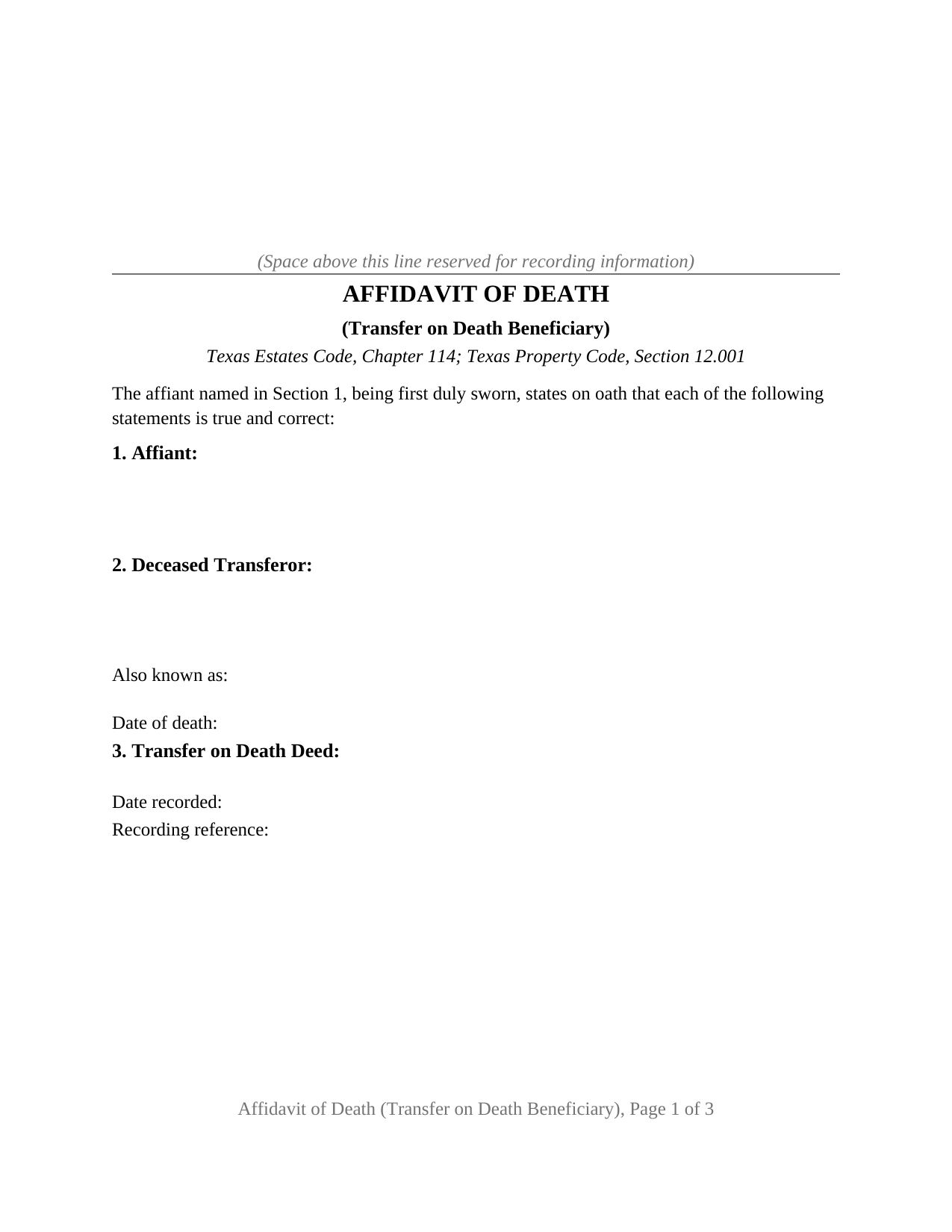
This Texas Affidavit of Death is the sworn statement a beneficiary records after the owner who signed a transfer on death deed has died. It is built for one affiant, the beneficiary designated in that recorded deed, and it carries one jurat. Its sworn statements track what Chapter 114 of the Texas Estates Code makes relevant at the transferor's death, and a certified copy of the death certificate rides with it into the county records as Exhibit A.
The transfer already happened; the record has not caught up
Under Section 114.103 of the Estates Code, the transferor's interest passes at death to a designated beneficiary who survives the transferor by 120 hours, by force of the transfer on death deed recorded during the transferor's life (an instrument recorded separately and not part of this package). No court is involved and no new deed is signed. What the county records show the day after the death, though, is a deed waiting to operate. A title examiner handling the beneficiary's later sale or refinance needs the connection made of record: this transferor died, the deed was never revoked, and this beneficiary survived and qualified. The affidavit supplies exactly that, sworn, in the deed records. Chapter 114 prescribes no post-death filing; the affidavit is Texas title practice, recordable under Property Code Section 12.001 because it is sworn to with a proper jurat.
Six statements the beneficiary swears to
The sworn statements are fixed printed text, so the affiant fills in facts and swears to the conclusions the statute cares about: that the transferor died on the date shown and that a certified copy of the death certificate is attached as Exhibit A, which Property Code Section 12.0011 lets the clerk record with a sworn affidavit; designated beneficiary status and survival by more than 120 hours; that the transferor owned the interest at death; and that no instrument of revocation, no later inconsistent transfer on death deed, and no recorded notice of a divorce judgment between the transferor and the affiant appears of record in the county where the deed is recorded, the recorded events Section 114.057 recognizes as revoking a deed.
Built for the last surviving transferor
One statement does work that generic affidavits skip. A deed made by two joint owners with right of survivorship is effective, under Section 114.103(b), only at the death of the last surviving joint owner, and a deed made by spouses holding community property with right of survivorship operates at the second death by its own terms. For either deed the affidavit is recorded after that last death, and Statement 5.4 has the affiant swear that the transferor named in the affidavit was the last surviving transferor. On a deed made by one transferor the condition never arises, so one affidavit form documents a death under any of the three Texas deed patterns without a selector or a conditional blank.
What the blanks collect
The factual entries are few: the affiant's name and mailing address; the deceased transferor's name as the deed states it, an also known as line for the name the death certificate uses, and the date of death; the deed's recording date and reference from the clerk's stamp or index; and the county and legal description, copied from the deed so the two instruments match. Everything else on the recordable pages is fixed text; the instructions cover page, which is not recorded, carries the entry conventions and the exhibit rule.
Sworn, not acknowledged
Because the document is an affidavit, the beneficiary signs in the presence of a notary and swears to the statements, and the notary completes a jurat rather than the acknowledgment certificate found on deed forms. Texas prescribes no jurat wording; the sworn to and subscribed certificate on this form follows the sample the Secretary of State publishes for Texas notaries, with venue lines that reflect wherever the affiant actually appears. The form is letter size, prints at 12 point body text above the 8 point minimum of Local Government Code Section 191.007, and reserves the top of page one for the clerk's recording stamp. Because the affidavit transfers nothing, it carries no Property Code Section 11.008 confidentiality notice.
The package includes the fillable affidavit form, a completed example filled in for a realistic Texas fact pattern, and the guide that walks through every section, the governing statutes, signing, and recording. This description and the guide describe the form and the law in general terms; they are not legal advice.
Important: County-Specific Forms
Our affidavit of death (transfer on death beneficiary) forms are specifically formatted for each of the 254 counties in Texas.
After selecting your county, you'll receive forms that meet all local recording requirements, ensuring your documents will be accepted without delays or rejection fees.