Vermont Certificate of Trust (Entity Trustee)
County Specific Legal Forms Validated as recently as September 2, 2026 by our Forms Development Team
About the Vermont Certificate of Trust (Entity Trustee)
How to Use This Form
- Select your county from the list
- Download the county-specific form
- Fill in the required information
- Have the document notarized if required
- Record with your county recorder's office
What Others Like You Are Saying
"The process was quick and simple to follow. Very efficient way to document Deeds."
"Professional product, with clear instructions that gave me high confidence in the accuracy my docume…"
"I had a nice surprise seeing how fast the process was to download in a safe manner the documents. Th…"
"This is my first time using the site for business and I must say this site made it so easy for me. I…"
"Very impressed with the Service in Miami-Dade County. THank you"
4.8/5 from 4,815 reviews. Read all
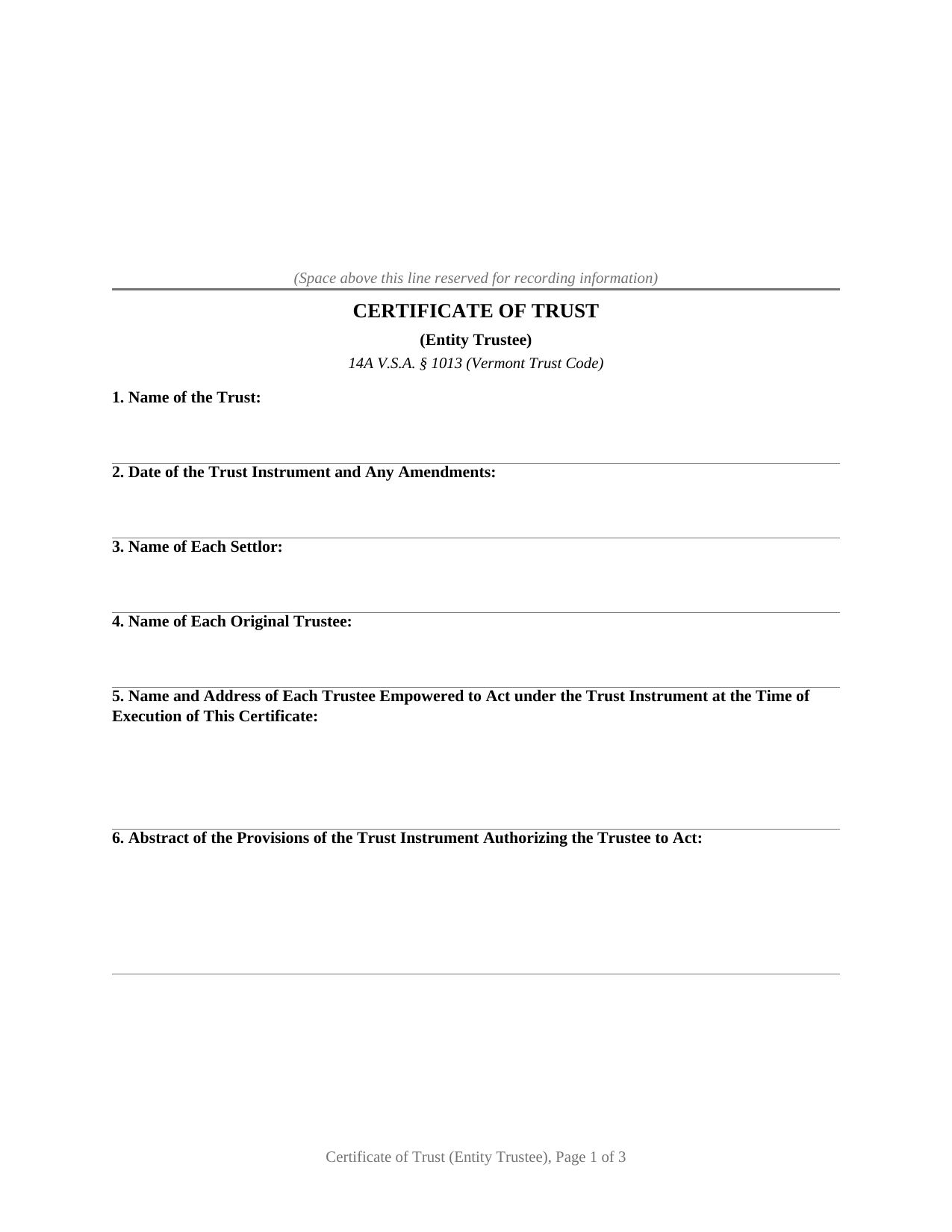
This fillable Vermont certificate of trust is set up for a trust whose acting trustee is an entity: a trust company, bank, or other organization that signs through one authorized officer or agent. Built on 14A V.S.A. § 1013 of the Vermont Trust Code, the form condenses a private trust instrument into a short set of sworn statements that record in the town land records, so the trustee can document its authority to sell, convey, pledge, mortgage, lease, or transfer trust property without recording the trust instrument itself.
One sworn signature for an organization
The form recites exactly one acting trustee, an entity identified by its legal name, form of organization, and address, and it carries one signature line for the officer or agent who signs on the entity's behalf. Vermont's statute makes the trustee's signature an oath taken before a notary public, so the notary block on this form is a sworn-to-and-subscribed certificate, and the line after the date holds the signer's full name and representative capacity: the officer's name, title, the entity's name, and the trust. A title line under the signature identifies the signer's office within the organization. A bank trust department selling a home held in a customer's trust, a corporate successor trustee named in an aging trust instrument, and a limited liability company holding title as trustee all present the pattern this certificate recites; a trust with an individual acting trustee follows a different execution pattern than the one this form carries.
Nine statements instead of the whole trust
Section 1013 lists what the certificate must include: the trust's name and the date of the trust instrument, each settlor, each original trustee, the name and address of each trustee empowered to act when the certificate is executed, an abstract of the provisions authorizing the trustee to act, statements that the trust exists and that the instrument has not been revoked or amended as to those provisions, a statement that no provisions limit the authority granted, and a statement about court supervision. The statute also says what stays private: a certification of trust need not contain the dispositive terms of the trust, so the family's beneficiary provisions never enter the public record. A recipient who wants more may require excerpts of the provisions that designate the trustee and confer the power to act in the pending transaction, and nothing in that subsection requires the trustee to hand over the entire instrument.
Conclusive proof in the land records
What the sworn format buys is reliance. A recorded certificate of trust documents the existence of the trust, the identity of the trustee, and the trustee's powers and any limitations on them as though the full trust instrument had been recorded. The statute makes the certificate conclusive proof as to the matters it contains, and any party may rely on its continued effectiveness unless that party has actual knowledge of facts to the contrary, the certificate is amended or revoked by a written instrument of the trustee, or the full trust instrument is placed of record. A person who in good faith enters into a transaction in reliance on the certification may enforce the transaction against the trust property as if its representations were correct. Buyers, lenders, and title examiners reading a Vermont chain of title look for exactly this instrument behind a trustee's deed.
Recording with the Vermont town clerk
Vermont records land documents by municipality, and the statute directs the certificate to the municipal land records where the land identified in it is located, which is why the form carries a section for the town or city, county, and legal description of the property. The statewide recording fee is $15.00 per page under 32 V.S.A. § 1671. Because the certificate evidences no transfer of title, it records without the property transfer tax return that accompanies a deed; the deed the trustee signs in the underlying transaction meets its own requirements separately and is prepared separately from this package.
The download includes the blank fillable certificate of trust, a completed example showing a Vermont trust company certifying its authority over a Chittenden County property, and a plain-language guide that walks through every section, the oath, and town clerk recording. The materials are informational and are not legal advice.
Important: County-Specific Forms
Our certificate of trust (entity trustee) forms are specifically formatted for each of the 14 counties in Vermont.
After selecting your county, you'll receive forms that meet all local recording requirements, ensuring your documents will be accepted without delays or rejection fees.