Vermont Certificate of Trust
County Specific Legal Forms Validated as recently as September 21, 2026 by our Forms Development Team
About the Vermont Certificate of Trust
How to Use This Form
- Select your county from the list
- Download the county-specific form
- Fill in the required information
- Have the document notarized if required
- Record with your county recorder's office
What Others Like You Are Saying
"This service is amazing! We have tried several other online recording services which all disappointe…"
"Everything that I needed was included. I appreciate that there was a sample as well as the step-by-s…"
"I did this on a desktop using a scanned .pdf file. Simple, straight-forward, excellent instructions,…"
"Great service, quick and affordable. Thank you!"
"Awesome service, I don’t know how much it saved me but I know it was a lot cheaper than going to a l…"
4.8/5 from 4,815 reviews. Read all
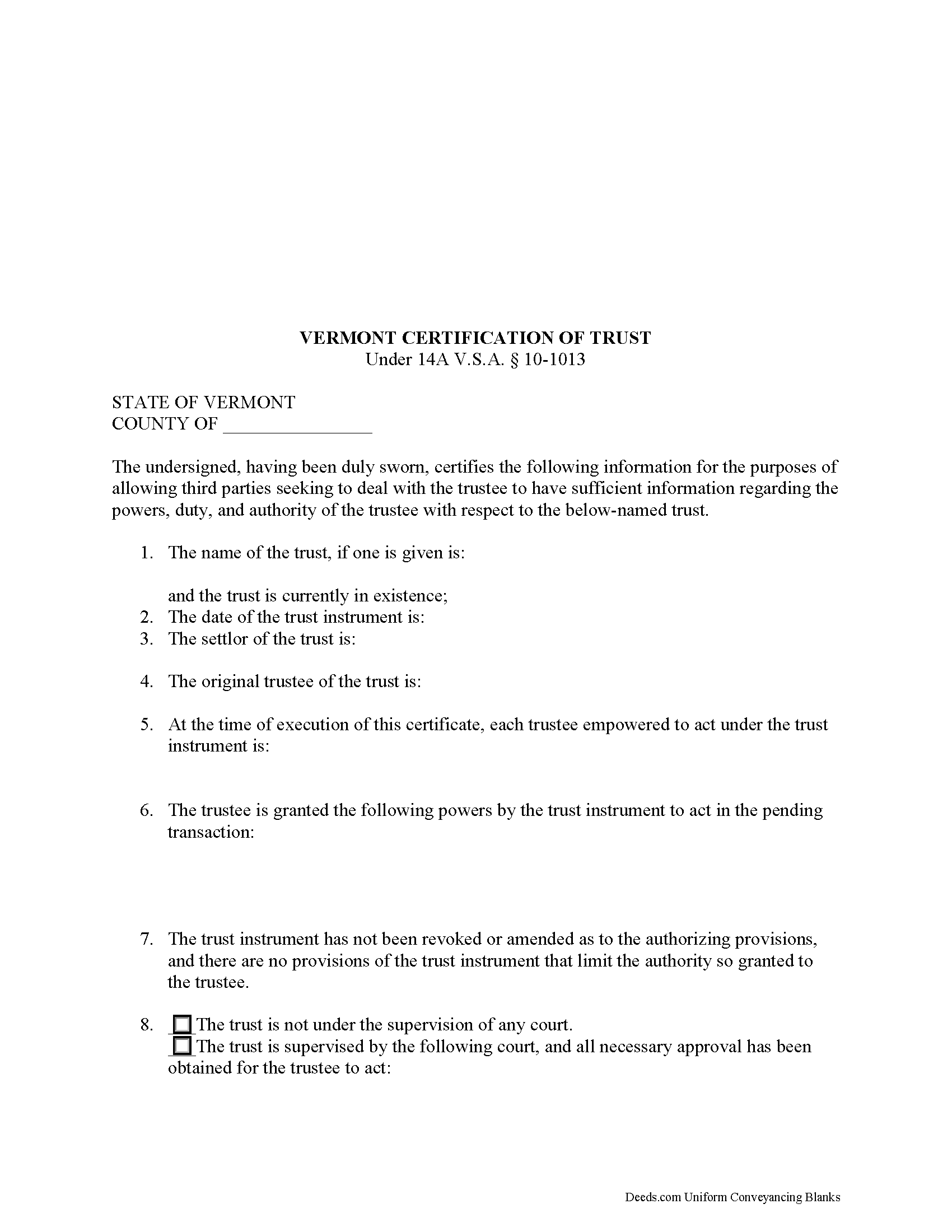
A Vermont certificate of trust for a trust with one individual trustee carries a single sworn signature: the trustee signs under oath before a notary public, and the certificate states that the individual named in it is the sole trustee empowered to act under the trust instrument. This fillable form prepares that certificate, the document Vermont practice also calls a certification of trust or trustee certificate, under 14A V.S.A. § 1013 of the Vermont Trust Code.
Proof of the trust without recording the trust
When a living trust holds Vermont real estate, the trust instrument itself usually stays out of the public records, and the land records show only a deed running to the trustee. Anyone dealing with that trustee, a buyer, a lender, a title examiner, or the town clerk indexing the records, still wants documentation that the trust exists and that the trustee holds authority to act. Section 1013 answers with a certificate that sets forth less than all of the provisions of the trust instrument and deliberately omits the dispositive terms, so the private side of the estate plan, who benefits and on what conditions, never enters the record. Once recorded, the certificate serves to document the trust's existence, the trustee's identity, and the trustee's powers as though the full trust instrument had been recorded, and the statute makes it conclusive proof as to the matters it contains, subject to stated exceptions. A person who in good faith enters into a transaction in reliance on the certification may enforce the transaction against the trust property as if its representations were correct.
One trustee, one sworn signature
The form is configured for a sole individual trustee. Section 4 carries the trustee's name and mailing address together with a statement that the individual named is the only trustee empowered to act at the time of execution, which is how the certificate answers the statute's requirement to name each empowered trustee. One signature line and one notarial certificate follow. A settlor serving as trustee of a revocable living trust that holds a Vermont home, and a successor trustee who has taken office alone under the trust's succession provisions, present the sole-trustee pattern this certificate states. A trust with two or more cotrustees empowered to act, or with a bank or trust company as trustee, presents facts outside this form's sole-trustee statement.
A stricter checklist than the uniform version
Vermont kept its own detailed certificate requirements when it adopted the Trust Code, and § 1013 asks for more than the uniform text used in many states. The certificate identifies the trust by name and date, names the settlor and the original trustee, states the date of any amendments, and carries an abstract of the provisions of the trust instrument that authorize the trustee to act. It then makes the sworn statements the statute lists: the trust exists, the trust instrument has not been revoked or amended as to the authorizing provisions, no provisions of the trust instrument limit the authority granted, and the trust either is not supervised by any court or, if supervised, all necessary approval has been obtained. The signature of the trustee must be under oath, so the notarial certificate on this form is a jurat, the sworn form, rather than the acknowledgment found on deeds. The form's numbered sections walk through the statutory checklist in order.
Recording with the town clerk
Vermont records land documents by municipality rather than by county. The certificate is recorded in the land records of the town or city where the land identified in it is located, at the statewide fee of 15 dollars per page under 32 V.S.A. § 1671. No property transfer tax return accompanies it, because a certificate of trust transfers nothing; the return travels with a deed. For trust assets other than real estate, the statute also contemplates presenting the certificate directly to a bank or other third party, and a recipient may request excerpts of the trust provisions that designate the trustee and confer the power to act, though never the entire instrument.
The download contains three pieces: the blank certificate as a fillable PDF, a completed example showing the document filled in for a realistic Vermont fact pattern, and a plain-language guide that walks through each numbered section, the sworn signing, and recording at the town clerk's office. The materials are informational and are not legal advice; a Vermont attorney can address how the statute operates on a specific trust or title.
Important: County-Specific Forms
Our certificate of trust forms are specifically formatted for each of the 14 counties in Vermont.
After selecting your county, you'll receive forms that meet all local recording requirements, ensuring your documents will be accepted without delays or rejection fees.