Vermont Discharge of Mortgage (Entity)
County Specific Legal Forms Validated as recently as October 7, 2026 by our Forms Development Team
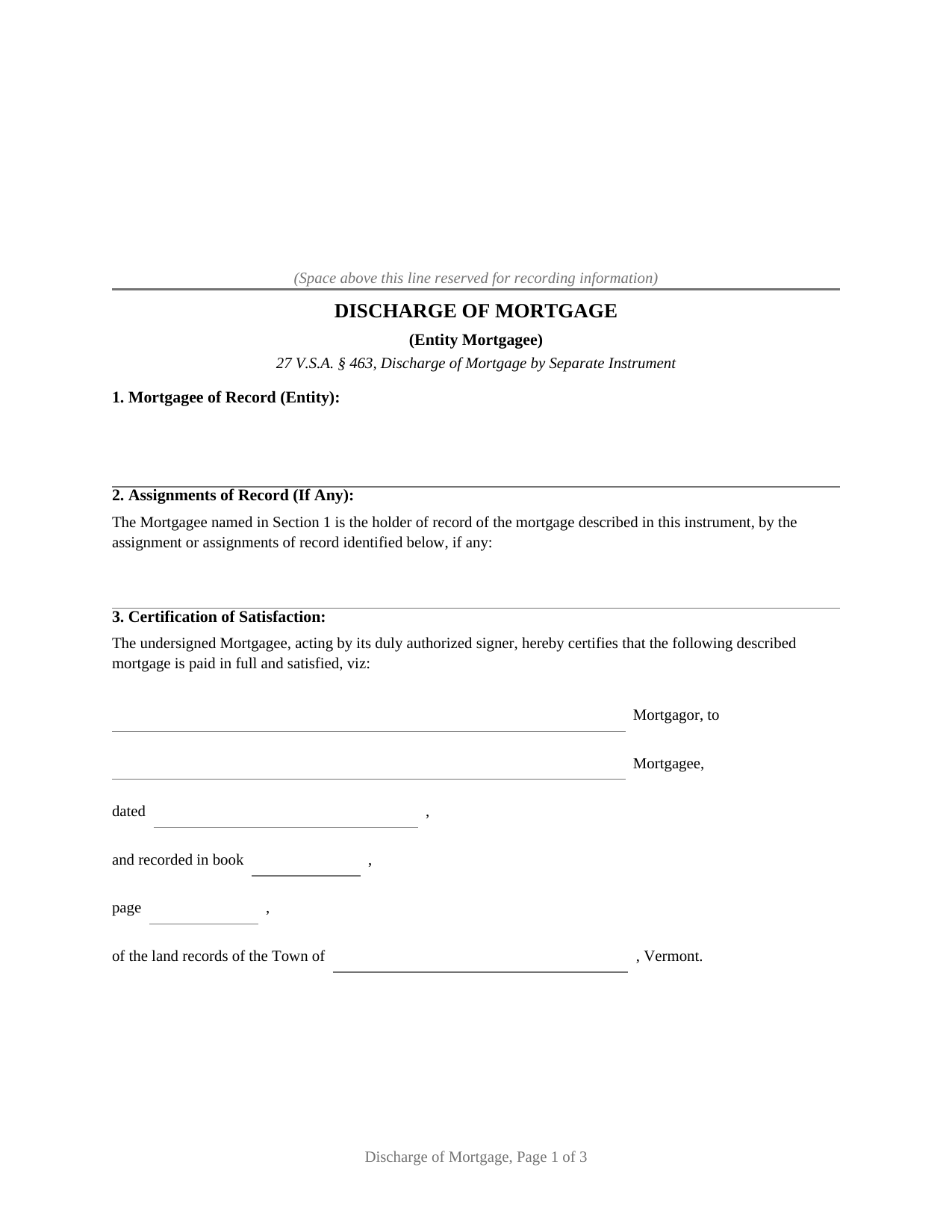
About the Vermont Discharge of Mortgage (Entity)
How to Use This Form
- Select your county from the list
- Download the county-specific form
- Fill in the required information
- Have the document notarized if required
- Record with your county recorder's office
What Others Like You Are Saying
"Easy to use and understand. I am glad to have found this resource."
"Finally able to print out the forms after a few tries. Honestly, I think it could have been designed…"
"Fast turn-around, very efficient!!"
"I was excited because I really wanted to see and get a copy of the Deed to my property. The personal…"
"Forms were easy to complete and print."
4.8/5 from 4,824 reviews. Read all
When an organization holds a paid off Vermont mortgage, the record is cleared with a discharge signed for the entity by an authorized officer. This form prepares a Vermont discharge of mortgage under 27 V.S.A. § 463 for an entity mortgagee, a bank, credit union, corporation, or limited liability company, executed by its authorized signer and recorded in the town land records. The instrument is sometimes searched as a satisfaction of mortgage or a mortgage release; Vermont's statutes call it a discharge.
The certification Vermont's statute spells out
Vermont law provides three statutory ways to discharge a recorded mortgage, and the separate instrument under section 463 is the one that travels: it can be signed at the lender's office, notarized there, and sent to the clerk for recording. The statute supplies the certification's shape. The mortgagee certifies that the described mortgage is paid in full and satisfied, identifying the mortgagor, the mortgagee, the date of the mortgage, and the book and page of the town land records where the mortgage is recorded, every entry taken from the face of the recorded mortgage and the clerk's recording stamp. Under section 463(b), once the satisfaction is acknowledged before a notary public and recorded, it discharges the mortgage and bars actions brought on it.
Signed for the entity by an authorized officer
The form recites one entity mortgagee of record and carries one signature line and one acknowledgment certificate for its authorized signer, with printed name, date, and title lines beneath the signature. The acknowledgment is completed in a representative capacity, the style Vermont's notary statutes supply for an officer signing on an organization's behalf, so the certificate carries the signer's name, the title, and the entity. A separate section identifies any recorded assignment by book and page, the chain that carries the mortgage from the original lender to the discharging entity; where the entity named on the form is the original mortgagee, that section records that no assignment exists. Banks and credit unions releasing home loans, a company that financed the sale of its own real estate, and a private lending company closing out a loan all present the entity pattern this discharge recites. The form recites an organizational holder acting through a signer; a mortgage held by an individual in a personal capacity presents a different execution and acknowledgment pattern.
Thirty days, with statutory damages behind it
Vermont attaches real deadlines to the discharge. Under 27 V.S.A. § 464, within 30 days after full performance of the conditions of the mortgage, the mortgagee of record must execute and deliver a valid and complete discharge, together with any instrument necessary to establish record ownership of the mortgage and the authority to execute the discharge. A holder or servicer that misses the deadline is liable for statutory damages of $25.00 per day, up to an aggregate of $5,000.00, and an aggrieved party who substantially prevails can also recover consequential damages, punitive damages, court costs, and attorney's fees. The same statute puts a five business day clock on written payoff statement requests. A promptly executed, recordable discharge is the compliance event those provisions measure.
Recording in the town where the mortgage lives
Vermont has no county recording system. Town and city clerks keep the land records, so the discharge is recorded with the clerk of the town or city where the mortgage itself is recorded, and a mortgage recorded in more than one town calls for a discharge in each of them. The statewide recording fee is $15.00 per page under 32 V.S.A. § 1671, and no Vermont property transfer tax return accompanies a discharge, since the transfer tax falls on transfers by deed of title rather than on the release of a lender's recorded interest. The form prints on letter size paper, keeps its text inside the statute's page and lettering figures, and reserves the top of its first page for the clerk's recording information.
The download includes the discharge of mortgage as a fillable PDF, a completed example showing the entire instrument filled in for a realistic Vermont fact pattern, and a plain language guide that walks through every section, the representative capacity notarization, and the recording step. The materials are informational and are not legal advice.
Important: County-Specific Forms
Our discharge of mortgage (entity) forms are specifically formatted for each of the 14 counties in Vermont.
After selecting your county, you'll receive forms that meet all local recording requirements, ensuring your documents will be accepted without delays or rejection fees.