Vermont Discharge of Mortgage (Entity Trustee)
County Specific Legal Forms Validated as recently as October 1, 2026 by our Forms Development Team
About the Vermont Discharge of Mortgage (Entity Trustee)
How to Use This Form
- Select your county from the list
- Download the county-specific form
- Fill in the required information
- Have the document notarized if required
- Record with your county recorder's office
What Others Like You Are Saying
"Awesomeness a true life saver I'm very appreciative."
"VERY NICE SERVICE"
"Not sure whether the two forms I printed will be helpful or not. Will find out when I go to a place …"
"awesome"
"Very intuitive to use and comprehensive enough for the most complex of cases."
4.8/5 from 4,824 reviews. Read all
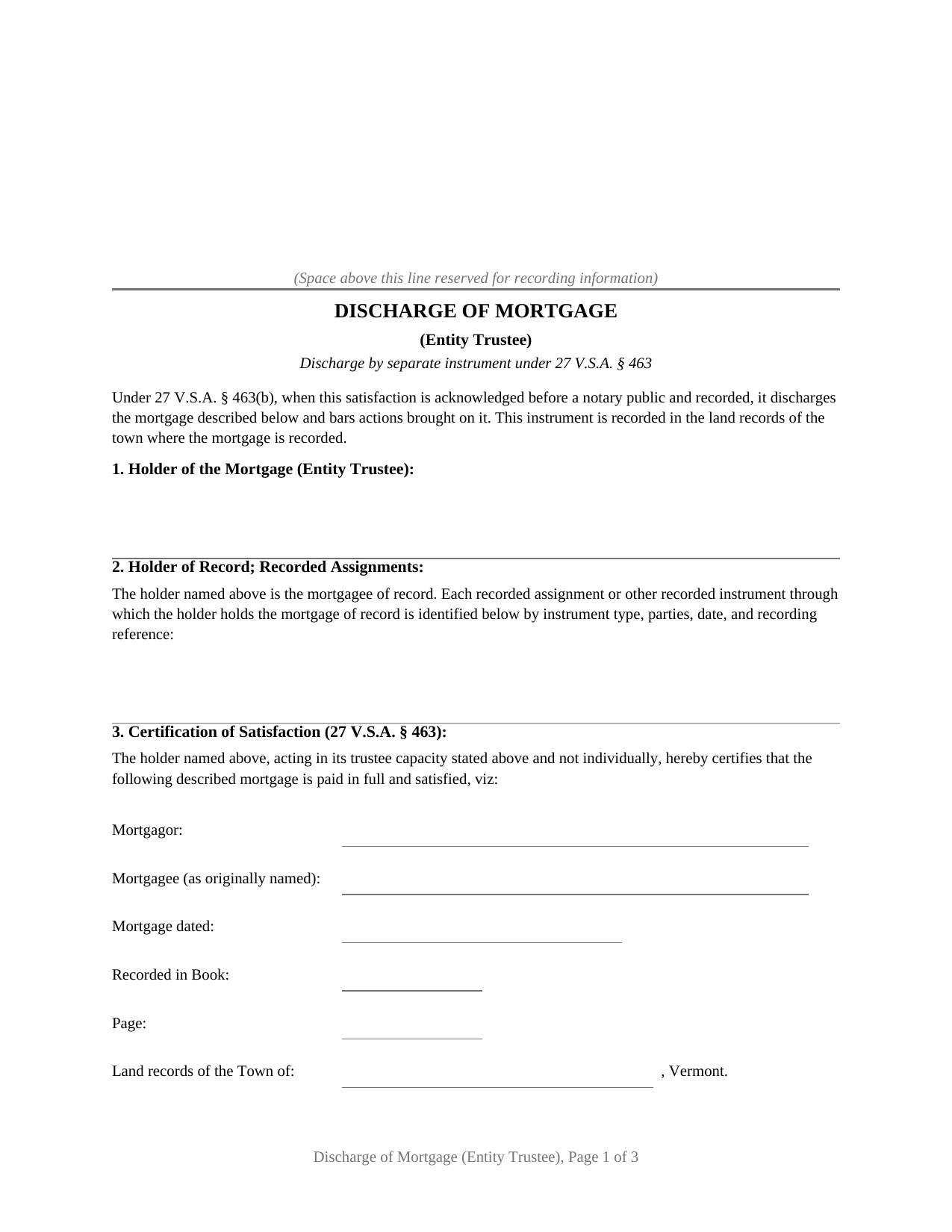
When a Vermont mortgage is held by an entity acting as trustee, the discharge that clears it from the town land records carries a different execution block than a discharge signed by an individual lender. This Vermont Discharge of Mortgage (Entity Trustee) prepares the separate-instrument discharge described in 27 V.S.A. Section 463 for exactly that holder: an entity, named in its trustee capacity, certifying satisfaction of the mortgage and signing through an authorized officer.
The statutory certification Vermont expects
Section 463 states the substance of a Vermont mortgage discharge by separate instrument: an acknowledgment of satisfaction, executed by the mortgagee or the mortgagee's assigns, substantially in the statutory form, certifying that the described mortgage is paid in full and satisfied and identifying the mortgagor, the mortgagee, the date of the mortgage, and the book, page, and town of its recording. The form carries that certification language and collects each statutory identification item in its own labeled blank, so the completed instrument reads the way the statute reads. Under Section 463(b), once the satisfaction is acknowledged before a notary public and recorded, it discharges the mortgage and bars actions brought on it.
The timing pressure behind the instrument comes from 27 V.S.A. Section 464: within 30 days after full performance of the mortgage conditions, the mortgagee of record executes and delivers a valid and complete discharge, together with any instrument necessary to establish record ownership and the authority to sign. A holder that misses the window faces statutory damages of $25.00 per day, up to $5,000.00 in the aggregate, plus consequential and punitive damages, costs, and attorney fees for an aggrieved party who substantially prevails.
An execution block built for a trustee
The form recites exactly one holder, an entity acting in a trustee capacity: a trust company named solely as trustee of a securitization trust, a bank holding a mortgage-backed pool, or a trustee holding a seller-financed note inside a family or business trust. The holder section states the entity's legal name, organizational form, and the trust for which it acts. The signature block carries the entity name and capacity on its own line, a signature line for the authorized signer, and printed name, title, and date entries beneath it, and the single acknowledgment certificate is completed in the representative capacity the Vermont short forms in 26 V.S.A. Section 5368 provide. A discharge signed by an individual mortgagee in a personal capacity, or an attorney's discharge affidavit under Section 464a, follows a different execution pattern than the entity-trustee configuration this form recites.
Because an entity trustee is often not the lender the mortgage originally named, the form gives the assignment chain its own section. Each recorded assignment through which the holder became mortgagee of record appears by parties, date, and recording reference, matching the Section 464(b) practice of establishing record ownership alongside the discharge, and letting a later title searcher read the chain and the discharge together.
Recorded with the town clerk, not a county recorder
Vermont records land instruments by town. The completed discharge goes to the clerk of the town whose land records hold the mortgage, at the statutory fee of $15.00 per page under 32 V.S.A. Section 1671. A discharge is not a transfer of title, so no Vermont Property Transfer Tax Return accompanies it. A mortgage recorded in more than one town presents a discharge recorded in each of those towns, and the guide walks through that detail along with the printed-name practice of 32 V.S.A. Section 1405.
Searches for this instrument also use the names satisfaction of mortgage, release of mortgage, and mortgage release; in Vermont the recorded separate instrument under Section 463 is the standard form of each.
The purchase delivers the blank discharge as a fillable PDF, a completed example showing the entire instrument filled in for a realistic Vermont fact pattern, and a plain-language guide that walks through every section, the representative acknowledgment, and town recording. The materials are informational and are not legal advice.
Important: County-Specific Forms
Our discharge of mortgage (entity trustee) forms are specifically formatted for each of the 14 counties in Vermont.
After selecting your county, you'll receive forms that meet all local recording requirements, ensuring your documents will be accepted without delays or rejection fees.