Vermont Special Warranty Deed (Joint Grantors)
County Specific Legal Forms Validated as recently as September 22, 2026 by our Forms Development Team
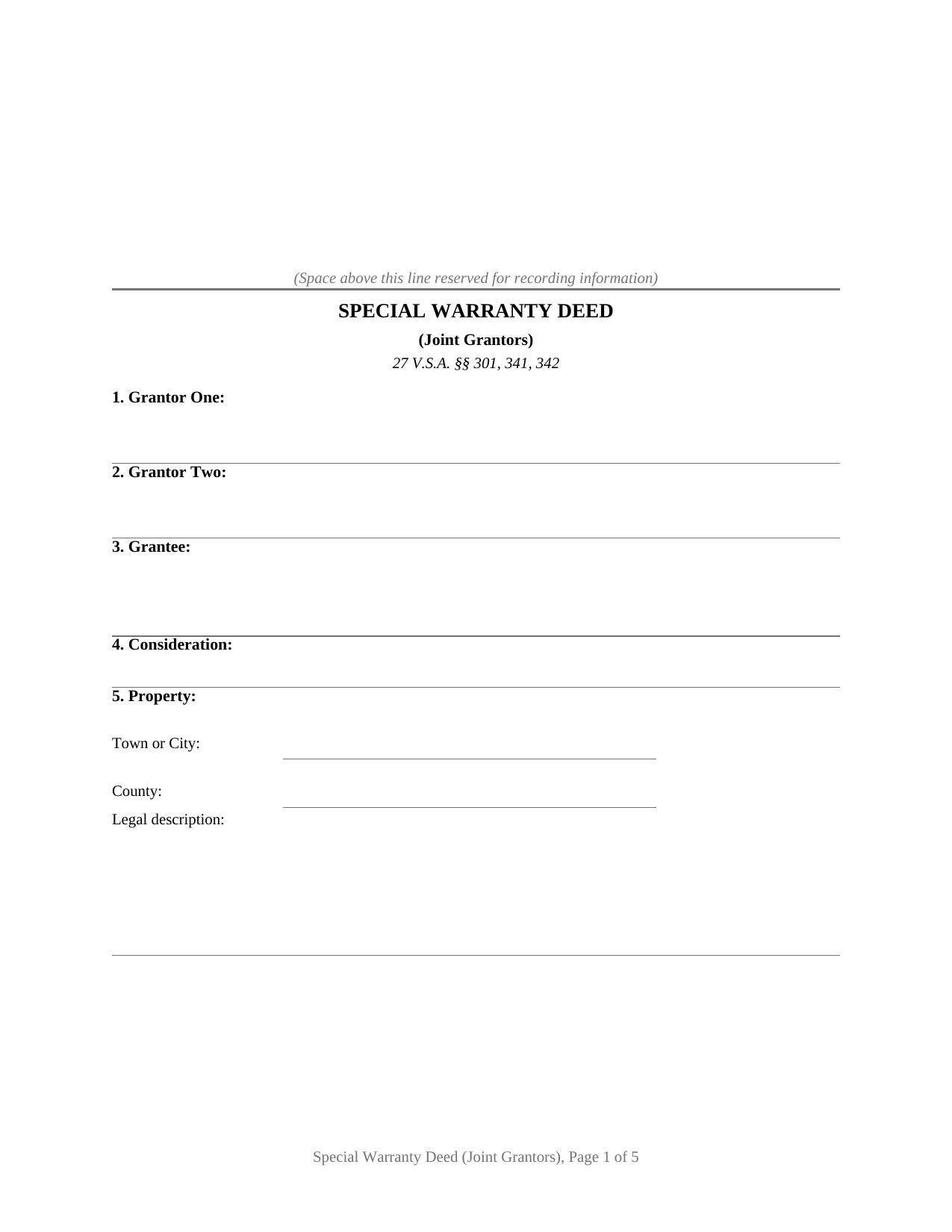
About the Vermont Special Warranty Deed (Joint Grantors)
How to Use This Form
- Select your county from the list
- Download the county-specific form
- Fill in the required information
- Have the document notarized if required
- Record with your county recorder's office
What Others Like You Are Saying
"I was very pleased with the ease in use of the forms. I suggest making sure the sample copy is total…"
"Very good service .I recommend it if you need your documentation on a weekend or when offices are cl…"
"After over a month of turmoil and feeling like "you can't get there from here",you solved …"
"It's useful to have forms specific to the County as well as the State. The examples are also helpful…"
"This was an excellent experience. The jurisdiction I was registering the Deed with, entrusts Deeds.c…"
4.8/5 from 4,818 reviews. Read all
Two record owners convey together on this deed. The form is Vermont's special warranty deed built for joint grantors: two grantor sections, two signature lines, and a full notary acknowledgment certificate for each signer, so a pair of co-owners passes their combined interest in one recorded instrument. The covenants run from both grantors, bind them jointly and severally, and stop at the edge of their own time in title.
Two grantors, one conveyance
The deed recites exactly two grantors, each an individual conveying in a personal capacity, and a single grantee section carrying the new owners' names and the vesting words they take under. Both grantors sign, and because co-owners often acknowledge at different times or in different places, the form carries a separate certificate for each signature, each set out in the statutory short form of Section 5368 of Title 26, with lines for the notary's printed name and commission number. Familiar pairs present this pattern in Vermont land records: siblings conveying property they inherited as tenants in common, a married couple selling a home held as tenants by the entirety, and two co-investors ending a joint venture. When the grantors are married to each other, their two signatures also supply the spousal joinder that 27 V.S.A. Sections 141 and 349 attach to homestead and entireties property. For the rarer case, a grantor whose spouse is not the other grantor and whose homestead is being conveyed, the deed adds a labeled joining spouse block with its own certificate. The form is not set up as a deed for one owner, for three or more co-owners, or for an entity or fiduciary seller; those configurations recite different parties than this deed carries.
Covenants from both grantors that stop with their ownership
Vermont writes warranty scope onto the face of a deed; no general statute implies covenants from an operative word alone. This deed states that the grantors are lawfully seized, hold good right and title to convey, and pass the property free from encumbrances they made or suffered except as the deed lists, then confines the duty to warrant and defend to claims arising by, through, or under the grantors or either of them. Vermont practice also labels the same instrument a limited warranty deed. The two-grantor version adds one point of reach: because both owners join in a single set of covenants, a claim traceable to either co-owner's period of ownership falls inside the promise, while anything older than the chain they share stays outside it.
One deed, one town clerk, one tax return
Vermont land records live with municipal clerks rather than county recorders, so the signed deed is presented for recording in the town or city where the property sits, at the statewide fee of fifteen dollars per page. Each grantor's acknowledgment before a notary public is the execution formality 27 V.S.A. Section 341(a) sets for deeds, and recording is what extends the conveyance's effect beyond the grantors and their heirs under Section 342. A completed Property Transfer Tax Return, Form PTT-172, with its Act 250 certificate, accompanies the deed at the counter; 32 V.S.A. Section 9608 directs clerks to accept no transfer deed without it. The guide in this package covers the return, the current rates and the clean water surcharge, the statutory exemptions, and every numbered section of the deed, along with the co-ownership vesting forms available to the grantees under 27 V.S.A. Section 2.
The download delivers three pieces: the special warranty deed as a fillable PDF, a completed example presenting a two-grantor Chittenden County transfer of inherited property, and a plain language guide covering completion, signing, and municipal recording. These materials describe Vermont law generally and are not legal advice; questions about a particular title or transfer belong with a Vermont attorney.
Important: County-Specific Forms
Our special warranty deed (joint grantors) forms are specifically formatted for each of the 14 counties in Vermont.
After selecting your county, you'll receive forms that meet all local recording requirements, ensuring your documents will be accepted without delays or rejection fees.