Vermont Special Warranty Deed (Grantor to Own Revocable Trust)
County Specific Legal Forms Validated as recently as October 22, 2026 by our Forms Development Team
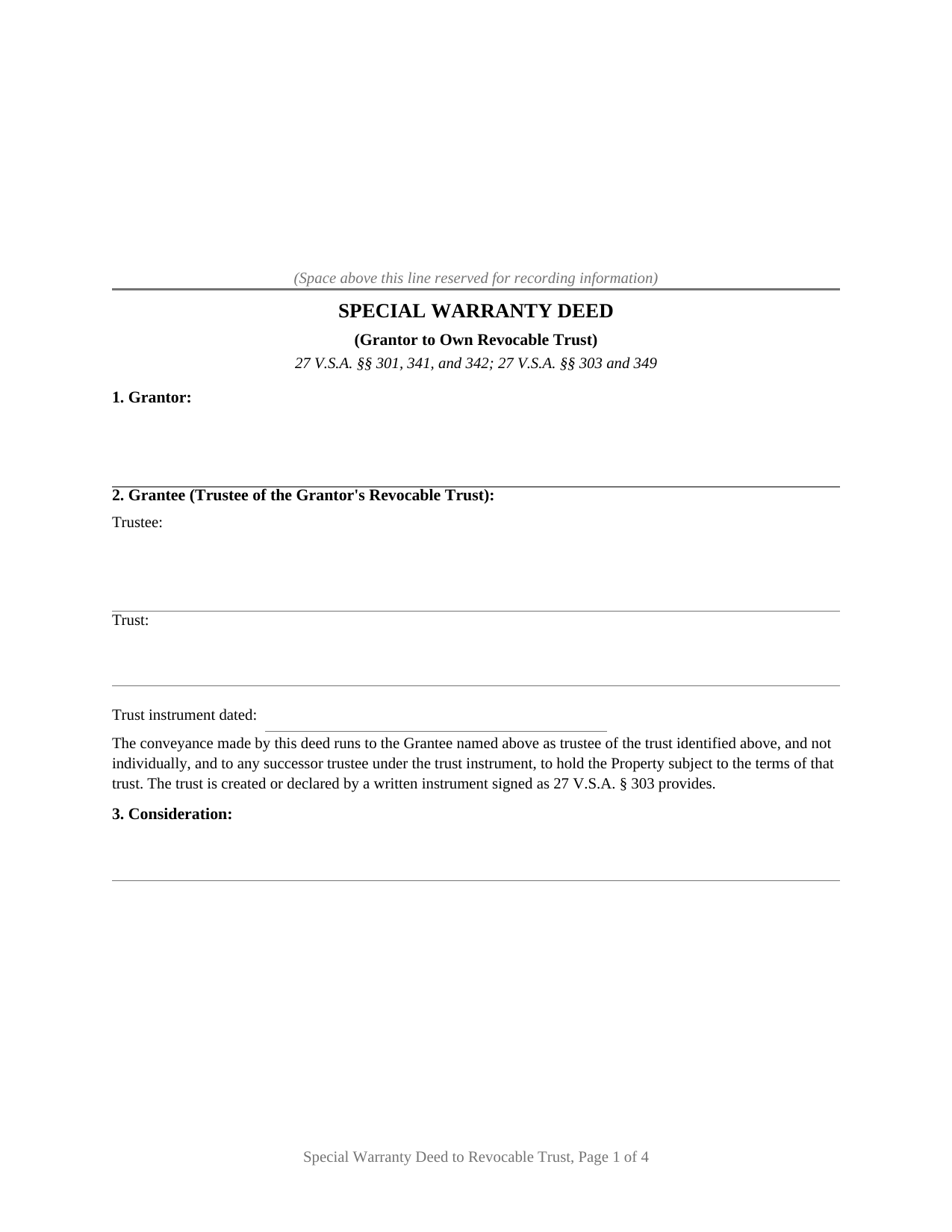
About the Vermont Special Warranty Deed (Grantor to Own Revocable Trust)
How to Use This Form
- Select your county from the list
- Download the county-specific form
- Fill in the required information
- Have the document notarized if required
- Record with your county recorder's office
What Others Like You Are Saying
"Great site, I was able to navigate with ease. We appreciate all those who contributed in making this…"
"It was OK but unfortunately useless. The jurisdictions are now requesting that documents such as Not…"
"Thank you! You are so awesome. Its amazing to be able to get everything together in a download packe…"
"Very easy process and efficient. Made my job easier."
"Thank you so much! Quick and easy. Received it in under 5 minutes."
4.8/5 from 4,836 reviews. Read all
The same person can stand on both sides of this deed, named once as an individual and once as a trustee. It is a Vermont special warranty deed set up for one owner conveying real property to the trustee of the owner's own revocable trust: the deed that moves a home, camp, or parcel out of a personal name and into a living trust. Its grantee section recites three things a personal-name deed never carries, the trustee, the exact name of the trust, and the date of the trust instrument, and its covenants reach only the grantor's own years in title.
One person, two capacities
Vermont statute answers the first question this deed raises. Under 27 V.S.A. Section 349, an owner may convey directly to that same person in another capacity, so the grantor and the trustee who takes title can be one and the same, with no straw conveyance in between. The trust itself stays off the record: 27 V.S.A. Section 303 asks only that an express trust concerning land be declared in a writing signed by its creator, and the deed identifies that writing by the trust's name and date rather than reciting its terms. Title vests in the named trustee and any successor trustee under the trust instrument, so a successor can deal with the real estate at the grantor's death or incapacity without a probate proceeding.
Built for funding a revocable living trust
The architecture is deliberately narrow. The form recites exactly one grantor, an individual holding record title, and one grantee, the trustee of that grantor's revocable trust; a single signature line and a single acknowledgment certificate on the short form of 26 V.S.A. Section 5368 complete it. An owner retitling the house after signing a new trust instrument, a widowed owner placing a long-held Lamoille County property in trust, and an owner gathering scattered parcels under one trust name present the pattern this deed recites. For a married grantor the deed carries a joining spouse block: 27 V.S.A. Section 141 makes a homestead conveyance inoperative as to the homestead without the spouse joining in its execution and acknowledgment, and a deed into the owner's own trust is still a conveyance. The form is not set up as a deed from two co-owners, from spouses conveying together, from an entity, or from a trustee conveying property out of a trust; each of those recites different parties and capacity language than this deed carries.
Why a warranty deed into a trust at all
No money changes hands here, yet the deed still carries covenants. No Vermont statute implies covenants into an ordinary conveyance, so this deed states them expressly: seizin, good right to convey, freedom from encumbrances the grantor made or suffered, and a duty to warrant and defend against claims by, through, or under the grantor, but no others. The special warranty deed, also called a limited warranty deed in Vermont title work, keeps a warranty instrument in the record without promising anything about defects older than the grantor's ownership.
The exempt transfer that still files a return
Even a deed that owes no transfer tax arrives at the town clerk's counter with tax paperwork. 32 V.S.A. Section 9603(5) exempts a transfer in trust, without actual consideration, to the extent of the benefit to the donor, and Section 9603(6) exempts a mere change in the form of ownership with no change in beneficial ownership; a Property Transfer Tax Return, Form PTT-172, is filed with the deed all the same, with the exemption number entered on the return, and the return itself asks whether the transferee is a grantor's revocable trust. Under Section 9608 the clerk of the town or city where the land lies cannot record the deed without the completed return, and the statewide recording charge is fifteen dollars for each page. The guide covers the return, the exemption entries, and what recording accomplishes under 27 V.S.A. Section 342.
The download holds the special warranty deed as a fillable PDF, a completed example showing an owner's transfer of a Stowe home into her revocable trust with every entry made, and a plain language guide walking through each numbered section, the trust recitals, the grantee vesting Vermont law recognizes, notarization, and municipal recording. The materials describe Vermont law generally and are not legal advice; how these rules meet a particular trust, marriage, or title is a question for a Vermont attorney.
Important: County-Specific Forms
Our special warranty deed (grantor to own revocable trust) forms are specifically formatted for each of the 14 counties in Vermont.
After selecting your county, you'll receive forms that meet all local recording requirements, ensuring your documents will be accepted without delays or rejection fees.