West Virginia Quitclaim Deed (Corporation Grantor)
County Specific Legal Forms Validated as recently as October 21, 2026 by our Forms Development Team
About the West Virginia Quitclaim Deed (Corporation Grantor)
How to Use This Form
- Select your county from the list
- Download the county-specific form
- Fill in the required information
- Have the document notarized if required
- Record with your county recorder's office
What Others Like You Are Saying
"Amazing time saver, fantastic resource if you have an idea of what you are looking for and you can r…"
"Thank you so much for making this process seemless. We are very pleased with the service."
"So quick. So easy. Worth every penny!"
"I think you all are great keep it going"
"This was very easy to do. Great experience. These are the forms I needed. I would recommend these to…"
4.8/5 from 4,829 reviews. Read all
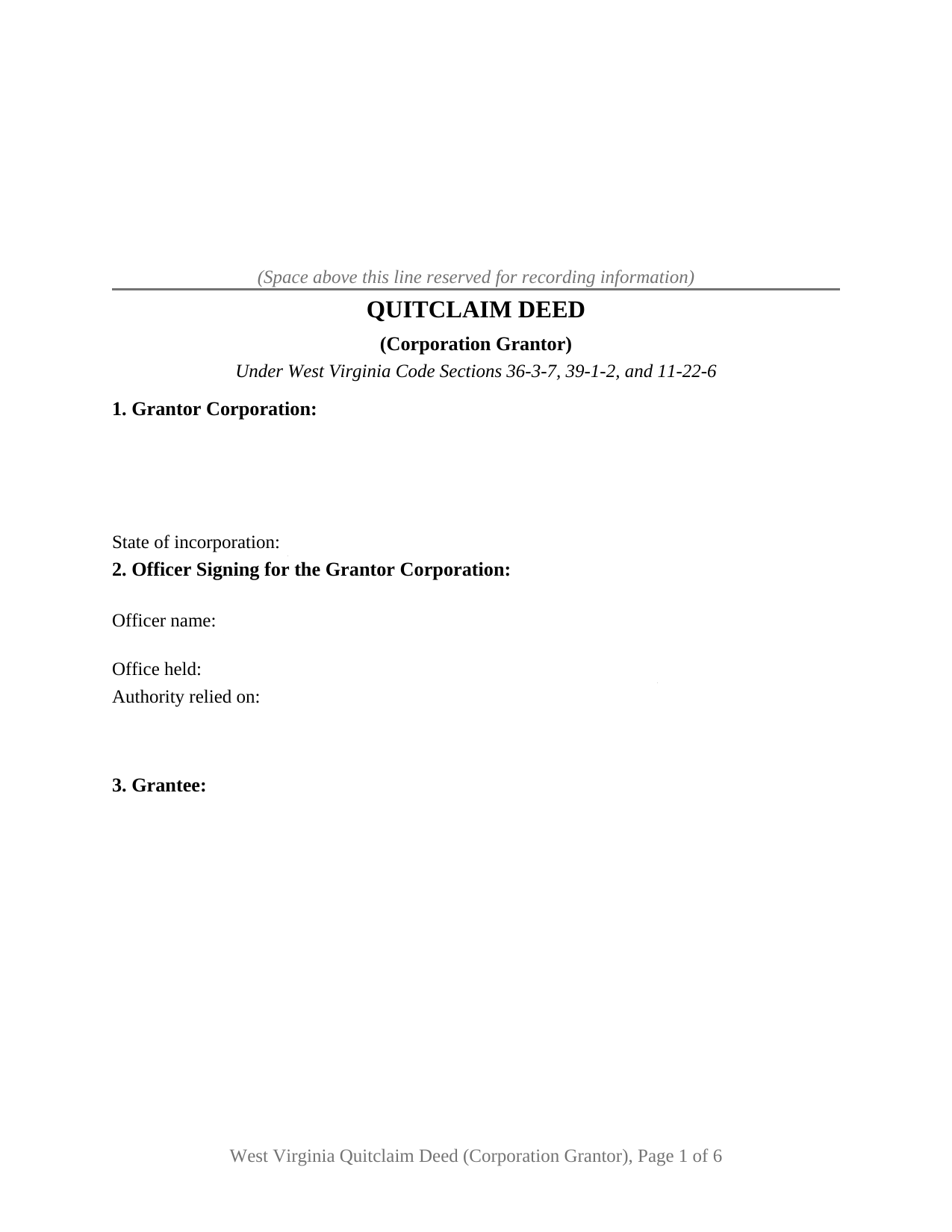
West Virginia's recording statute never asks which person inside a corporation may sign away land, and the Business Corporation Act keeps that answer in the bylaws and the minute book. This West Virginia quitclaim deed is arranged around it: one corporation as grantor, one officer signing in an office the deed names, and the authority relied on, collected in Section 2 ahead of any release language.
Where a corporate signer's authority sits
W. Va. Code Section 31D-3-302 gives a corporation, unless its articles of incorporation provide otherwise, the same powers as an individual to hold and deal with real property and to sell, convey, mortgage, pledge, lease, exchange, and otherwise dispose of it. Which human being exercises it is a separate question, and Section 31D-8-841 answers that inside the company: each officer has the authority set forth in the bylaws or, consistent with them, the duties the board prescribes. So the form takes the office held and the source of authority, a board resolution or the bylaw article carrying the power to convey. Section 31D-3-304 then narrows who may question a corporation's power to act at all.
Approval is the next layer, and it also sits outside the deed. Section 31D-12-1201 asks nothing of shareholders for a disposition in the usual and regular course of business or for a transfer to an entity whose shares the corporation owns. Section 31D-12-1202 does ask, where the disposition would leave the corporation without a significant continuing business activity, routing that transaction through a board resolution the directors submit to the shareholders.
A release, never a promise
The operative language is a release. Under Section 36-3-7, words releasing all claims upon the land operate as a quitclaim: what the corporation holds at law passes, what it holds in equity passes, and nothing further does. Section 9 of this quit claim deed sets those release words beside a printed line disclaiming any covenant or warranty of title. Not one covenant word from chapter 36, article 4 appears, so a recorded deed of trust, a judgment lien, or a mineral reservation rides through untouched, and Section 36-3-1 makes a corporate seal unnecessary.
Why a corporate gift reaches the clerk on two signatures
Since July 11, 2025, Section 39-1-2(b)(2) has closed the record to a quitclaim deed made without consideration unless the grantee signs and acknowledges it as well, or two witnesses prove it as to the grantee before the clerk of the county commission, and a deed recorded against that rule is void. Every exception the subsection lists names a family relationship between individuals, so a corporate release passing no consideration sits outside all of them. Section 11 draws that second signature block with a certificate of its own, and it stays empty where consideration passes.
What this form draws, and what it leaves out
Section 1 takes one corporation with its state of incorporation, Section 3 a single grantee, and Section 10 one signature over one certificate. A corporation clearing a residual interest standing in its name since an older transaction, a corporation releasing a parcel to an affiliate whose shares it owns, and a corporation releasing what it holds to a purchaser taking title without covenants all present the corporate grantor pattern this deed carries. Two corporations signing together, an individual owner, a trustee, or a signer under a power of attorney each execute through different blocks than this form draws. One line common on West Virginia deeds is absent by design: dower and curtesy are abolished by Section 43-1-1, and the notice duty of Section 43-1-2 speaks to a married person who conveys, so an entity grantor brings no joinder signature.
The figure the clerk reads
Section 12 carries the declaration of consideration or value that Section 11-22-6 places on the instrument, with a line for any exemption claimed under Section 11-22-1, among them the exclusion for a transfer from a subsidiary to its parent. Where stamps are due, the clerk computes them at the state rate of one dollar and ten cents for each five hundred dollars of value, plus the county excise and the twenty dollar Affordable Housing Fund fee on transfers for consideration. The State Tax Commissioner Sales Listing Form is completed separately.
This package includes the deed as a fillable PDF, a completed example filled in for an Ohio County release, and a guide to the twelve sections and the recording steps. The materials are informational and are not legal advice.
Important: County-Specific Forms
Our quitclaim deed (corporation grantor) forms are specifically formatted for each of the 55 counties in West Virginia.
After selecting your county, you'll receive forms that meet all local recording requirements, ensuring your documents will be accepted without delays or rejection fees.