West Virginia Quitclaim Deed (Corrective)
County Specific Legal Forms Validated as recently as September 24, 2026 by our Forms Development Team
About the West Virginia Quitclaim Deed (Corrective)
How to Use This Form
- Select your county from the list
- Download the county-specific form
- Fill in the required information
- Have the document notarized if required
- Record with your county recorder's office
What Others Like You Are Saying
"I downloaded the Lady Bird deed. The process was quick and easy to download. Just select your county…"
"Not just good, very good. Very intuitive and very responsive. It just works!"
"The forms worked well for entering information. I have finished without much trouble. Since the form…"
"Excellent service--couldn't be more complete and useful !"
"Excellent deed correction experience and guidance!!! Thank you! R. Scott."
4.8/5 from 4,815 reviews. Read all
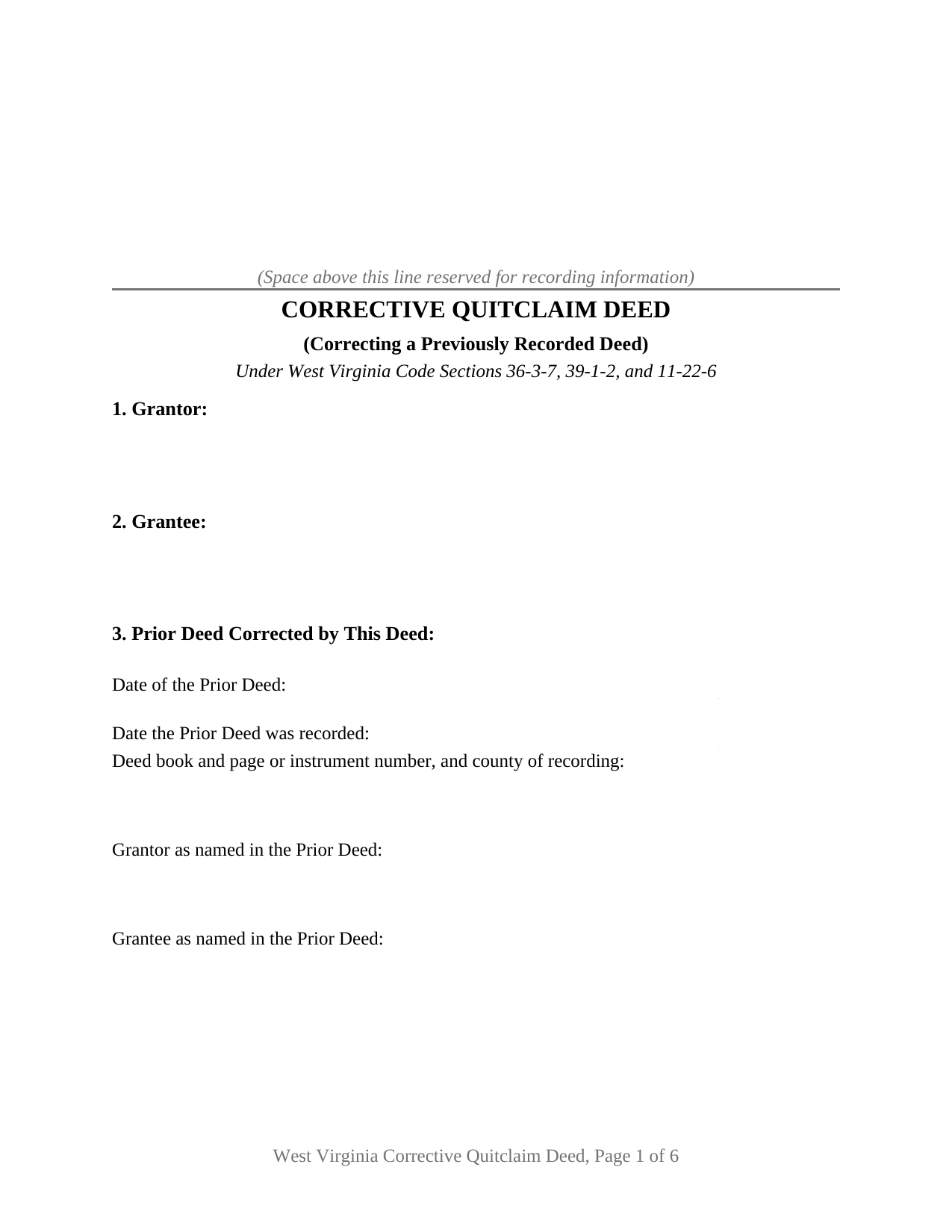
A deed already stamped by the clerk of the county commission cannot be edited. West Virginia's land records run chronologically, so a mistake found after recording is answered by a second instrument filed behind the first, and this Corrective Quitclaim Deed is that second instrument. It identifies the earlier deed by date, book and page, and county, sets the wrong term beside the corrected one, and releases the same interest again to the same grantee.
Why the second deed says so little
West Virginia publishes no statutory correction deed and no statutory quitclaim form. W. Va. Code Section 36-3-7 works instead: words releasing to the grantee all claims upon the land operate as a quitclaim of everything the grantor holds at law and in equity. Section 9 pairs those release words with one stated purpose, correcting the deed identified in Section 3 in the respect stated in Section 4, and with a printed line that no covenant of Chapter 36, Article 4 is made or implied. Section 36-3-6 supplies the money answer, providing that a deed is not invalid merely because consideration is neither paid nor recited.
The correction an attorney makes instead
One class of error never reaches a deed at all. Since 2020, W. Va. Code Section 36-3-11 has allowed an obvious description error in a recorded deed, deed of trust, or mortgage to be fixed by a corrective affidavit of a West Virginia attorney, after notice to the parties and a 30 day objection window. That affidavit is prepared and recorded separately and is not included here. Its narrowness leaves room for a deed: a misspelled party name, a dropped reservation, a prior book and page pointing at the wrong instrument, and any description problem that is not obvious.
What a correction cannot back-date
A corrective deed takes its own place in line. Under Section 40-1-9 an instrument is void as to lien creditors and later purchasers for value without notice until it is duly recorded, so priority runs from the day this deed reaches the record, and only the Section 36-3-11 affidavit relates back. Nor does any deed bind a person who never signed it. Where the parties disagree, the route is reformation in circuit court, and in Smith v. Smith the Supreme Court of Appeals held that reforming a clear and unambiguous deed takes a mistake of fact, mutual to both parties, shown by clear and convincing evidence.
One grantor, one grantee, and the signature a free correction attracts
The form recites one individual grantor, one grantee, one prior deed, and one correction to it. Section 10 carries the grantor's signature above an acknowledgment certificate in the short form of Section 39-4-16. Section 11 carries a second signature line with a certificate of its own for the grantee, because since July 11, 2025 W. Va. Code Section 39-1-2(b)(2) has barred from the record a quitclaim passing no consideration where the grantee has not signed and acknowledged it, subject to the transfer on death and close family exceptions listed there, and a deed recorded against that rule is void. A correction between unrelated parties, passing no money, sits outside every listed exception, the pattern the completed example works through. A misspelled grantee name carried through a caption and a signature block, and a source of title reference reading wrong against the prior instrument, both present the single correction pattern this deed recites. Corrections executed by two record grantors, by a company, by a trustee, or by an agent run through blocks this form does not draw.
The deed West Virginia's tax rule names outright
The transfer tax rule names this instrument outright. The State Tax Department's legislative rule, 110 CSR 22 at Section 2.6.1.13, places a quit claim or corrective deed without consideration outside the definition of a taxable document, and adds that either kind carrying consideration over one hundred dollars is taxable. Section 12 prints the declaration of consideration or value that Section 11-22-6 puts on the instrument, with its own line for the exemption ground, which is what the clerk reads before deciding whether stamps are due. The Sales Listing Form required with every recorded document comes from the clerk and is completed separately.
This package delivers the corrective quit claim deed as a fillable PDF, a completed example worked through a Raleigh County name correction, and a guide that walks the twelve numbered sections, the two certificates, and the recording package. The materials are informational and are not legal advice.
Important: County-Specific Forms
Our quitclaim deed (corrective) forms are specifically formatted for each of the 55 counties in West Virginia.
After selecting your county, you'll receive forms that meet all local recording requirements, ensuring your documents will be accepted without delays or rejection fees.