West Virginia Quitclaim Deed (Reserving Life Estate)
County Specific Legal Forms Validated as recently as September 22, 2026 by our Forms Development Team
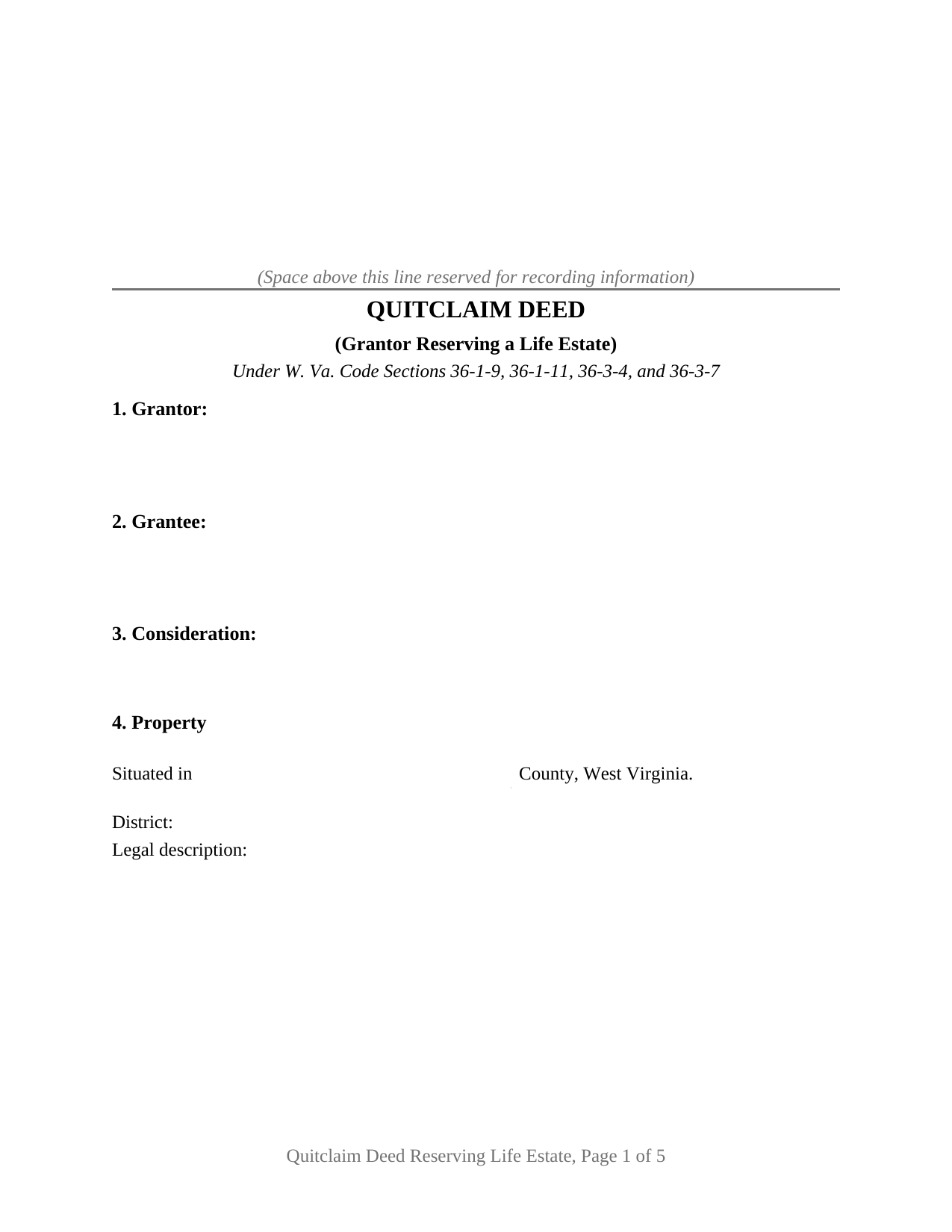
About the West Virginia Quitclaim Deed (Reserving Life Estate)
How to Use This Form
- Select your county from the list
- Download the county-specific form
- Fill in the required information
- Have the document notarized if required
- Record with your county recorder's office
What Others Like You Are Saying
"Helpful, timely service. Overall, an excellent transaction. Would definitely use Deeds.com again if …"
"This service is excellent. I submitted a Quickclaim Deed so my home would be in the name of a Living…"
"NO PROBLEMS. I LIKE THE DEED DOCUMENT AND INSTRUCTIONS. MADE IT EASY."
"Service seems smooth. I just wonder what the turn around time on recording is (I need proof of recor…"
"Get Rid of the places to initial each page on the Trust Deed. The Co. Recorder (Davis) does not requ…"
4.8/5 from 4,815 reviews. Read all
A West Virginia owner who wants a parcel to reach one person at death, and who intends to keep living in it until then, can arrange both in a single release. This quitclaim deed reserves a life estate to the grantor and carries the remainder to the grantee, so the record shows two estates in the same land from the day it is filed: the grantor's, measured by the grantor's own life, and the grantee's, vested at once and possessory later.
The clause that holds something back
West Virginia publishes no statutory life estate deed and no statutory quitclaim form, so this quit claim deed is built from Chapter 36. Section 36-3-7 turns a deed releasing all claims upon the land into a quitclaim of everything the grantor holds at law and in equity. Section 36-1-11 explains why the reservation has to be written out: property conveyed with no words of limitation carries the whole estate the grantor could dispose of, unless a contrary intention appears in the conveyance. Section 9 states that intention plainly, and Section 36-1-9 supplies the other half, allowing an estate to commence in futuro by a conveyance between living persons rather than by will. The pairing is long settled: in McDougal v. Musgrave, decided in 1899, the Supreme Court of Appeals held that a clause expressly reserving a life estate to the grantor was neither repugnant to the granting language nor void, and that such a deed is read as a whole.
What the grantee owns before anyone dies
A remainder is a present interest with deferred possession, unlike a death beneficiary designation. The grantor keeps possession, use, rents, and profits for life. The grantee meanwhile holds something with legal weight: an interest that passes to the grantee's heirs, that the grantee's creditors can reach, and that a divorce can put in issue. Neither holder owns the entire fee alone, so a sale or mortgage reaching past the life estate takes both signatures, and where the two cannot act together Chapter 36, Article 2 sends the question to the circuit court, which may decree a sale of land burdened by future interests. Nor is any of it revocable: reversing the arrangement takes a conveyance back.
One grantor, one grantee, and a conditional third signature
The form recites one individual grantor, one grantee, and one parcel, the reserved estate measured by the life of the grantor who signs. Section 10 carries a single grantor signature above a certificate in the short form of Section 39-4-16, reciting that the record was acknowledged before the officer on a stated date. Section 11 holds a signature line and a certificate of its own for the grantee, because since July 11, 2025 a quitclaim passing no consideration has needed the grantee's execution and acknowledgment to reach the record, unless the parties stand in one of the close family relationships the subsection excepts: spouses, parents and children, grandparents and grandchildren. A gift of a remainder to a child sits inside those exceptions; a gift to a nephew, a sibling, or an unrelated friend sits outside them, and a deed that reaches the record in violation is void and passes nothing. The completed example works that harder pattern through a Greenbrier County gift from an aunt to her nephew, the certificates completed four days apart before different notaries. Deeds by two owners, by an entity or a fiduciary, by an agent under a power of attorney, and reservations measured by another person's life follow patterns this form does not draw.
Valuing an estate that never moves
The split estate surfaces again in the recording paperwork. Section 11-22-6 puts a declaration of consideration or value at the end of the instrument, and the clerk reads that figure to compute excise stamps; a quitclaim made without consideration sits among the transfers Section 11-22-1 leaves outside the tax, and the declaration names that ground. Where money does change hands, only the remainder is bought, and Chapter 43, Article 2 supplies the arithmetic: interest at five and six tenths percent on the property's value, multiplied by the annuity figure set opposite the life tenant's age in the statutory table, gives the gross value of the life estate, leaving the remainder as the balance.
This package includes the deed as a fillable PDF, a completed example worked through a Greenbrier County gift of a remainder, and a guide covering the twelve sections, both certificates, and the recording package. The materials are informational and are not legal advice.
Important: County-Specific Forms
Our quitclaim deed (reserving life estate) forms are specifically formatted for each of the 55 counties in West Virginia.
After selecting your county, you'll receive forms that meet all local recording requirements, ensuring your documents will be accepted without delays or rejection fees.