Alabama Quitclaim Deed (Interspousal)
County Specific Legal Forms Validated as recently as October 16, 2026 by our Forms Development Team
About the Alabama Quitclaim Deed (Interspousal)
How to Use This Form
- Select your county from the list
- Download the county-specific form
- Fill in the required information
- Have the document notarized if required
- Record with your county recorder's office
What Others Like You Are Saying
"These guys saved the day! Very good at what they do and deliver AS ADVERTISED!! My county's recorder…"
"I was happy with the quick response to obtain the requested forms. Effective and easy website to use…"
"quick and easy to use, thank you"
"Loved my experience with deeds.com! Easy and simple to fill in the form, plus the extra instructions…"
"Very pleased with the service provided. Will use again if the need arises. Thank you"
4.8/5 from 4,828 reviews. Read all
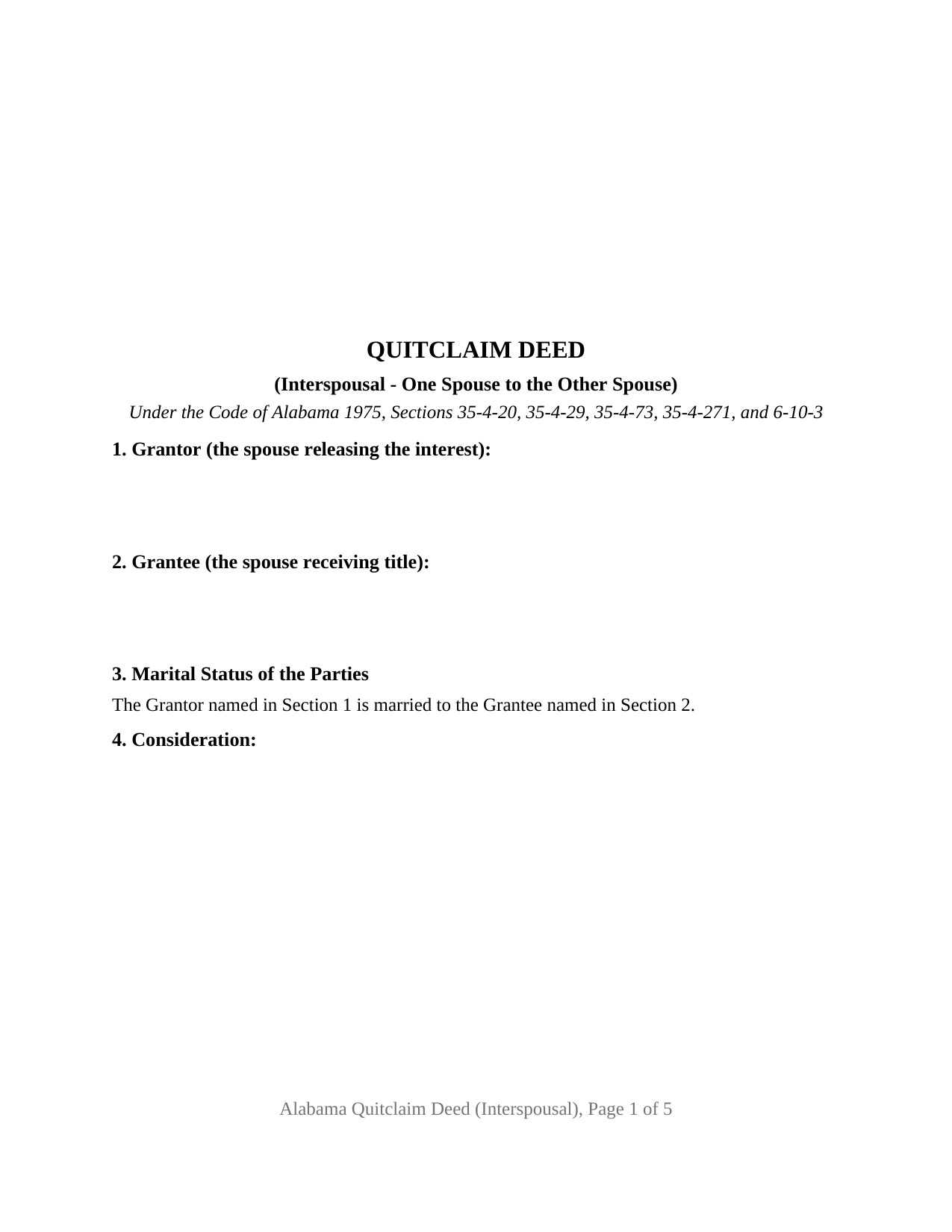
The second signature on this deed belongs to the person receiving the property. The Alabama Quitclaim Deed (Interspousal) carries a transfer of Alabama real estate from one spouse to the other: the grantor spouse releases whatever right, title, and interest that spouse holds, with no warranty attached, and the grantee spouse signs beneath, taking title and supplying the assent Alabama's homestead statute asks of a married person's husband or wife.
Both spouses sign, and only one of them conveys
Section 1 names the spouse letting go of the interest and Section 2 names the spouse receiving it, each with a mailing address. Section 3 prints the single fact that the two are married to each other, which states the marital status of the individual grantor that Ala. Code Section 35-4-73 keeps in the recording gate. Section 9 carries two signature blocks, and a certificate follows each. The operative section holds the two roles apart in printed words: the grantee takes title, makes no covenant, conveys nothing, and signs only for the further purpose the homestead statute describes. A spouse releasing an undivided half so the other holds the parcel alone, and a spouse whose name went onto a deed for convenience releasing it back to the spouse who bought the property, present the interspousal pattern recited here. The form is not set up for a release running to anyone outside the marriage, for two owners of record conveying together, or for an entity.
The homestead statute, read on a deed that runs to the spouse
Ala. Code Section 6-10-3 conditions a married person's homestead conveyance on the other spouse's voluntary signature and assent, shown by that spouse's examination before an officer who takes acknowledgments and by the officer's certificate, in the individual pattern of Ala. Code Section 35-4-29. Between spouses, that other spouse is the grantee, which leaves a question with no located answer: no Alabama appellate decision found in the research for this form says whether a conveyance running to the assenting spouse is itself the assent. The form answers structurally instead of arguing. The grantee spouse signs and acknowledges, so the certificate Section 6-10-3 describes sits in the record whether or not the parcel was ever homestead property.
What marriage does and does not do to Alabama title
Alabama recognizes no tenancy by the entirety and is not a community property state, and it abolished dower and curtesy effective January 1, 1983 (Ala. Code Section 43-8-57). Marriage by itself therefore puts neither spouse on the other's title, and this deed moves the grantor spouse's own record interest as it stands at delivery. Where both spouses already appear on the vesting deed, Ala. Code Section 35-4-7 makes them tenants in common unless that deed expressed survivorship, and a release by one leaves the other holding the released share alongside the share already held. The operative words here are remise, release, quitclaim, and convey; the deed adds that Section 35-4-271, which attaches title covenants to a different set of operative words, yields no covenant on this instrument.
At the probate office
The signed deed is presented to the judge of probate for the county holding the land. Recording puts the grantee spouse ahead of a later purchaser, mortgagee, or judgment creditor who takes without notice (Ala. Code Section 35-4-90). The office collects the recordation tax that Ala. Code Section 40-22-1 measures at 50 cents for each $500.00 of value or fraction of that amount, and the same statute lists instruments carrying no such tax, among them a deed made for nominal consideration to perfect title. Alabama's sales value information travels with the deed, commonly on Department of Revenue Form RT-1, a state form filled in at recording and no part of this instrument. Page one keeps its upper three inches clear for the stamp, and the endorsement of the preparer's name and address that Sections 35-4-110 and 35-4-113 call for before recordation is printed in the deed's own text.
Buyers reach this instrument as a quit claim deed, a quick claim deed, or an interspousal transfer deed. The package delivers the blank fillable PDF, a completed example set in Mobile County, and a guide walking each entry, both certificates, and the homestead statute. None of it is legal advice, and an Alabama attorney can read these rules against a particular homestead, marriage, or chain of title.
Important: County-Specific Forms
Our quitclaim deed (interspousal) forms are specifically formatted for each of the 67 counties in Alabama.
After selecting your county, you'll receive forms that meet all local recording requirements, ensuring your documents will be accepted without delays or rejection fees.