Alabama Quitclaim Deed (Married Grantor with Non-Owner Spouse Joinder)
County Specific Legal Forms Validated as recently as September 11, 2026 by our Forms Development Team
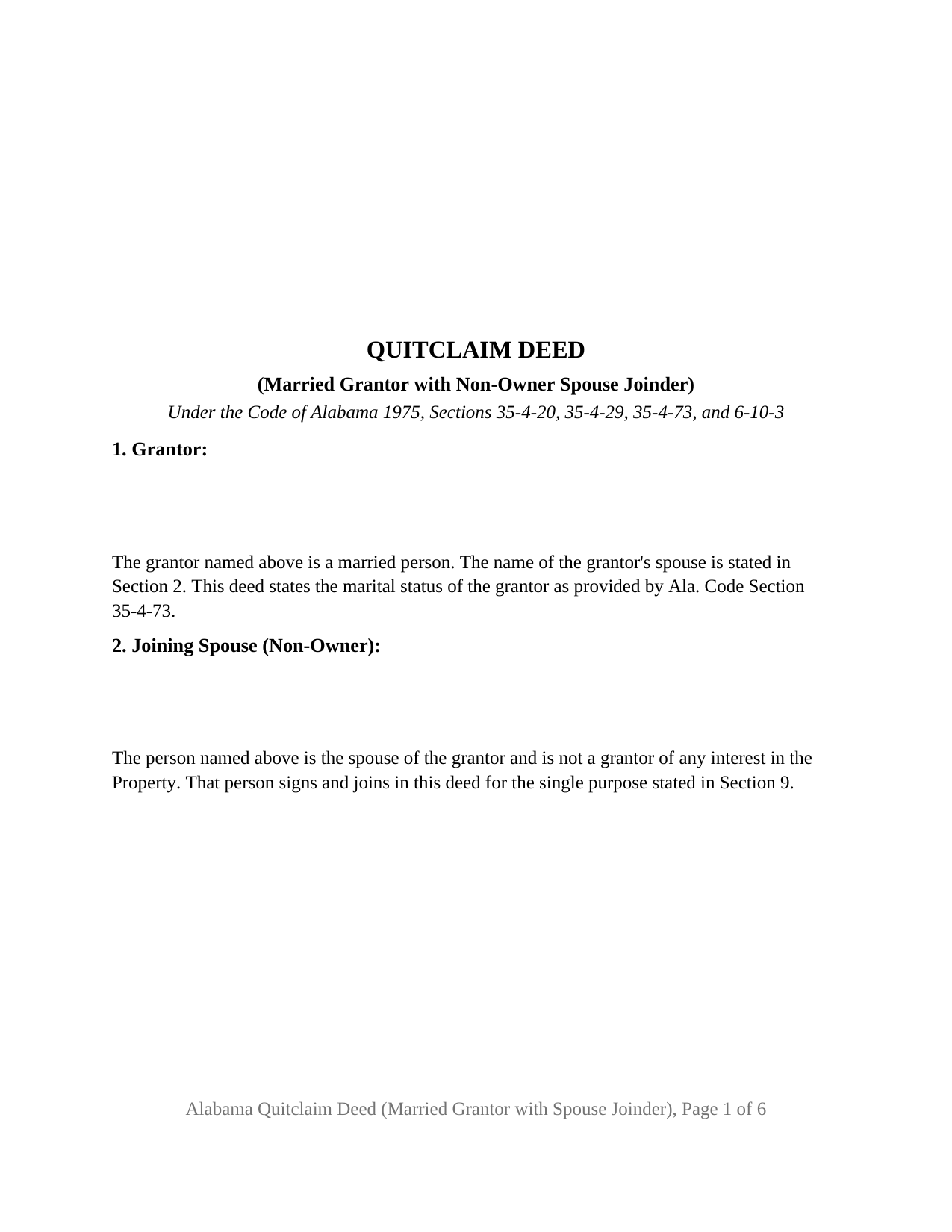
About the Alabama Quitclaim Deed (Married Grantor with Non-Owner Spouse Joinder)
How to Use This Form
- Select your county from the list
- Download the county-specific form
- Fill in the required information
- Have the document notarized if required
- Record with your county recorder's office
What Others Like You Are Saying
"Very user-friendly. Looks like everything I needed in one place. Great job."
"Happy with the forms no complaints at all."
"Deeds.com provided the document template and instructions I needed, right when I needed them. I was …"
"Deed.com has been an amazing resource for my solo practice. Very timely communication and quick resu…"
"Thanks for such great service!"
4.8/5 from 4,828 reviews. Read all
One of the two signatures on this deed transfers nothing. The Alabama Quitclaim Deed (Married Grantor with Non-Owner Spouse Joinder) is built for a single married owner of record who releases Alabama real property to a grantee, with the owner's spouse signing beside the grantor for one statutory reason and taking no part in the conveyance itself. The grantor releases whatever right, title, and interest the grantor holds, without warranty; the spouse gives an assent.
A signature that gives assent, not title
Ala. Code Section 6-10-3 makes no mortgage, deed, or other conveyance of the homestead by a married person valid without the voluntary signature and assent of the husband or wife. The statute then says how that assent is shown: by the spouse's examination before an officer authorized by law to take acknowledgments of deeds, and by that officer's certificate, in substantially the individual acknowledgment form of Ala. Code Section 35-4-29. The signature alone is not the whole of what the statute asks for, so this deed gives the joining spouse a signature block and a full acknowledgment certificate beside the grantor's.
Why the deed states that the spouse is not a grantor
A second name on a deed invites a reader to assume a second conveyance. The operative section here closes that reading: it states that the spouse named in the deed conveys no interest, makes no covenant or warranty, and is not a grantor, and that the spouse signs for the single purpose of giving the Section 6-10-3 assent to the grantor's conveyance, to the extent the property is or may be the homestead. That phrasing lets the deed work whether or not the parcel is homestead property, a question the public record often leaves open, without turning the spouse into a source of title.
Configured for one owner of record and one joining spouse
Section 1 takes the grantor's name and mailing address and states that the grantor is married, meeting the Ala. Code Section 35-4-73 rule that a recorded conveyance state the marital status of each individual grantor. Section 2 takes the spouse's name and address and identifies that person as a spouse who is not an owner. Section 10 carries two signature lines, and one certificate per signer closes the instrument. A married owner of record placing title in a family member's name where the spouse has never appeared in the chain of title, an owner who acquired the parcel before the marriage and releases it under a family arrangement, and a release where the grantee's title examiner wants the Section 6-10-3 certificate in the record all present the pattern this deed recites. The form is not set up for two owners each conveying an interest, for an unmarried grantor, or for an entity.
A joinder, not a dower release
Older Alabama deeds carried a release of dower, and that is not what this signature does. Ala. Code Section 43-8-57 abolished dower and curtesy effective January 1, 1983, so dower survives only as a question about pre-1983 title. Alabama also recognizes no tenancy by the entirety and is not a community property state, so marriage by itself gives the non-owner spouse no estate in the land. What the spouse holds is the homestead protection Section 6-10-3 describes, and the assent on this deed is addressed to that protection alone.
Release words, and one trip to the probate office
The deed remises, releases, quitclaims, and conveys, and it says on its face that no covenant arises under Ala. Code Section 35-4-271, which reads covenants of title into the words grant, bargain, and sell. Recording is with the judge of probate where the land lies, and the tax Ala. Code Section 40-22-1 imposes on a recorded conveyance, fifty cents for each five hundred dollars or fraction of the value conveyed, is collected there with Alabama's sales value information; page one holds its top three inches open for the recording stamp and the form prints the preparer endorsement Ala. Code Sections 35-4-110 and 35-4-113 make a recording prerequisite.
This Alabama quitclaim deed, searched for as often as a quit claim deed or a quick claim deed, downloads as a blank fillable PDF, with a completed example worked through a Baldwin County transfer and a guide covering each entry, the homestead statute, and both certificates. These materials explain Alabama law generally and are not legal advice; questions about a particular homestead, marriage, or chain of title belong with an Alabama attorney.
Important: County-Specific Forms
Our quitclaim deed (married grantor with non-owner spouse joinder) forms are specifically formatted for each of the 67 counties in Alabama.
After selecting your county, you'll receive forms that meet all local recording requirements, ensuring your documents will be accepted without delays or rejection fees.