Alabama Quitclaim Deed (Trustee Grantee)
County Specific Legal Forms Validated as recently as October 13, 2026 by our Forms Development Team
About the Alabama Quitclaim Deed (Trustee Grantee)
How to Use This Form
- Select your county from the list
- Download the county-specific form
- Fill in the required information
- Have the document notarized if required
- Record with your county recorder's office
What Others Like You Are Saying
"I did a Beneficiary Deed, package came with all forms and instructions. Recorder accepted first time…"
"Great Website and layout!! so easy!"
"Sofar very good. Especially an example helps."
"The material was very usable and site was easy to navigate. Well worth the money. If I have similar …"
"Very quick and efficient service! I will continue to use them for future reference."
4.8/5 from 4,828 reviews. Read all
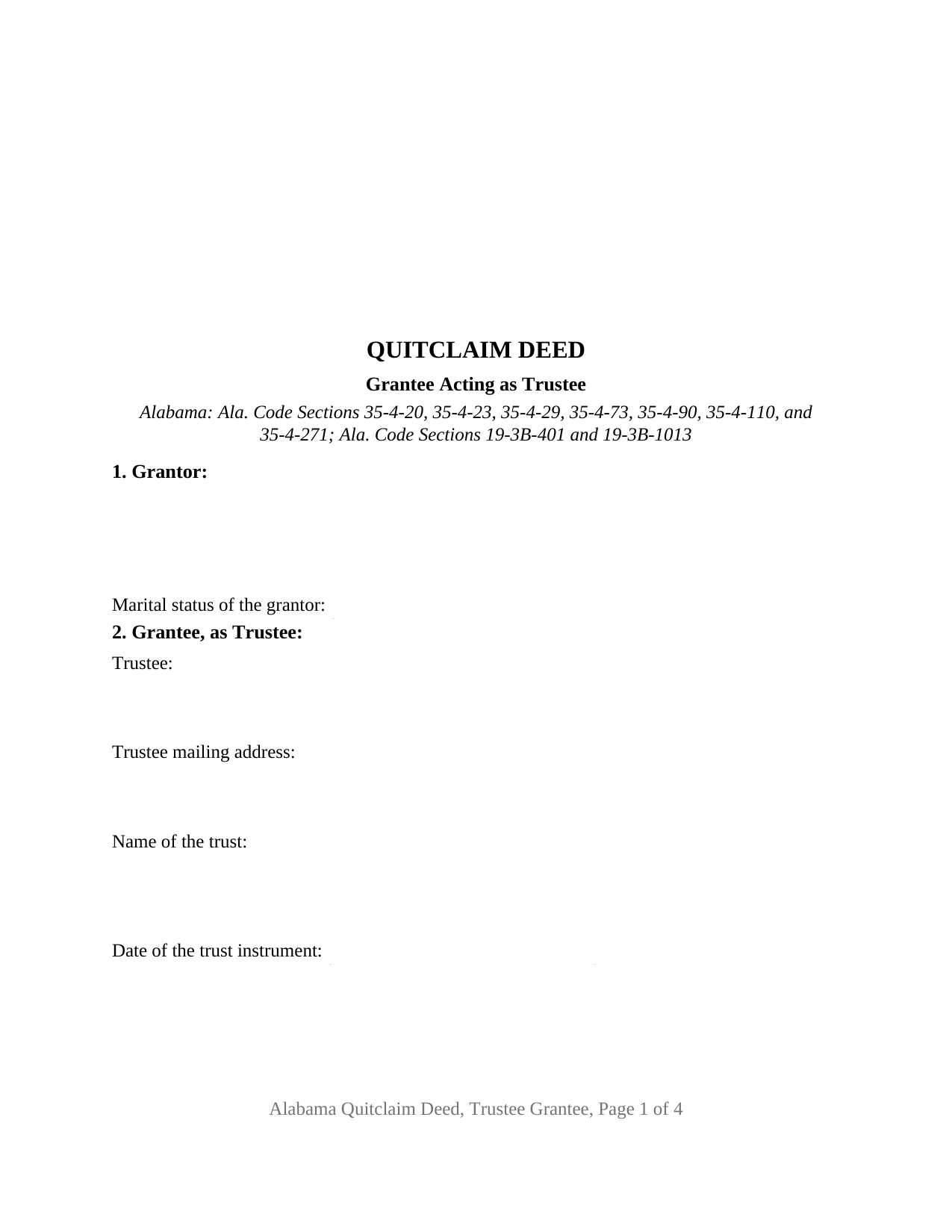
The grantee name on this deed is followed by a capacity. The Alabama Quitclaim Deed (Trustee Grantee) releases Alabama real property from one individual owner of record to a person who takes as trustee, and Section 2 collects four facts about that side: the trustee's name and mailing address, the name of the trust, and the date of the trust instrument. No covenant or warranty of title travels with the release.
Why the grantee blank takes four entries
A deed handing land to a trustee has to say whose hands those are and in what capacity. The operative section states that the grantee takes as trustee and not individually, under the trust identified in Section 2, and it runs the release to the successor trustees serving under that trust. Ala. Code Section 19-3B-401 frames it the same way, listing a transfer of property to another person as trustee among the methods by which a trust is created, and Ala. Code Section 19-3B-816(a) describes the trustee's authority to collect trust property and accept additions to it.
Configured for one owner of record and one trustee
Section 1 takes a single grantor's name, mailing address, and marital status; Section 9 carries one signature line; and one acknowledgment certificate closes the instrument. An owner who signed a revocable living trust and later moves the residence into the trustee's name, an owner deeding a parcel to the trustee of a family trust that already holds the adjoining acreage, and an owner who took title individually after the trust was signed present the pattern this deed recites. Where the settlor is also the trustee, one person appears in both sections. The form is not set up for two owners releasing together, for an entity grantor, or for a grantee taking title individually; a married grantor's homestead transfer raises the two signature condition of Ala. Code Section 6-10-3, which this configuration does not carry and which the deed prints in capital letters.
Release words, and the status line Alabama asks for
A deed executed after July 21, 1972 is not accepted for record unless it recites the marital status of each individual grantor (Ala. Code Section 35-4-73), so that entry sits in Section 1 of this deed. Because Ala. Code Section 35-4-271 reads covenants of seisin, freedom from encumbrances, and quiet enjoyment into the words grant, bargain, and sell, this deed omits them, uses remise, release, quitclaim, and convey, and states expressly that no Section 35-4-271 covenant arises. What reaches the trust is the interest the grantor holds at delivery, with liens and easements of record riding along.
What stays with the trustee rather than the deed
The trust instrument does not travel to the probate office. Ala. Code Section 35-4-257 addresses the separate act of recording an instrument that creates or declares a trust; this deed names the trust and its date, leaving the terms where the settlor put them. When a buyer or lender later deals with the trustee, Ala. Code Section 19-3B-1013 supplies the certification of trust a trustee may furnish instead, listing facts such as the date of execution, whether the trust is revocable, and the name in which title to trust property may be taken. That certification is prepared separately and is no part of this package.
Recording in the county where the land lies
The signed and notarized deed goes to the judge of probate of that county, and recording is what puts the trustee ahead of a later purchaser, mortgagee, or judgment creditor without notice (Ala. Code Section 35-4-90). The probate judge collects the recordation tax that Ala. Code Section 40-22-1 measures against the value of the interest conveyed, along with Alabama's sales value information on Department of Revenue Form RT-1, a state form completed at recording and not part of the deed. Page one keeps its upper three inches clear for the stamp, and the preparer endorsement of Ala. Code Sections 35-4-110 and 35-4-113 is printed in the deed's text.
Searches for this instrument run to quit claim deed, quick claim deed, and deed into trust. The download delivers this Alabama quitclaim deed as a blank fillable PDF, with a completed example worked through a Montgomery County transfer into a revocable living trust and a guide covering every entry, the trustee capacity language, and the certificate. Nothing here is legal advice: these pages set out Alabama law generally, and an Alabama attorney can weigh it against a particular trust and chain of title.
Important: County-Specific Forms
Our quitclaim deed (trustee grantee) forms are specifically formatted for each of the 67 counties in Alabama.
After selecting your county, you'll receive forms that meet all local recording requirements, ensuring your documents will be accepted without delays or rejection fees.